
Mailgun
Sinch · Ranked #4 of 7 in Transactional Email APIs
Mature developer-focused API with a 99.99% uptime SLA, broad SDKs, and strong validation/analytics add-ons.
Developer email infrastructure at scale
Overview
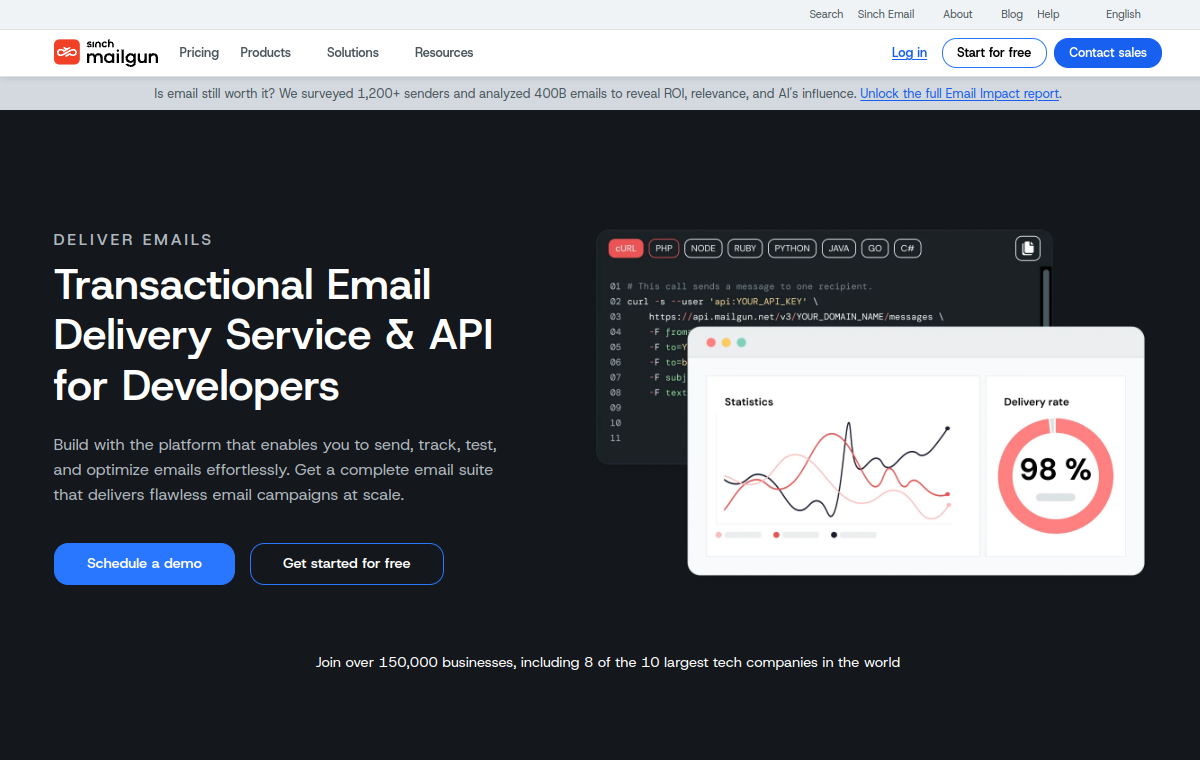
Mailgun is a developer-first transactional and bulk email API, originally launched in 2010, acquired by Rackspace in 2012, spun out under Thoma Bravo in 2017, and now part of Sinch's email portfolio. It targets engineering teams that need to send, receive, track, and validate email programmatically, covering signup confirmations, password resets, receipts, notifications, and high-volume bulk sends. Its core proposition is a clean REST API and SMTP relay backed by mature multi-language SDKs, deliverability tooling (dedicated IPs, IP warmup, inbound routing, suppression management), analytics/logs, and an add-on email-validation product. Mailgun sits alongside SendGrid, Postmark, Amazon SES, and Resend as one of the canonical "email-as-an-API" providers, and is consistently ranked at or near the top of G2's Transactional Email grid for customer satisfaction.
Where Mailgun wins is breadth and scale for technical teams: a well-documented API, official SDKs across seven languages, a contractual 99.99% uptime SLA on the core sending services, and an enterprise "burst sending" tier that guarantees a first delivery attempt on 99% of up to ~15 million messages per hour. Third-party monitoring (Knock's email-API benchmarks) shows strong real-world latency, roughly a 133ms median and ~557ms p99 response time over a recent three-month window, with a near-zero 5xx error rate. That makes it a credible choice for products that need both transactional reliability and large bulk throughput from a single vendor, plus deliverability/validation features that pure SMTP relays lack.
Where it loses is cost predictability and account stability. Reviewers across G2, Capterra, and Trustpilot repeatedly flag that pricing escalates sharply with volume and that overage rates have risen over time (the legacy pay-as-you-go Flex plan doubled from $1.00 to $2.00 per 1,000 messages in December 2025 and is closed to new users). The most damaging recurring complaint is abrupt account suspensions, frequently right after signup or several months into integration, often with no clear explanation and multi-day reactivation delays, which is a serious risk for production systems. Mailgun is also explicitly developer-oriented, so non-technical teams find it less approachable than marketing-first tools. Net: a strong, scalable engineering choice, but one where teams should budget carefully and have a contingency for suspension risk.
How this score is derived
The APIbenchmarks Index is a weighted sum of four dimensions, each scored on an absolute 0–100 reference scale. See the methodology for every mapping.
| Dimension | Score | Weight | Contribution |
|---|---|---|---|
| Documentation & DXReviewers single out the docs and SDK code as self-explanatory and integrable in minutes, with a dedicated developer documentation portal covering API, SMTP, webhooks, and per-language SDK guides. | 80 | 30% | 24.0 |
| ReliabilityBacked by a contractual 99.99% uptime SLA on API/SMTP/outbound delivery plus third-party-measured ~133ms median latency and near-zero 5xx error rate, though account-suspension incidents undercut perceived reliability for some users. | 86 | 25% | 21.5 |
| Ecosystem & SDKsMature ecosystem with seven official SDKs (Python, Ruby, PHP, Java, C#, Node.js, Go), inbound routing, webhooks, email validation, and broad platform integrations, now part of Sinch's communications suite. | 84 | 25% | 21.0 |
| AccessibilityStrong for developers (free tier, clear API, SMTP fallback) but explicitly developer-oriented and less approachable for non-technical/marketing teams, with surprise account suspensions creating onboarding friction. | 78 | 20% | 15.6 |
| APIbenchmarks Index (ABI) | 82.1 | ||
Table 1. Derivation of the ABI for Mailgun. Contribution = score × weight; the index is their sum.
At a glance
- Vendor
- Sinch
- Pricing model
- Per monthly email volume
- Free tier
- 100 emails/day (forever)
- Official SDKs
- 9 languages
Pricing
| Free | $0/mo | Up to 100 emails/day, API access, one sending domain, basic tracking, ticket support |
| Basic | from $15/mo | 10,000 emails/month, no daily limit, webhooks, one custom domain, two API keys; ~$1.80/1K overage |
| Foundation | $35/mo | 50,000 emails/month, email templates, up to 1,000 sending domains, 5-day log retention; ~$1.30/1K overage |
| Scale | $90/mo | 100,000 emails/month, 5,000 validations, dedicated IPs, send-time optimization, live chat, 30-day log retention; ~$1.10/1K overage |
| Enterprise | Custom (contact sales) | High-volume senders, burst/rapid-fire sending SLA, custom infrastructure and response-time SLAs |
Key features
- •Transactional + bulk email sending via REST API and SMTP
- •Inbound email routing and parsing
- •Webhooks for delivery, opens, clicks, bounces, complaints, unsubscribes
- •Email validation / verification (bulk and real-time)
- •Dedicated IPs with managed IP warmup
- •Suppression management (bounces, complaints, unsubscribes, allowlists)
- •Email templates and template versioning
- •Detailed analytics, logs, and message-log retention (5–30 days by tier)
- •Send-time optimization (higher tiers)
- •Burst / rapid-fire sending for enterprise high-volume senders
Official SDKs
Strengths & trade-offs
- +Clean, well-documented REST API plus SMTP relay; reviewers report integration in minutes
- +Seven official, actively maintained SDKs (Python, Ruby, PHP, Java, C#, Node.js, Go)
- +Contractual 99.99% uptime SLA on core API/SMTP/outbound delivery for all plan tiers
- +Enterprise burst/rapid-fire sending: 99% first-attempt delivery on up to ~15M messages/hour
- +Strong measured performance: ~133ms median and ~557ms p99 latency, near-zero 5xx rate (Knock benchmarks)
- +Deliverability tooling built in: dedicated IPs, IP warmup, inbound routing, suppression management, email validation
- –Pricing escalates steeply with volume; reviewers say it has gotten 'pricier and pricier'
- –Legacy pay-as-you-go Flex plan doubled to $2.00/1K in Dec 2025 and is closed to new users
- –Recurring abrupt account suspensions, sometimes right after signup or mid-integration, with no clear reason
- –Reactivation after suspension can take many days (one user reported 8 days), risking production outages
- –Explicitly developer-oriented; non-technical and marketing teams find it less approachable
- –Support quality is inconsistent on lower tiers despite a high review-response rate
What developers say
G2 4.2/5 · Trustpilot 4.1/5 (~1,480 reviews) · Capterra 4.3/5 (197 reviews)
Developers consistently praise the API, docs, and deliverability, but a recurring thread of surprise account suspensions and rising prices drags down sentiment.
“The API and SDKs are straightforward, webhooks are reliable, logs are clear, and deliverability is strong.”
Key figures
| Uptime SLA (API, SMTP, outbound delivery) | 99.99% monthly | Mailgun SLA ↗ |
| Median API response time (p50, 3-mo avg) | ~133 ms | Knock email-API benchmarks ↗ |
| p99 API response time (3-mo avg) | ~557 ms | Knock email-API benchmarks ↗ |
| 5xx / timeout error rate (3-mo avg) | 0.00% (peak day 0.04%) | Knock email-API benchmarks ↗ |
| Burst sending throughput | ~15M messages/hour (250k/min), 99% first attempt <5 min | Mailgun Burst Sending ↗ |
| Foundation plan price | $35/mo for 50,000 emails | Mailgun pricing page ↗ |
| Scale plan price | $90/mo for 100,000 emails | Mailgun pricing page ↗ |
Compare Mailgun head to head
Sources
- https://www.mailgun.com/pricing/
- https://www.mailgun.com/legal/sla/
- https://www.mailgun.com/enterprise/burst-sending/
- https://documentation.mailgun.com/docs/mailgun/sdk/introduction
- https://knock.app/email-api-benchmarks/mailgun
- https://www.g2.com/products/mailgun/reviews
- https://www.capterra.com/p/159630/Mailgun/reviews/
- https://www.trustpilot.com/review/mailgun.com
- https://www.mailgun.com/blog/product/g2-reviews-how-do-users-rate-mailgun/
Figures last verified 2026-06-27. Spotted an error? corrections@apibenchmarks.com