
Flagsmith
Flagsmith · Ranked #6 of 7 in Feature Flag APIs
Open-source (BSD-3) flag platform with a strong self-hosted story via Docker/Kubernetes plus a managed cloud and an MCP server for AI agents.
Open-source, self-hostable feature flags + remote config
Overview
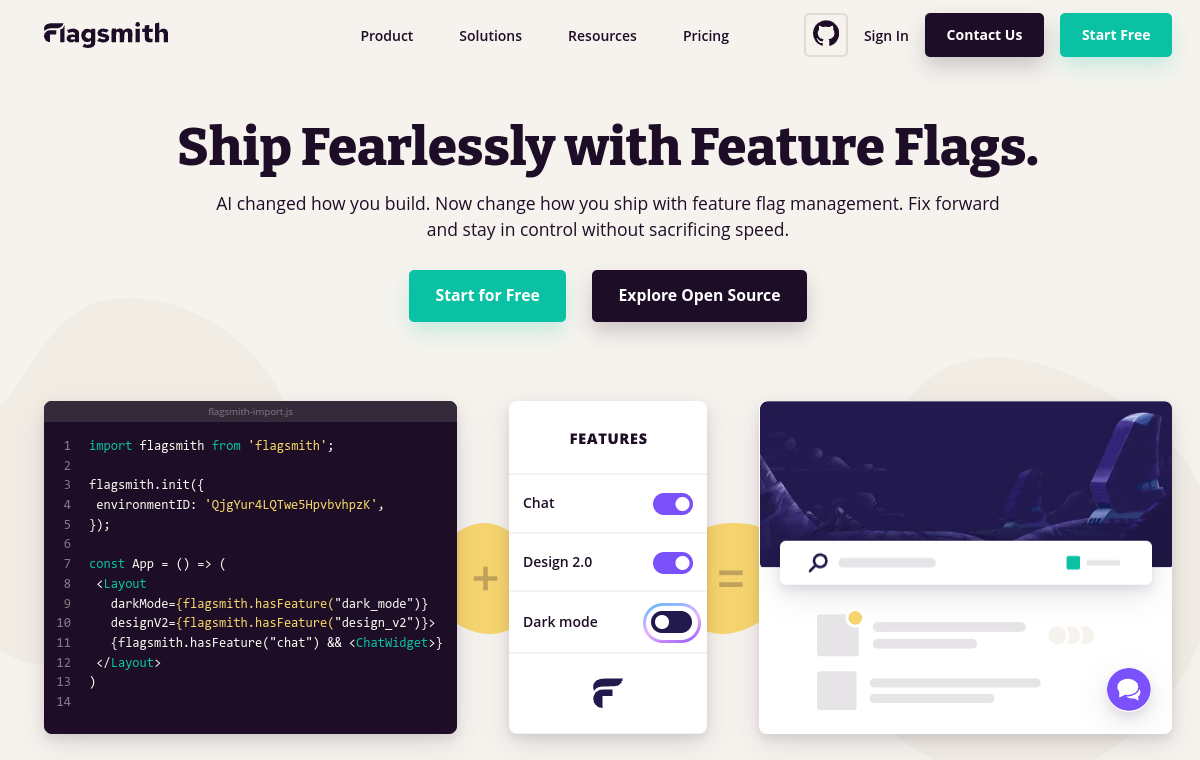
Flagsmith is an open-source feature flag and remote configuration platform that lets teams toggle features, run rollouts, manage remote config and segment users across web, mobile and server-side applications. Its defining characteristic is the BSD-3-Clause open-source core: the full flag engine, targeting rules, multivariate flags and remote config can be self-hosted on your own infrastructure (Docker, Kubernetes/Helm, AWS/GCP/Azure) with no request caps or per-seat fees, while a managed SaaS at app.flagsmith.com and an Enterprise tier handle teams that want a hosted, supported deployment. This positions Flagsmith primarily for engineering-led, privacy- or compliance-conscious teams who want flag management without vendor lock-in, and as a cheaper, simpler alternative to LaunchDarkly.
Where it wins: breadth of SDK coverage (15+ official client- and server-side SDKs), genuinely usable free and self-hosted tiers, strong segmentation/identity targeting, and an Edge API replicated across 8 AWS regions with latency-based routing that targets sub-200ms responses globally. Reviewers consistently praise the clean UI, low barrier to entry for non-technical users, and responsive support. Self-hosting plus SAML/SSO, RBAC, change requests and audit logs (on Scale-Up/Enterprise) make it credible for regulated environments.
Where it loses: it is deliberately a flagging/config tool, not an experimentation suite, there is no built-in stats engine to declare experiment winners, so you need Amplitude/Mixpanel/Statsig alongside it, and it lacks advanced safety features like automated rollbacks and guardrail-metric monitoring that LaunchDarkly ships. Several of the more advanced delivery and SCIM/LDAP capabilities sit behind a custom-priced Enterprise tier, and a few reviewers report occasional bugs in the management dashboard. For teams wanting an all-in-one experimentation + flags platform, Flagsmith is a flagging layer rather than a complete solution.
How this score is derived
The APIbenchmarks Index is a weighted sum of four dimensions, each scored on an absolute 0–100 reference scale. See the methodology for every mapping.
| Dimension | Score | Weight | Contribution |
|---|---|---|---|
| Documentation & DXThorough, well-organized docs at docs.flagsmith.com covering quick-start, every SDK, Edge API/Proxy performance, self-hosting and an SDK API spec, backed by an open-source GitHub repo. | 78 | 30% | 23.4 |
| ReliabilityPublic SLA commits to a 99.95% monthly uptime target with tiered service credits, plus a transparent statuspage.io status/incident history and a multi-region Edge API with global failover. | 74 | 25% | 18.5 |
| Ecosystem & SDKs15+ official open-source SDKs, third-party integrations (Slack, Datadog, Amplitude, Segment, etc.), Terraform provider and a ~6.4k-star GitHub project with active community and self-host options. | 80 | 25% | 20.0 |
| AccessibilityGenuinely usable free SaaS tier (50k requests/mo) and an unrestricted self-hosted open-source build give a very low barrier to entry; reviewers note even non-technical users onboard quickly. | 86 | 20% | 17.2 |
| APIbenchmarks Index (ABI) | 79.1 | ||
Table 1. Derivation of the ABI for Flagsmith. Contribution = score × weight; the index is their sum.
At a glance
- Vendor
- Flagsmith
- Pricing model
- Per request (API calls)
- Free tier
- Free cloud: 50k requests/mo, 1 seat, unlimited flags (self-host fully free)
- Official SDKs
- 12 languages
Pricing
| Free | $0 | 50,000 requests/month, 1 team member, unlimited flags/environments/identities/segments, API access |
| Start-Up | $40-45/mo | $40/mo billed yearly or $45/mo monthly; 1,000,000 requests/month, 3 team members, scheduled flags, 2FA, A/B testing, integrations, email support |
| Scale-Up | $250-300/mo | $250/mo yearly or $300/mo monthly; 5,000,000+ requests/month, 5 seats (up to 20 at $50/member/mo), SAML/SSO, RBAC, change requests, audit logs |
| Enterprise | Custom | 5M+ requests, 20+ seats, tailored hosting (cloud/private cloud/self-hosted), 24/7 priority support, enterprise SLA, SCIM/LDAP |
| Open Source (self-hosted) | Free | BSD-3-Clause core, self-host on your own infra, no request limits, unlimited users/flags/environments |
Key features
- •Feature flags and remote configuration
- •User/identity targeting and segmentation rules
- •Multivariate (A/B/MVT) flags and percentage rollouts
- •Scheduled flag changes
- •Edge API with multi-region latency-based routing and optional local Edge Proxy
- •Real-time flag updates
- •RBAC, change requests, audit logs and governance controls
- •SAML/SSO, 2FA, SCIM/LDAP (Enterprise)
- •Self-hosting via Docker, Kubernetes/Helm on AWS/GCP/Azure
- •Third-party integrations (Slack, Datadog, Amplitude, Segment) and Terraform provider
Official SDKs
Strengths & trade-offs
- +Fully open-source (BSD-3) core that can be self-hosted with no request limits or per-seat fees
- +Broad official SDK coverage: 15+ client- and server-side languages/platforms
- +Genuinely usable free SaaS tier (50k req/mo) plus low Start-Up pricing vs LaunchDarkly
- +Strong identity/segmentation targeting and multivariate flags
- +Edge API across 8 AWS regions with latency-based routing targeting sub-200ms globally
- +Clean, approachable UI praised by both technical and non-technical users
- –No built-in experimentation stats engine; needs Amplitude/Mixpanel/Statsig to determine winners
- –Lacks advanced safety features like automated rollbacks and guardrail-metric monitoring
- –On-prem/private hosting and SCIM/LDAP gated behind custom-priced Enterprise tier
- –Occasional reported bugs in the management dashboard
- –Some SDKs lack built-in caching/flag-loading conveniences out of the box
- –Switching between environments to manage flags can feel clunky
What developers say
G2 4.5/5 (~100 reviews); Capterra 4.7/5 (3 reviews)
Users widely praise Flagsmith's open-source/self-hosted flexibility, clean UI and attentive support, while critics note it stops short of full experimentation/advanced-rollout tooling and gates on-prem behind steep enterprise pricing.
“Flagsmith offers a clear view on which features are active in which environments, which greatly simplifies the deployment lifecycle and gives the business more confidence in the rollout of new features.”
Key figures
| SLA uptime commitment | 99.95% monthly | Flagsmith Service Level Agreement ↗ |
| Edge API global latency target | Sub-200ms worldwide (8 AWS regions, latency-based routing) | Flagsmith Edge API page ↗ |
| Edge Proxy throughput / latency | ~2,000 req/s at ~7ms mean latency (M1 MacBook Pro, simple flags) | Flagsmith Edge Proxy docs ↗ |
| Free tier request allowance | 50,000 requests/month | Flagsmith pricing page ↗ |
| Overage pricing | $50 per additional 1M requests/month | Flagsmith pricing page ↗ |
| GitHub stars (open-source repo) | ~6,415 stars, BSD-3-Clause | Flagsmith GitHub ↗ |
Compare Flagsmith head to head
Sources
- https://www.flagsmith.com/pricing
- https://www.flagsmith.com/service-level-agreement
- https://status.flagsmith.com/uptime
- https://docs.flagsmith.com/clients/
- https://www.flagsmith.com/edge-api
- https://docs.flagsmith.com/performance/edge-proxy
- https://github.com/flagsmith/flagsmith
- https://www.g2.com/products/flagsmith/reviews
- https://www.capterra.com/p/220220/Flagsmith/
Figures last verified 2026-06-27. Spotted an error? corrections@apibenchmarks.com