
Courier
Courier · Ranked #5 of 7 in Push Notification APIs
Multi-channel notification API routing across 50+ providers, with strong AI-tooling (MCP server) and client inbox SDKs.
Multi-channel notification routing
Overview
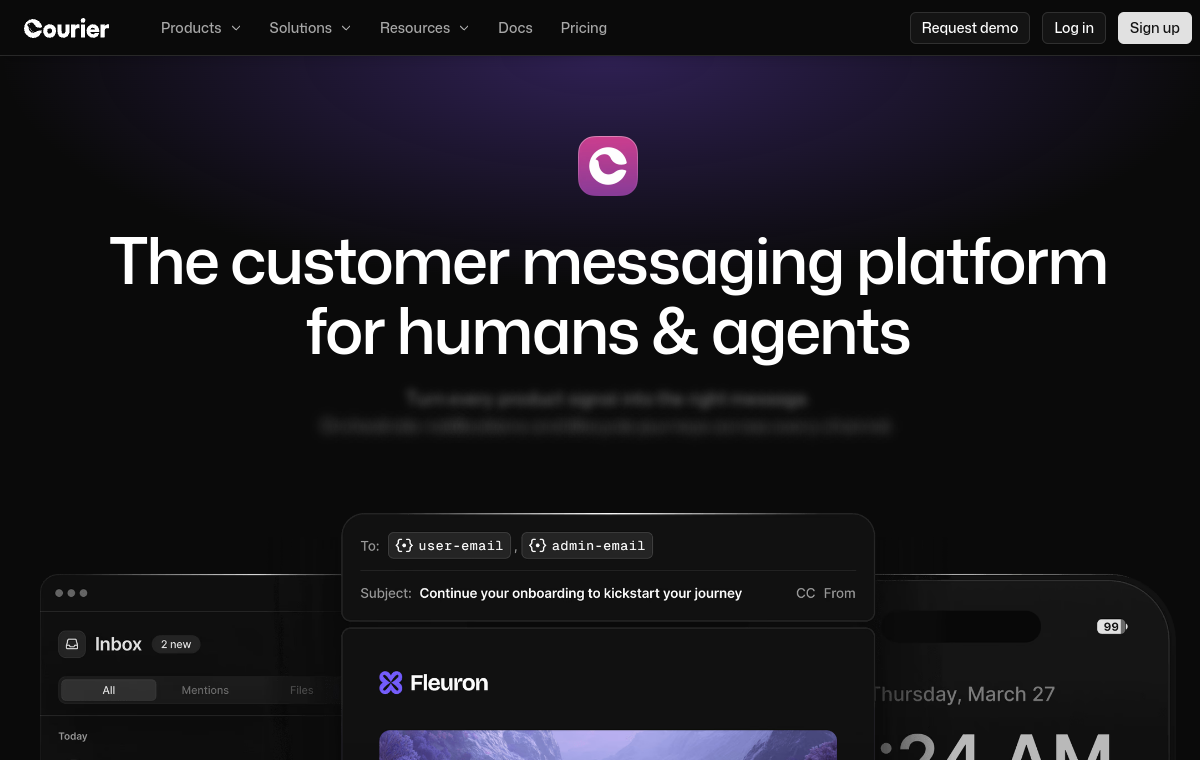
Courier (trycourier, courier.com) is a developer-first notification infrastructure platform that abstracts email, push, SMS, in-app inbox, and chat (Slack/Teams) behind a single API and a visual template designer. For push specifically, Courier is an orchestration layer rather than a push delivery network of its own: it routes to roughly a dozen underlying push providers, APNS, Firebase Cloud Messaging, Expo, OneSignal, Airship, Pusher Beams, MagicBell, Pushbullet, and others, while adding preference management, routing, batching, throttling, and a unified send endpoint on top. Its native iOS, Android, React Native, and Flutter SDKs handle device-token registration and automatic delivery/click tracking, which is the part of push that teams most often get wrong by hand. The core pitch is "design once, deliver to any channel," so push is rarely sold standalone, it is one channel inside a broader cross-channel notification system.
The product is aimed at engineering teams that want to stop maintaining bespoke per-provider integrations and want non-technical stakeholders to edit templates without a deploy. Courier wins on developer experience: documentation, logging/observability, multi-language SDKs, a CLI, and a first-party MCP server for coding agents are repeatedly praised, and reviewers consistently rate it highly on ease of setup and ease of doing business. It is less compelling for teams that only need raw, high-volume push and nothing else, since the value is in orchestration and the visual layer. The Handlebars-based templating has a small learning curve, and a few users report latency during peak periods.
Pricing is genuinely simple and transparent, a 10,000-send/month free Developer tier, then flat pay-as-you-go at $0.005 per send on Business, with Enterprise adding SLAs, RBAC, EU data residency, and volume discounts. Because pricing is per-send across all channels rather than per push specifically, Courier can look expensive next to a single-purpose push vendor at very high volume, but competitive for teams consolidating multiple channels. Reliability is strong: the public status page shows 100% 90-day uptime on the core API, web app, and Inbox, with only minor observability dips, and Courier publishes a 99.9% uptime SLA for its EU region.
How this score is derived
The APIbenchmarks Index is a weighted sum of four dimensions, each scored on an absolute 0–100 reference scale. See the methodology for every mapping.
| Dimension | Score | Weight | Contribution |
|---|---|---|---|
| Documentation & DXDocumentation, logging/observability, multi-language SDKs, a CLI, and a first-party MCP server are repeatedly cited by reviewers as best-in-class for developer experience. | 85 | 30% | 25.5 |
| ReliabilityThe public status page reports 100% 90-day uptime for the API, web app, and Inbox (observability at 99.96%), with a published 99.9% uptime SLA for the EU region. | 78 | 25% | 19.5 |
| Ecosystem & SDKsCourier integrates with ~11 push providers (APNS, FCM, Expo, OneSignal, Airship, Pusher Beams, MagicBell, etc.) plus email/SMS/chat vendors, and ships official SDKs across Node, Python, Ruby, Go, PHP, Java, and mobile. | 80 | 25% | 20.0 |
| AccessibilityA generous 10,000-send/month free tier, flat $0.005-per-send pay-as-you-go pricing, and a visual template designer make it approachable for both individual developers and non-technical staff. | 88 | 20% | 17.6 |
| APIbenchmarks Index (ABI) | 82.6 | ||
Table 1. Derivation of the ABI for Courier. Contribution = score × weight; the index is their sum.
At a glance
- Vendor
- Courier
- Pricing model
- Per notification (usage-based)
- Free tier
- 10k notifications/mo
- Official SDKs
- 12 languages
Pricing
| Developer (Free) | $0/mo | 10,000 sends per month across all channels; includes journeys, broadcasts, and internationalization. |
| Business | $0.005 per send | Pay-as-you-go with no volume cap; adds AI Translations and an AI Agent node. |
| Enterprise | Custom | Volume discounts, enterprise SLAs, RBAC, dedicated Slack support, observability integrations, and EU data residency. |
Key features
- •Single send API endpoint targeting email, push, SMS, in-app inbox, Slack, and MS Teams
- •Integration with ~11 push providers including APNS, FCM, Expo, OneSignal, Airship, and Pusher Beams
- •Push channel overrides for body, title, icon, clickAction, and data payloads
- •Automatic delivery/click tracking via tracking URLs in the mobile SDKs
- •Batching by inactivity period, max event count, or max wait time
- •Throttling per user, global, or dynamic scope to prevent alert fatigue
- •Visual notification designer for non-technical template editing
- •Routing, preferences, and in-app notification Inbox components
- •AI Translations and AI Agent node on Business tier
- •EU data residency / EU datacenter option
Official SDKs
Strengths & trade-offs
- +Single unified API and template designer covers push, email, SMS, in-app inbox, and chat, no per-provider integrations to maintain
- +Routes to ~11 push providers (APNS, FCM, Expo, OneSignal, Airship, Pusher Beams, etc.) so teams aren't locked to one push vendor
- +Native iOS, Android, React Native, and Flutter SDKs auto-manage device tokens and delivery/click tracking
- +Strong developer tooling: well-rated docs, logging, CLI, and a first-party MCP server for coding agents
- +Transparent flat pricing ($0.005/send) with a real 10,000-send/month free tier
- +Built-in batching, throttling, and preference management to prevent notification fatigue
- –Per-send pricing across all channels can be costlier than a single-purpose push vendor at very high volume
- –Handlebars-based templating has a learning curve some small teams find awkward
- –Some users report platform slowness during peak usage
- –Push is an orchestration layer, not a delivery network, actual push deliverability still depends on the underlying provider
- –Webhook channel support reported as less mature than other channels
- –Thin third-party review footprint (only a handful of public reviews) makes independent validation harder
What developers say
G2 4.5/5 · 59 reviews
Reviewers strongly praise Courier's developer experience, documentation, and multi-channel simplicity, while flagging templating learning curve, occasional slowness, and premium pricing at scale.
“From a developer standpoint, Courier provides great documentation and great logging information to help support notifications, and makes it easy to send across email, Slack, SMS, and push from a single API.”
Key figures
| API uptime (90-day) | 100.0% | Courier status page ↗ |
| Web Application uptime (90-day) | 100.0% | Courier status page ↗ |
| Courier Inbox uptime (90-day) | 100.0% | Courier status page ↗ |
| Observability uptime (90-day) | 99.96% | Courier status page ↗ |
| EU region uptime SLA | 99.9% | Courier EU datacenter docs ↗ |
| Price per send (Business) | $0.005 | Courier pricing page ↗ |
| Free tier volume | 10,000 sends/month | Courier pricing page ↗ |
Compare Courier head to head
Sources
- https://www.courier.com/pricing
- https://www.courier.com/docs/external-integrations/push/intro-to-push
- https://status.courier.com
- https://www.courier.com/docs/platform/workspaces/eu-datacenter
- https://www.g2.com/products/courier/reviews
- https://www.capterra.com/p/220085/Courier/
- https://github.com/trycourier
- https://www.courier.com/blog/simplifying-notifications-courier-ios-sdk
Figures last verified 2026-06-27. Spotted an error? corrections@apibenchmarks.com