
OneSignal
OneSignal · Ranked #1 of 7 in Push Notification APIs
The most popular self-serve engagement platform, with an unusually generous unlimited-mobile-push free tier.
Self-serve push + omnichannel engagement
Overview
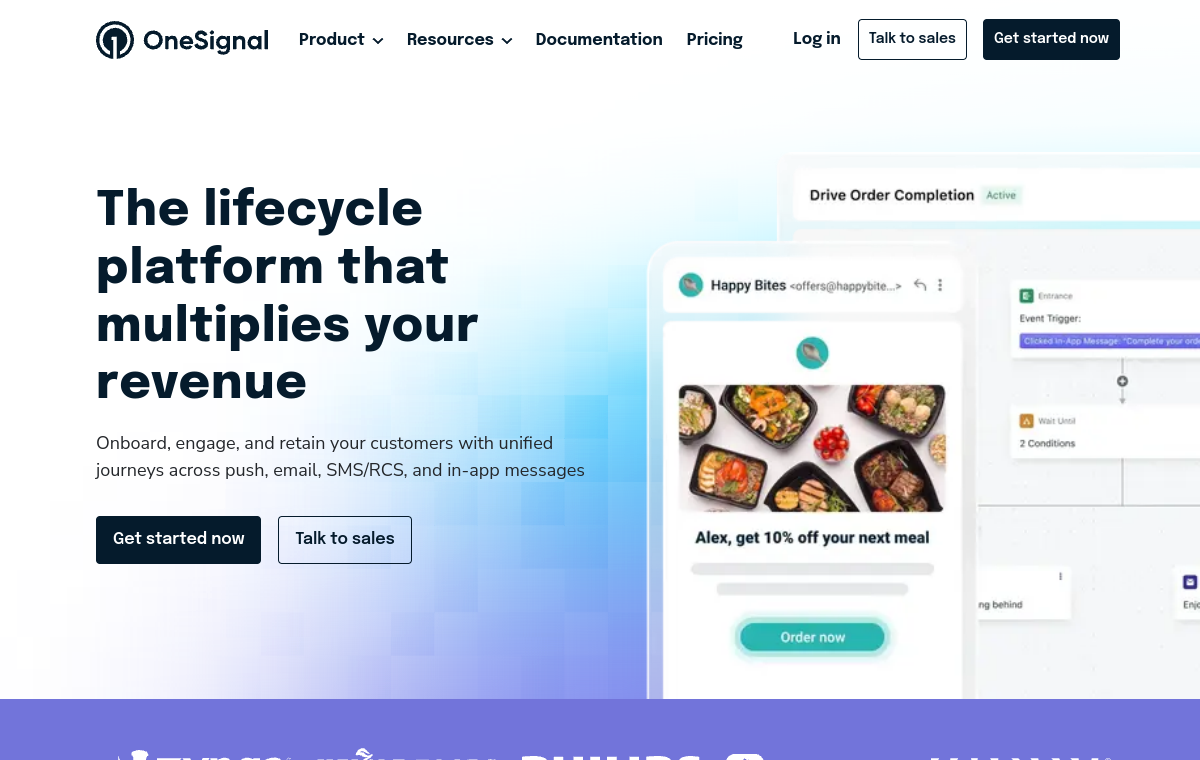
OneSignal is a customer-engagement and messaging platform built around push notifications, with web push, in-app messaging, email, and SMS layered on top of the same audience and segmentation engine. It is positioned as the default "free push" service for indie developers and startups, then upsells into a multichannel marketing tool for mid-market teams. Its core differentiator is a genuinely generous free tier (unlimited mobile push sends, unlimited mobile/web subscribers, with only a 10,000-subscriber-per-message cap on web push) paired with broad SDK coverage and a clean REST API. The company operates at very large scale, publicly reporting delivery of more than 10 billion messages per day across over a million apps/companies, and has published a throughput record of 850,000+ push notifications per second.
Where OneSignal wins: time-to-first-notification is short (reviewers commonly cite ~20-minute setup), the SDK matrix is unusually wide (native iOS/Android plus React Native, Flutter, Expo, Unity, Cordova/Ionic, Capacitor, .NET MAUI, Huawei, Amazon, FlutterFlow), and the REST API and docs are well regarded. It is one of the few providers that bundles push, in-app, email, and SMS under one segmentation model, so a small team can run real lifecycle campaigns without stitching tools together. The billing model is usage-aligned for push (you pay per monthly active user / per web subscriber, with unlimited sends), which is attractive for high-send-volume, lower-audience apps.
Where it loses: support is the most consistent complaint, especially on free and lower tiers, where users describe slow, templated, or doc-link responses and report API changes shipping without clear notice. Analytics depth is shallower than dedicated marketing-automation suites (attribution gets murky across concurrent campaigns), and pricing "scales weirdly", the per-MAU model can become expensive as audiences grow even if you are not increasing send volume, pushing larger teams toward custom-negotiated Professional/Enterprise contracts. The 99.9% availability commitment is only contractual on the Enterprise SLA, not the free tier. Net: an excellent default for startups and a strong multichannel option for mid-market, but enterprises with deep analytics or hands-on support needs should scrutinize the upper tiers.
How this score is derived
The APIbenchmarks Index is a weighted sum of four dimensions, each scored on an absolute 0–100 reference scale. See the methodology for every mapping.
| Dimension | Score | Weight | Contribution |
|---|---|---|---|
| Documentation & DXDocumentation and the REST API are repeatedly praised by reviewers as clean and readable, with per-platform SDK setup guides at documentation.onesignal.com, though some users report the docs occasionally lag behind API changes. | 84 | 30% | 25.2 |
| ReliabilityOneSignal delivers 10B+ messages/day and publishes a 99.95% trailing uptime on its public status page, but the 99.9% availability figure is a contractual commitment only under the Enterprise SLA. | 85 | 25% | 21.3 |
| Ecosystem & SDKsVery broad SDK coverage (native iOS/Android, React Native, Flutter, Expo, Unity, Cordova/Ionic, Capacitor, .NET MAUI, Huawei, Amazon, FlutterFlow) plus WordPress and Zapier-style integrations make it one of the widest-reach push ecosystems. | 86 | 25% | 21.5 |
| AccessibilityA genuinely usable free tier with unlimited mobile push sends and a clean dashboard lowers the barrier to entry, but advanced features and dependable support sit behind paid and annual-contract tiers. | 92 | 20% | 18.4 |
| APIbenchmarks Index (ABI) | 86.4 | ||
Table 1. Derivation of the ABI for OneSignal. Contribution = score × weight; the index is their sum.
At a glance
- Vendor
- OneSignal
- Pricing model
- MAU-based ($0.012/MAU)
- Free tier
- Unlimited mobile push + 10k web subs
- Official SDKs
- 12 languages
Pricing
| Free | $0/mo | Unlimited mobile push sends and subscribers; web push capped at 10,000 subscribers per message; 1 active in-app message; 10,000 free email sends/mo. |
| Growth | From $19/mo + usage | $0.012 per mobile monthly active user (unlimited sends), $0.004 per web push subscriber, unlimited in-app messaging; email 20,000 free sends/mo then $1.50 per 1,000. |
| Professional | Custom (annual) | Annual contract with volume-based discounting; adds advanced operational and team features for mid-market. |
| Enterprise | Custom (annual) | Annual contract with volume discounts, 99.9% uptime SLA, and tiered severity-based support response times. |
Key features
- •Mobile push notifications (iOS, Android, Huawei, Amazon)
- •Web push notifications
- •In-app messaging
- •Email channel
- •SMS channel
- •Audience segmentation and targeting
- •iOS Live Activities support
- •Journeys / lifecycle automation
- •REST API for sends and audience management
- •A/B testing and delivery scheduling
Official SDKs
Strengths & trade-offs
- +Genuinely generous free tier: unlimited mobile push sends and subscribers, enough segmentation to run real campaigns without paying
- +Very broad SDK coverage (iOS, Android, React Native, Flutter, Expo, Unity, Cordova/Ionic, Capacitor, .NET MAUI, Huawei, Amazon, FlutterFlow)
- +Clean, readable REST API and documentation; reviewers cite ~20-minute first integration
- +True multichannel under one segmentation model: push, web push, in-app messaging, email, and SMS
- +Proven scale and throughput: 10B+ messages/day, public record of 850,000+ push notifications/second
- +Usage-aligned push billing (per MAU / per web subscriber) with unlimited sends suits high-volume, lower-audience apps
- –Support is the most common complaint, slow, templated, or doc-link responses, especially on free/lower tiers
- –Per-MAU pricing 'scales weirdly' and can get expensive as audience grows even without more sends
- –Analytics are shallower than dedicated marketing suites; attribution gets murky across concurrent campaigns
- –Reports of API changes shipping without clear advance notice, breaking integrations
- –99.9% uptime is only a contractual SLA on the Enterprise (annual) tier, not on free/Growth
- –In-app messaging and Live Activities require the SDK and cannot be delivered via the REST API alone
What developers say
G2 4.7/5 (~1,176 reviews)
Developers love the generous free tier, fast setup, and broad SDK and API coverage, but support responsiveness and pricing at scale are recurring frustrations.
“The free tier is genuinely useful, most competitors lock basic segmentation behind paid plans, but OneSignal gives enough to run real campaigns without paying anything. Setup took maybe 20 minutes and the API documentation is actually readable, which is rare.”
Key figures
| Peak push throughput | 850,000+ notifications/second | OneSignal blog (throughput record) ↗ |
| Daily message volume | 10+ billion messages/day across 1M+ companies | OneSignal homepage ↗ |
| Enterprise uptime SLA | 99.9% monthly availability | OneSignal Enterprise SLA ↗ |
| Trailing uptime (status page) | ~99.95% | OneSignal status page ↗ |
| Mobile push price | $0.012 per monthly active user (Growth, unlimited sends) | OneSignal pricing page ↗ |
| Web push price | $0.004 per web push subscriber (Growth) | OneSignal pricing page ↗ |
| Email overage price | $1.50 per 1,000 sends after 20,000 free/mo (Growth) | OneSignal pricing page ↗ |
Compare OneSignal head to head
Sources
- https://onesignal.com/pricing
- https://onesignal.com/
- https://onesignal.com/enterprise-sla
- https://status.onesignal.com/uptime
- https://onesignal.com/blog/throughput-record/
- https://documentation.onesignal.com/docs/en/mobile-sdk-setup
- https://www.g2.com/products/onesignal/reviews
- https://www.trustpilot.com/review/onesignal.com
- https://www.capterra.com/p/163452/OneSignal/reviews/
Figures last verified 2026-06-27. Spotted an error? corrections@apibenchmarks.com