
Bird (MessageBird)
Bird · Ranked #7 of 8 in SMS & Messaging APIs
Rebranded MessageBird pushing the cheapest entry SMS rates with a generous free plan, now positioned as an AI-first CRM/omnichannel platform.
Low-cost omnichannel + AI CRM
Overview
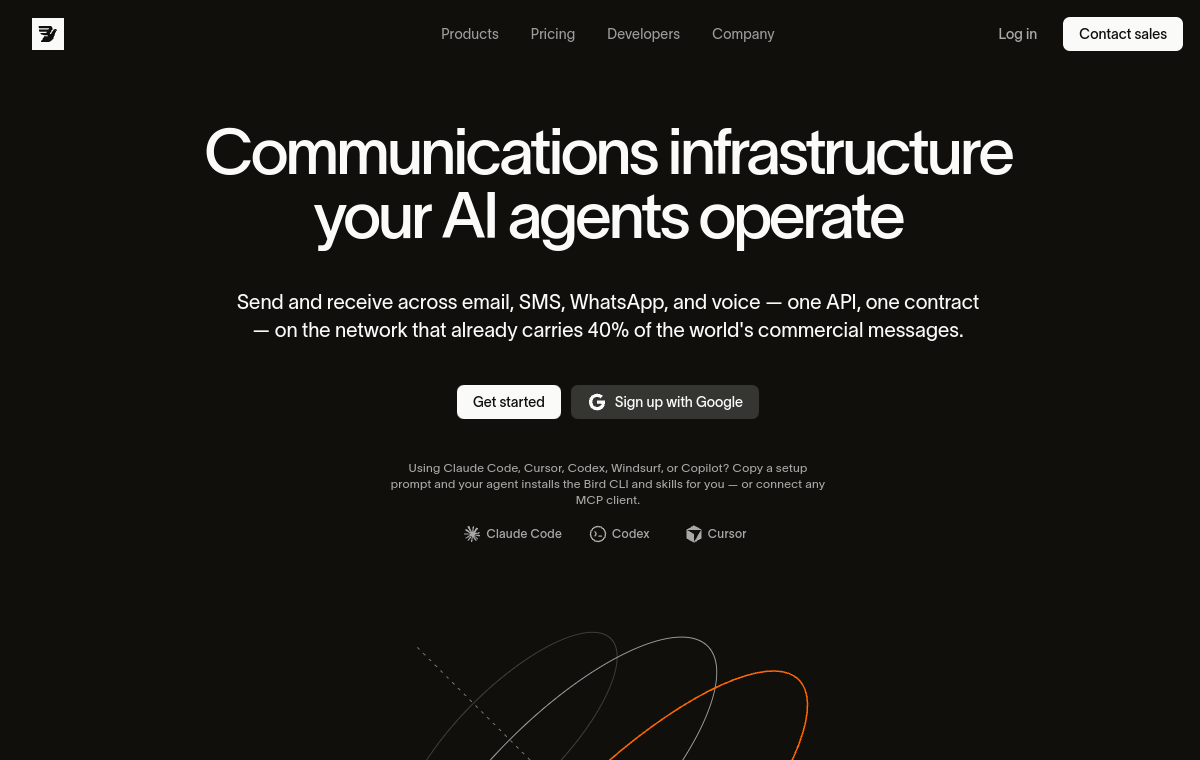
Bird (formerly MessageBird) is a Netherlands-founded omnichannel communications platform that rebranded from "MessageBird" to "Bird" in 2023. Originally an SMS gateway, it has expanded into a CPaaS + marketing/customer-engagement suite spanning SMS, MMS, WhatsApp, email, voice, push, and AI agents, with a unified API and a visual no-code "Flows" builder. Its SMS product is sold both as raw connectivity for developers (per-message REST/SMPP) and as part of a higher-level Marketing/CRM platform. The core buyer is mid-market and enterprise teams in EMEA and globally who want one vendor for transactional messaging plus marketing automation, rather than a pure programmable-SMS shop. Bird competes most directly with Twilio, Vonage, Sinch, and Plivo.
On raw API quality, third-party benchmarking from Knock (Mar–Jun 2026) shows Bird's SMS endpoint is extremely reliable but not the fastest: a 0.00% average daily error rate across 80 measured days (among the lowest of any provider tracked), but a p50 response time of 333ms and p99 of 528ms, which is slower than several competitors. Knock also flags declining adoption (ranked 6th of 7 providers and routing under 1M messages on its platform), consistent with the perception that Bird has de-emphasized the low-level developer SMS use case in favor of the broader Bird marketing platform. SLA documentation backs the reliability story with a 99.9% monthly/annual uptime commitment for SMS and platform services (99.95% for email) and a service-credit mechanism.
The recurring friction points are commercial, not technical. Reviews repeatedly cite pricing that is higher and harder to predict than alternatives (number rentals, inbound/opt-out charges, segment billing, and contract-dependent platform rates that aren't fully transparent on the pricing page), plus slow or hard-to-reach support after the platform pivot. The developer SDK surface remains solid (official Node, Python, PHP, Java, Go, Ruby libraries), and the free/test tier lowers the barrier to start, but teams evaluating Bird purely for high-volume programmable SMS should weigh the latency and pricing-clarity tradeoffs against Twilio/Plivo, while teams wanting an integrated messaging + marketing automation stack are closer to Bird's current sweet spot.
How this score is derived
The APIbenchmarks Index is a weighted sum of four dimensions, each scored on an absolute 0–100 reference scale. See the methodology for every mapping.
| Dimension | Score | Weight | Contribution |
|---|---|---|---|
| Documentation & DXComprehensive developer portal (developers.messagebird.com / bird.com API reference) with per-channel API docs, quickstarts, status hierarchies, and official libraries across six languages, though content is split across legacy MessageBird and new Bird domains. | 76 | 30% | 22.8 |
| ReliabilityThird-party Knock benchmarks show a 0.00% average daily SMS error rate over 80 days and the SLA guarantees 99.9% uptime for SMS, making reliability a genuine strength even though response latency is mid-pack. | 74 | 25% | 18.5 |
| Ecosystem & SDKsBroad channel coverage (SMS, MMS, WhatsApp, email, voice, push, AI agents), a no-code Flows builder, and prebuilt CRM/marketing integrations, but Knock data shows declining SMS adoption as Bird repositions away from pure CPaaS. | 72 | 25% | 18.0 |
| AccessibilityA no-credit-card free/test tier (5 SMS/day) and instant test API keys make it easy to start, but production access requires payment + sender verification and platform pricing is contract-dependent and not fully transparent. | 84 | 20% | 16.8 |
| APIbenchmarks Index (ABI) | 76.1 | ||
Table 1. Derivation of the ABI for Bird (MessageBird). Contribution = score × weight; the index is their sum.
At a glance
- Vendor
- Bird
- Pricing model
- Per SMS message
- Free tier
- 5 SMS/day free, no card
- Official SDKs
- 9 languages
Pricing
| Free | $0 | No credit card; ~5 SMS/day, 10 emails/day, 15 AI agent messages/day, public API access and test API key |
| Pay-as-you-go / Pay-as-you-grow | From $0 + usage | Consumption pricing: ~$0.0058 SMS, $0.0075 MMS, $0.001 WhatsApp/other channels, $0.0005 push, $0.003 voice, ~$0.11/number; outbound US SMS ~$0.00331 (carrier 10DLC fees extra) |
| Bundle | Custom (from 50,000 contacts) | Volume bundle plan for scaling marketing/contact bases with per-message rates that fall as volume grows |
| Enterprise | Custom / negotiated | Unlimited usage, advanced security controls, dedicated support and IPs; priced by volume, headcount and contract length, not published |
Key features
- •Global outbound/inbound SMS via REST API and SMPP with TLS
- •Batch sending up to 50 recipients per request and message scheduling
- •Sticky VMN for consistent sender numbers (CA, NL, UK)
- •Delivery receipts, status reporting and inbound webhooks
- •Standard, binary and flash SMS plus GSM/Unicode auto-encoding
- •Built-in URL shortening within messages
- •Contacts API v2 with groups, import and merge
- •Omnichannel: WhatsApp, MMS, email, voice, push, AI agents
- •No-code visual Flows automation builder
- •Rate limits of 50 req/s GET and 500 req/s POST
Official SDKs
Strengths & trade-offs
- +Among the lowest SMS error rates of any benchmarked provider (0.00% avg daily error over 80 days on Knock)
- +Genuine omnichannel reach from one API: SMS, MMS, WhatsApp, email, voice, push and AI agents
- +No-credit-card free/test tier and instant test API keys lower the barrier to start
- +Official SDKs across six languages (Node, Python, PHP, Java, Go, Ruby) plus REST and SMPP/TLS
- +No-code Flows builder lets non-developers build messaging automations
- +99.9% SMS/platform uptime SLA with a service-credit mechanism
- –Pricing is widely seen as higher and harder to predict than competitors (number rentals, inbound/opt-out charges, segment billing)
- –Platform pricing is contract-dependent and not fully transparent on the pricing page
- –Mid-pack API latency (p50 333ms, p99 528ms) slower than several rivals
- –Declining SMS adoption per Knock (6th of 7 providers) as Bird pivots toward marketing platform
- –Support response times flagged as slow/hard to reach in multiple reviews
- –Steep learning curve and a UI some users find complicated after the Bird rebrand
What developers say
G2 4.1/5; GetVOIP 4.5/5 (12 reviews, 92% recommend)
Users praise reliability, ease of use and broad channel coverage, but consistently flag high/unpredictable pricing and slow support after the Bird rebrand.
“Been using them since they started, very happy! Automatic invoices on low credit, simple API. Using it for over a decade and never had issues.”
Key figures
| SMS API p50 response time | 333ms | Knock SMS API benchmarks (Mar 29–Jun 26, 2026) ↗ |
| SMS API p99 response time | 528ms | Knock SMS API benchmarks ↗ |
| Average daily error rate (5xx/timeouts) | 0.00% (80 of 80 zero-error days) | Knock SMS API benchmarks ↗ |
| SMS / platform uptime SLA | 99.9% (email 99.95%) | Bird/MessageBird SLA ↗ |
| Outbound US SMS price | ~$0.00331/msg (+10DLC carrier fees) | Bird SMS pricing ↗ |
| Pay-as-you-go SMS / MMS rate | ~$0.0058 SMS / $0.0075 MMS | Bird pricing ↗ |
| API rate limits | 50 req/s GET, 500 req/s POST | MessageBird SMS API docs ↗ |
Compare Bird (MessageBird) head to head
Sources
- https://bird.com/en-us/pricing/sms
- https://www.messagebird.com/en/pricing
- https://developers.messagebird.com/api/sms-messaging/
- https://developers.messagebird.com/libraries
- https://knock.app/sms-api-benchmarks/messagebird
- https://docs.bird.com/connectivity-platform/terms-conditions/what-is-messagebirds-service-level-agreement-sla
- https://www.g2.com/products/messagebird-bird/reviews
- https://getvoip.com/reviews/bird/
- https://apidog.com/blog/bird-sms-api-cost/
Figures last verified 2026-06-27. Spotted an error? corrections@apibenchmarks.com