
OpenWeather
OpenWeather · Ranked #1 of 7 in Weather APIs
The most widely adopted weather API, with a huge free tier, the One Call product, and enormous community/tutorial presence.
Ubiquitous developer weather API
Overview
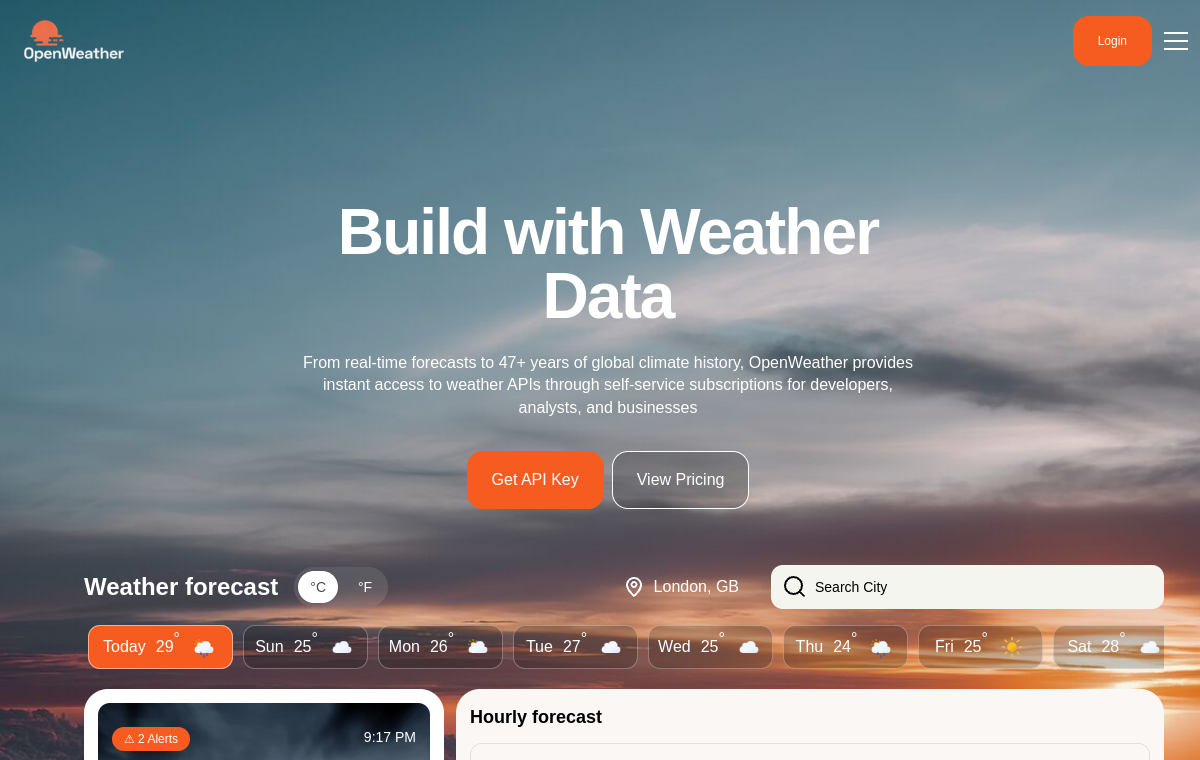
OpenWeather (operated by OpenWeather Ltd, openweathermap.org) is one of the most widely adopted weather data providers for developers, offering a broad family of REST APIs covering current conditions, short- and long-range forecasts, historical archives going back to 1979, air pollution, UV, agricultural and solar/energy datasets. Its flagship product is the One Call API 3.0, which bundles current weather, a minute-by-minute precipitation forecast for the next hour, hourly forecasts for 48 hours, daily forecasts for 8 days, government weather alerts, a 47+ year historical archive, and human-readable weather summaries into a single endpoint. The company positions itself on a proprietary hyperlocal ML model (OWHL/OWM) updated roughly every 10 minutes and blending station, satellite, radar and numerical model inputs (GFS, ECMWF) plus partnerships with national met agencies including the UK Met Office. After Dark Sky's shutdown, One Call 3.0 became the de facto migration target for many teams that needed minute-level and hyperlocal data.
OpenWeather's main appeal is accessibility and price transparency at the low end: a permanent free tier (60 calls/min, ~1M calls/month) and a "pay as you call" One Call subscription that gives 1,000 calls/day free and then bills per call (0.0012 GBP / roughly $0.0015 per call). This makes it extremely cheap for hobbyists, prototypes and small apps, and the documentation plus large ecosystem of community SDKs (PyOWM, OWM JAPIs, etc.) lower the barrier further. The classic Weather/Forecast plans (Startup ~$40/mo, Developer ~$180/mo, Professional ~$470/mo, Enterprise from $3,000/mo) scale call limits and tighten update frequency and SLA as you move up.
The weaknesses are concentrated around data consistency, support and reliability guarantees. Developers commonly complain about inconsistency between the Geocoding API and weather endpoints (duplicate or mismatched city results), occasional confusing migrations (2.5 to 3.0 deprecation), and the fact that meaningful uptime guarantees and faster data refresh are gated behind higher paid tiers, the entry Startup plan carries only a ~95% availability target, with 99.5%+ reserved for Developer and above. Support is entirely self-service via a help desk with no live channel, which frustrates teams running production workloads. For accuracy-critical or SLA-bound use cases, buyers often weigh it against Xweather (Aeris), Tomorrow.io, Visual Crossing or the free Open-Meteo.
How this score is derived
The APIbenchmarks Index is a weighted sum of four dimensions, each scored on an absolute 0–100 reference scale. See the methodology for every mapping.
| Dimension | Score | Weight | Contribution |
|---|---|---|---|
| Documentation & DXWell-organized docs with per-endpoint guides, code samples and a 2.5-to-3.0 migration guide make first integration straightforward even without an SDK. | 80 | 30% | 24.0 |
| ReliabilityUptime is tiered and modest at the low end (~95% on Startup, 99.5%+ on Developer/Professional and up to 99.9% for enterprise), and there is no prominent public real-time status page. | 82 | 25% | 20.5 |
| Ecosystem & SDKsMature and broad: large community of third-party wrappers (PyOWM, OWM JAPIs), an official awesome-openweather list, and One Call 3.0 is the common Dark Sky replacement. | 90 | 25% | 22.5 |
| AccessibilityA permanent free tier, pay-as-you-call billing with 1,000 free calls/day, and simple API-key auth make it one of the easiest weather APIs to start with for free. | 88 | 20% | 17.6 |
| APIbenchmarks Index (ABI) | 84.6 | ||
Table 1. Derivation of the ABI for OpenWeather. Contribution = score × weight; the index is their sum.
At a glance
- Vendor
- OpenWeather
- Pricing model
- Per call / freemium tiers
- Free tier
- 1M calls/mo (classic) + 1k One Call calls/day
- Official SDKs
- 5 languages
Pricing
| Free | $0 | 60 calls/min, ~1,000,000 calls/month; current weather, 5-day/3-hour forecast, basic endpoints |
| One Call API 3.0 (pay as you call) | 1,000 calls/day free, then ~0.0012 GBP (~$0.0015) per call | Current, minute (1h), hourly (48h), daily (8d), alerts, historical archive, summaries; per-call billing |
| Startup | ~$40/month | 600 calls/min, 10M calls/month; ~95% availability target, data update every ~2 hours |
| Developer | ~$180/month | 3,000 calls/min, 100M calls/month; 99.5% availability, hourly updates |
| Professional | ~$470/month | 30,000 calls/min, 1B calls/month; 99.5% availability, ~10-min updates |
| Enterprise | from $3,000/month | 100,000 calls/min, 3B calls/month; up to 99.9% availability, dedicated/custom terms |
Key features
- •One Call API 3.0: current, minute (1h), hourly (48h), daily (8d) forecast in a single call
- •Government/agency weather alerts
- •Historical weather archive from 1979 (47+ years) and forecasts up to ~1.5 years ahead
- •Human-readable weather summaries
- •Minute-by-minute hyperlocal precipitation forecast
- •Air Pollution API (current, forecast, historical)
- •UV Index and Solar/Energy and Agro (agricultural) datasets
- •Geocoding API (direct and reverse) for city/coordinate lookup
- •Weather Maps (tile layers) and Stations API
- •Proprietary OWM/OWHL ML model updated roughly every 10 minutes
Official SDKs
Strengths & trade-offs
- +Permanent free tier plus pay-as-you-call billing (1,000 free calls/day) makes it extremely cheap to start and prototype
- +One Call API 3.0 consolidates current, minute, hourly (48h), daily (8d), alerts and 47-year history into one endpoint
- +Hyperlocal ML model updated ~every 10 minutes; vendor cites <1% of temperature predictions deviating more than 5C
- +Very large ecosystem of community SDKs and integrations (PyOWM, OWM JAPIs, awesome-openweather list)
- +Well-structured documentation with code samples and an explicit 2.5-to-3.0 migration guide
- +Common, well-supported migration target for teams leaving the discontinued Dark Sky API
- –Reported inconsistency between the Geocoding API and weather endpoints (duplicate/mismatched city results)
- –Meaningful uptime (99.5%+) and faster data refresh are gated behind higher paid tiers; Startup targets only ~95%
- –No prominent public real-time status/incident page for self-service customers
- –Support is entirely self-service via help desk with no live/phone channel
- –History of disruptive API version deprecations (e.g. One Call 2.5 retirement) forcing migrations
- –Free tier rate limits (60 calls/min, 429 errors) are easy to hit for moderately popular apps
What developers say
Generally positive among developers for price, breadth and documentation, with recurring complaints about geocoding/weather data inconsistency, version migrations and self-service-only support.
“My first issue was inconsistency between API for drop-down list search and weather... When searching Paris we have 3 the same”
Key figures
| Model accuracy (temperature) | <1% of temperature predictions deviate by more than 5C | OpenWeather FAQ ↗ |
| One Call API 3.0 price | 1,000 calls/day free, then ~0.0012 GBP (~$0.0015) per call | OpenWeather One Call API 3.0 pricing ↗ |
| Free tier rate limit | 60 calls/min, ~1,000,000 calls/month (429 on overage) | OpenWeather pricing page ↗ |
| Enterprise availability / SLA | up to 99.9% uptime | OpenWeather corporate pricing ↗ |
| Data refresh frequency | updated roughly every 10 minutes (One Call 3.0) | OpenWeather One Call API 3.0 ↗ |
| Startup plan availability | ~95% uptime, data updated every ~2 hours | data.cheap OpenWeather pricing summary ↗ |
Compare OpenWeather head to head
Sources
- https://openweathermap.org/price
- https://openweathermap.org/full-price
- https://openweathermap.org/api/one-call-3
- https://openweathermap.org/faq
- https://openweather.co.uk/pricing-corp
- https://github.com/csparpa/pyowm
- https://medium.com/@fallen.snitch/review-on-free-openweather-api-and-usage-what-problem-i-could-have-910b394c45e4
- https://www.visualcrossing.com/resources/blog/best-weather-api-for-2025/
- https://data.cheap/solutions/openweather-api
Figures last verified 2026-06-27. Spotted an error? corrections@apibenchmarks.com