
Tomorrow.io
Tomorrow.io · Ranked #2 of 7 in Weather APIs
Modern weather-intelligence platform with proprietary high-resolution forecasting and 60+ data layers, marketed at 99.9% uptime.
Enterprise weather intelligence
Overview
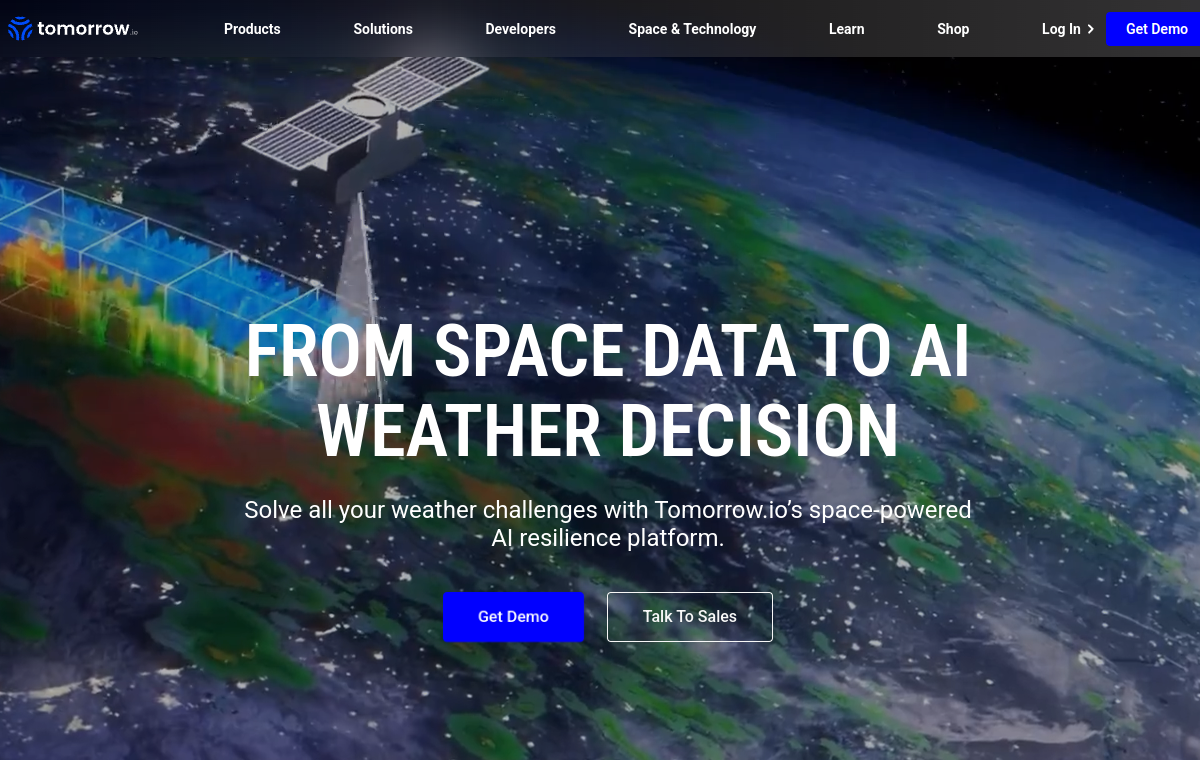
Tomorrow.io (formerly ClimaCell) is a weather-intelligence platform whose Weather API has become one of the most feature-rich offerings in the category. Rather than simply reselling NOAA/ECMWF model output, the company runs its own proprietary forecasting stack that fuses public model data, satellite imagery, and non-traditional signals (including connected vehicles and wireless-signal attenuation) with AI/ML to produce hyperlocal forecasts. The API exposes 60+ data layers, far beyond core temperature/wind/precip into air quality, pollen, lightning, solar radiation, soil, maritime, aviation, fire and flood indices, across realtime, intraday, up-to-14-day forecast, and ~20 years of historical data, queried through a unified "Timeline" endpoint plus dedicated Realtime, Forecast, Historical, Maps (tile), and Route/monitoring endpoints. It is aimed squarely at developers and operationally weather-sensitive enterprises (aviation, logistics, energy, sports, government) who need richer parameters and per-point/polygon/polyline geometry than commodity weather APIs provide.
Commercially, Tomorrow.io splits into an API plan (priced on call volume) and a Platform plan (priced on seats/monitored locations/features). The free developer tier is genuinely usable for prototyping, 500 calls/day, 3 req/s, up to 5-day forecast, 1 alert and 1 monitored location, but the most differentiated parameters (pollen, lightning, air quality) and any meaningful scale sit behind "contact sales," which means the public pricing surface is thin and real costs require a sales conversation. This is the main friction point versus self-serve competitors like OpenWeather, WeatherAPI.com, or Visual Crossing, where paid tiers and per-call prices are published outright.
On reputation, Tomorrow.io is widely cited (including in its own and third-party "best weather API" roundups) for breadth of data and a polished developer interface, and it lists marquee customers (Delta, JetBlue, Uber, Ford, NFL, U.S. Air Force, National Grid). The clearest negative signal comes from its consumer weather app, where users on the App Store report notable temperature inaccuracies in some locations and slow support response, a reminder that "hyperlocal AI forecasting" quality is location-dependent. For API buyers the practical trade-off is rich capability and a 99.9% advertised uptime against opaque enterprise pricing and the need to validate forecast accuracy for their specific geographies.
How this score is derived
The APIbenchmarks Index is a weighted sum of four dimensions, each scored on an absolute 0–100 reference scale. See the methodology for every mapping.
| Dimension | Score | Weight | Contribution |
|---|---|---|---|
| Documentation & DXExtensive developer docs at docs.tomorrow.io with an OpenAPI reference, Postman collection, code samples in multiple languages, and an LLM-ready llms.txt index, though some reference pages render as navigation hubs. | 88 | 30% | 26.4 |
| ReliabilityVendor advertises a 99.9% uptime SLA across the API, but no public third-party-verified status-page uptime history was found to independently confirm it. | 85 | 25% | 21.3 |
| Ecosystem & SDKsMature integration ecosystem: official JavaScript sample/widget/proxy repos, Mapbox/Leaflet/OpenLayers/Google Maps/Cesium map support, RapidAPI listing, and adoption by large enterprises and 30,000+ developers. | 74 | 25% | 18.5 |
| AccessibilityA real free tier (500 calls/day) and self-serve API keys lower the entry barrier, but premium data layers and scaled usage require contacting sales rather than a published self-serve upgrade path. | 82 | 20% | 16.4 |
| APIbenchmarks Index (ABI) | 82.6 | ||
Table 1. Derivation of the ABI for Tomorrow.io. Contribution = score × weight; the index is their sum.
At a glance
- Vendor
- Tomorrow.io
- Pricing model
- Per API call / tiered
- Free tier
- Free plan (rate-limited daily/hourly/per-sec)
- Official SDKs
- 8 languages
Pricing
| Free API Plan | $0 | 500 API calls/day, 3 req/s, up to 5-day forecast, 1 weather alert, 1 monitored location; core parameters (temp, wind, precip, humidity). |
| API Plan (paid) | Usage-based / contact sales | Priced on API call volume with tiers for higher demand; unlocks premium layers (pollen, lightning, air quality) and longer forecasts. No public per-call price. |
| Platform Plan | Contact sales | Cost depends on team size, number of monitored locations, and feature usage; for the Weather Intelligence Platform UI rather than raw API. |
Key features
- •Timeline API (realtime + intraday + up to 14-day forecast in one call)
- •Realtime Weather and Weather Forecast endpoints
- •Historical weather (~20 years)
- •60+ data layers: air quality, pollen, lightning, solar radiation, soil, maritime, aviation, fire danger, flood risk
- •Maps/Tiles API for weather-layer visualization on map libraries
- •Route weather and monitored-location alerting with webhook integration
- •Point, polygon and polyline location geometry
- •Weather alerts and government/severe-weather data
- •LLM-ready interface (llms.txt) for AI agents
- •99.9% uptime SLA (advertised)
Official SDKs
Strengths & trade-offs
- +60+ data layers far beyond core weather, air quality, pollen, lightning, fire, flood, solar, soil, maritime and aviation indices in one API
- +Unified Timeline endpoint returns realtime, forecast and historical in a single call, simplifying integration
- +Proprietary AI/ML forecasting fusing satellite, model and non-traditional data for hyperlocal results
- +Flexible geometry: point, polygon and polyline queries plus map tiles for OpenLayers/Leaflet/Mapbox/Google Maps/Cesium
- +Genuinely usable free tier (500 calls/day) with self-serve API keys for fast prototyping
- +Strong docs ecosystem incl. OpenAPI reference, Postman collection, official JS sample repos, and an LLM-ready llms.txt
- –Premium parameters and any real scale are gated behind 'contact sales' with no published paid per-call pricing
- –Forecast accuracy is location-dependent; consumer app users report sizable temperature errors in some areas
- –Reports of slow/unresponsive support on the consumer side
- –Free tier is restrictive (3 req/s, 5-day forecast, 1 alert, 1 location), limited for anything beyond prototyping
- –No public third-party-verified uptime history to back the 99.9% SLA claim
- –No single official heavyweight server SDK (e.g. typed Python/Java client); ecosystem leans on samples and REST
What developers say
Broadly praised for data breadth and developer experience and used by major enterprises, but consumer-app users flag location-specific forecast inaccuracy and slow support, and API pricing opacity is a recurring gripe.
“The all-around best Weather API for 2025, offering 80+ data layers and a top-rated interface.”
Key figures
| Advertised uptime | 99.9% | Tomorrow.io Weather API page ↗ |
| Free plan request quota | 500 calls/day, 3 req/s | Tomorrow.io Free API Plan Rate Limits / Pricing Overview ↗ |
| Data layers | 60+ parameters/layers | Tomorrow.io Weather API page ↗ |
| Forecast horizon | Up to 14 days | Tomorrow.io Weather API page ↗ |
| Historical depth | ~20 years | Tomorrow.io Weather API page ↗ |
| Free plan price | $0 (1 alert, 1 monitored location, 5-day forecast) | Tomorrow.io Pricing Overview ↗ |
Compare Tomorrow.io head to head
Sources
- https://www.tomorrow.io/weather-api/
- https://support.tomorrow.io/hc/en-us/articles/23554984091156-Tomorrow-io-Pricing-Overview
- https://support.tomorrow.io/hc/en-us/articles/20273728362644-Free-API-Plan-Rate-Limits
- https://docs.tomorrow.io/reference/welcome
- https://github.com/tomorrow-io-API
- https://www.tomorrow.io/blog/top-weather-apis/
- https://appsupports.co/1443325509/tomorrow-io-weather-forecast/negative-reviews
- https://www.trustpilot.com/review/tomorrow.io
Figures last verified 2026-06-27. Spotted an error? corrections@apibenchmarks.com