
Clay
Clay · Ranked #6 of 7 in Data Enrichment APIs
Spreadsheet-style enrichment orchestration over 150+ data providers; powerful as a platform but API-as-primitive is thin, built for workflows, not raw API integration.
Multi-provider enrichment orchestration
Overview
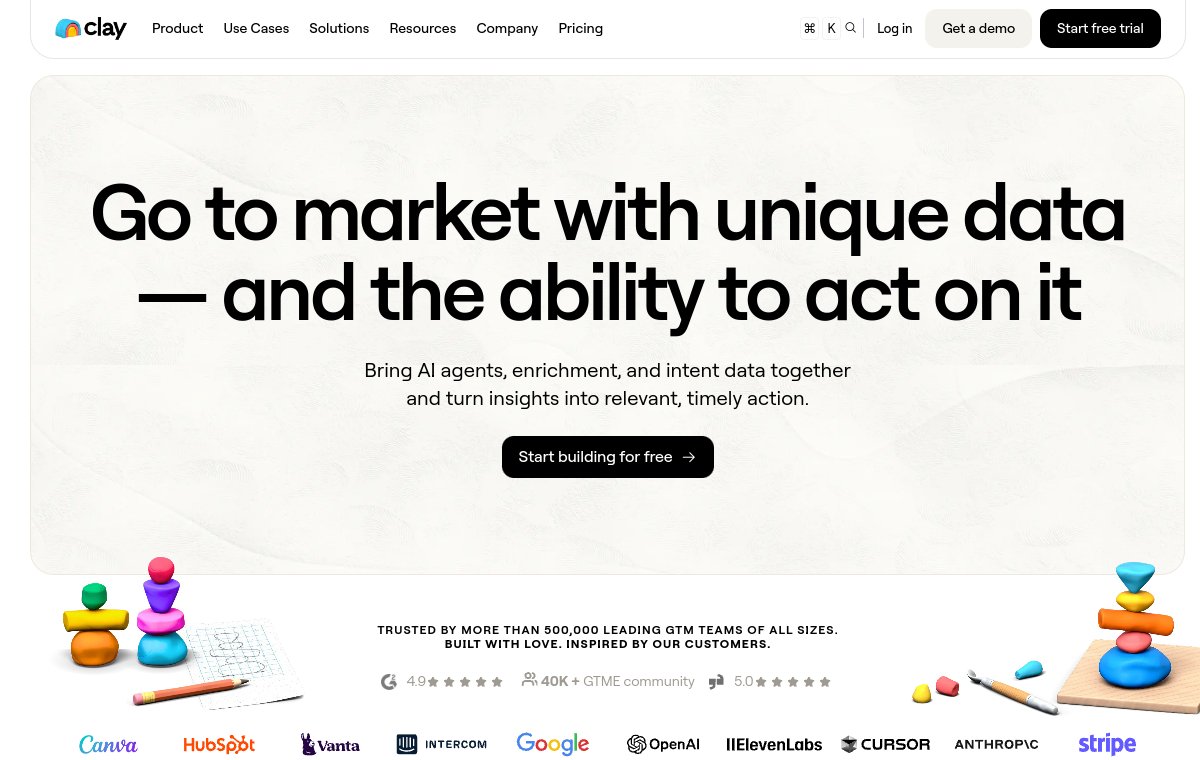
Clay (clay.com) is a GTM data-enrichment and workflow automation platform built around a spreadsheet-like table interface. Rather than owning a proprietary contact database, Clay aggregates 150+ third-party data providers (Apollo, Hunter, Clearbit, People Data Labs, Prospeo, BuiltWith, LinkedIn and others) behind a single subscription and lets users chain them in "waterfall" enrichments, an ordered fallback sequence that queries provider after provider until one returns a match for a given field (e.g. work email or mobile). This waterfall model is Clay's central differentiator and the reason match rates for emails and firmographics tend to beat any single-source tool. Layered on top are Claygent (web-research AI agents that can navigate and extract from sites), signal monitoring across ~3M companies (funding, hiring, job changes, tech installs), CRM auto-sync, an HTTP API integration node, and webhooks.
Clay is best suited to technically-minded RevOps, growth, and outbound teams who treat it as a workflow IDE rather than a plug-and-play list tool. The platform is genuinely powerful but carries a notable learning curve, reviewers commonly cite needing several hours in the first week and two-to-three weeks before workflows are reliable. Its pricing is a dual-credit system: "Data Credits" pay third-party providers for the actual data (from ~$0.05 each), while "Actions" pay for the platform work of routing and running each step. A March 2026 update renegotiated provider rates and cut many marketplace lookups by half to as much as a tenth, but credit burn and auto-recharge billing remain the most-cited complaints. Clay does not directly expose its enrichment as a standalone REST API for developers; instead the API surface is an inbound/outbound HTTP node (GET/POST/PUT/DELETE) inside tables, plus webhooks, gated to the Growth tier and above.
The split in public sentiment is striking and informative: G2 sits around 4.7–4.9/5 (reflecting RevOps operators who have climbed the curve and love the coverage), while Trustpilot sits at roughly 2.2–2.5/5 (reflecting solo operators who expected a simpler tool and hit credit-burn and support friction). The honest read is that Clay rewards investment and dedicated ownership but punishes casual, plug-and-play expectations. Phone/mobile coverage is a known weak spot (~30–35% match), and the platform is not a true API-first enrichment service for engineering teams who want a clean programmatic endpoint.
How this score is derived
The APIbenchmarks Index is a weighted sum of four dimensions, each scored on an absolute 0–100 reference scale. See the methodology for every mapping.
| Dimension | Score | Weight | Contribution |
|---|---|---|---|
| Documentation & DXStrong, Clay University offers structured courses plus detailed docs on waterfalls, enrichments, and the HTTP API, though depth is oriented to no-code builders rather than API engineers. | 65 | 30% | 19.5 |
| ReliabilityMixed signal, no public status page or SLA was found for non-Enterprise tiers, and Trustpilot reviewers report bugs that consume credits, while Enterprise contracts add 15-minute syncs and custom DPAs. | 75 | 25% | 18.8 |
| Ecosystem & SDKsExcellent, 150+ integrated data providers under one subscription plus native CRM sync (Salesforce, HubSpot), webhooks, and an HTTP API node make it the connective hub of many outbound stacks. | 60 | 25% | 15.0 |
| AccessibilityPolarizing, the table UI is approachable but the real power requires a steep learning curve (hours to weeks), so accessibility is high for RevOps operators and low for casual solo users. | 68 | 20% | 13.6 |
| APIbenchmarks Index (ABI) | 66.9 | ||
Table 1. Derivation of the ABI for Clay. Contribution = score × weight; the index is their sum.
At a glance
- Vendor
- Clay
- Pricing model
- Data Credits + Actions
- Free tier
- Free plan with limited credits (no card)
- Official SDKs
- 1 languages
Pricing
| Free | $0/mo | 100 Data Credits/mo, 500 Actions/mo, up to 200 rows per table, unlimited seats and tables, multi-provider waterfalls, Claygent, Clay Sequencer. |
| Launch | from ~$167–185/mo (annual) | 2,500 Data Credits/mo (30,000/yr), 15,000 Actions/mo, up to 50,000 rows per table, phone enrichment, job-change signals, email integrations, custom/reusable functions, scheduled runs. |
| Growth | from ~$446–495/mo (annual) | 6,000 Data Credits/mo (72,000/yr), 40,000 Actions/mo, native CRM auto-sync, HTTP API integration, webhooks, web intent signals, 1 ads audience, priority support. |
| Enterprise | Custom (annual commitment, ~$30k/yr+ typical) | Custom credits/actions (100,000+ credits, 200,000+ actions typical), data warehouse syncs, SSO, RBAC, dedicated growth strategist, custom CSA/DPA, 15-minute sync frequency, unlimited ads audiences. |
Key features
- •Waterfall enrichment across 150+ data providers (Apollo, Hunter, Clearbit, People Data Labs, Prospeo, BuiltWith, LinkedIn)
- •Claygent, AI web-research agents with Navigator to interact with and extract from web pages
- •Signal monitoring across ~3M companies (funding, hiring, promotions, job changes, tech installs)
- •Spreadsheet-style enrichment tables (up to 50,000 rows on paid tiers)
- •HTTP API integration node (GET/POST/PUT/DELETE) with JWT auth, pagination, and rate-limit config
- •Webhooks for inbound/outbound data
- •Native CRM auto-sync (Salesforce, HubSpot)
- •Clay Sequencer for email outreach
- •Reusable/custom functions and scheduled runs
- •Ads audience export and web intent signals
Official SDKs
Strengths & trade-offs
- +Waterfall enrichment chains 150+ data providers under one subscription, materially raising email/firmographic match rates versus any single source
- +Combines enrichment, AI web research (Claygent), and signal monitoring (funding, hiring, job changes, tech installs) in one platform
- +Spreadsheet-style table UI plus Clay University make complex multi-step enrichment accessible without code
- +Native CRM auto-sync (Salesforce, HubSpot), webhooks, and an HTTP API node fit it into existing outbound stacks
- +March 2026 provider renegotiation cut many marketplace lookup costs by half to ~one-tenth
- +Generous free tier (100 credits, unlimited seats/tables) to learn and prototype
- –Dual credit/action model causes fast, hard-to-predict credit burn; auto-recharge billing reportedly fires without advance warning
- –Steep learning curve, reviewers cite hours in week one and 2–3 weeks before workflows are reliable
- –Phone/mobile number coverage is weak (~30–35% match rate)
- –No standalone developer REST enrichment API; HTTP integration is an in-table node gated to Growth+
- –Polarized reliability/support reputation (G2 ~4.7–4.9 vs Trustpilot ~2.2–2.5), with some users reporting bugs that eat credits
- –Relies entirely on third-party providers rather than owning a database, so coverage and cost depend on partners
What developers say
G2 ~4.7–4.9/5 (≈189–312 reviews); Trustpilot ~2.2–2.5/5 (small sample)
Sharply polarized: RevOps operators on G2 praise waterfall coverage and time savings, while solo users on Trustpilot/Reddit cite steep learning curve, unpredictable credit burn, and support friction.
“Data Cleaning/Enrichment received a 94% satisfaction rating; users consistently praise waterfall enrichment for reducing list-building time and improving email match rates.”
Key figures
| Data Credit unit price | from $0.05 each | Clay pricing page ↗ |
| Launch plan price | from ~$167–185/mo (annual), 2,500 credits + 15,000 actions/mo | Clay pricing page ↗ |
| Growth plan price | from ~$446–495/mo (annual), 6,000 credits + 40,000 actions/mo | Clay pricing page ↗ |
| Mobile phone number match rate | ~30–35% | Clay data enrichment review (Cleanlist) ↗ |
| HTTP API source import limit | 50,000 rows per import | Clay Docs, HTTP API integration ↗ |
| Integrated data providers | 150+ providers | Clay Claygent / product pages ↗ |
| G2 aggregate rating | ~4.7–4.9/5 (≈189–312 reviews) | G2 ↗ |
Compare Clay head to head
Sources
- https://www.clay.com/pricing
- https://university.clay.com/docs/http-api-integration-overview
- https://university.clay.com/docs/building-a-data-waterfall
- https://www.clay.com/claygent
- https://www.g2.com/products/clay-com-clay/reviews
- https://prospeo.io/s/clay-reviews
- https://www.cleanlist.ai/blog/clay-data-enrichment-review
- https://www.cleanlist.ai/blog/2026-03-12-clay-pricing-changes-2026
Figures last verified 2026-06-27. Spotted an error? corrections@apibenchmarks.com