
Stripe
Stripe · Ranked #1 of 7 in Payments APIs
The reference-standard payments API: best-in-class docs, SDKs in every major language, official MCP server, and instant self-serve sandbox.
Developer-first payments platform
Overview
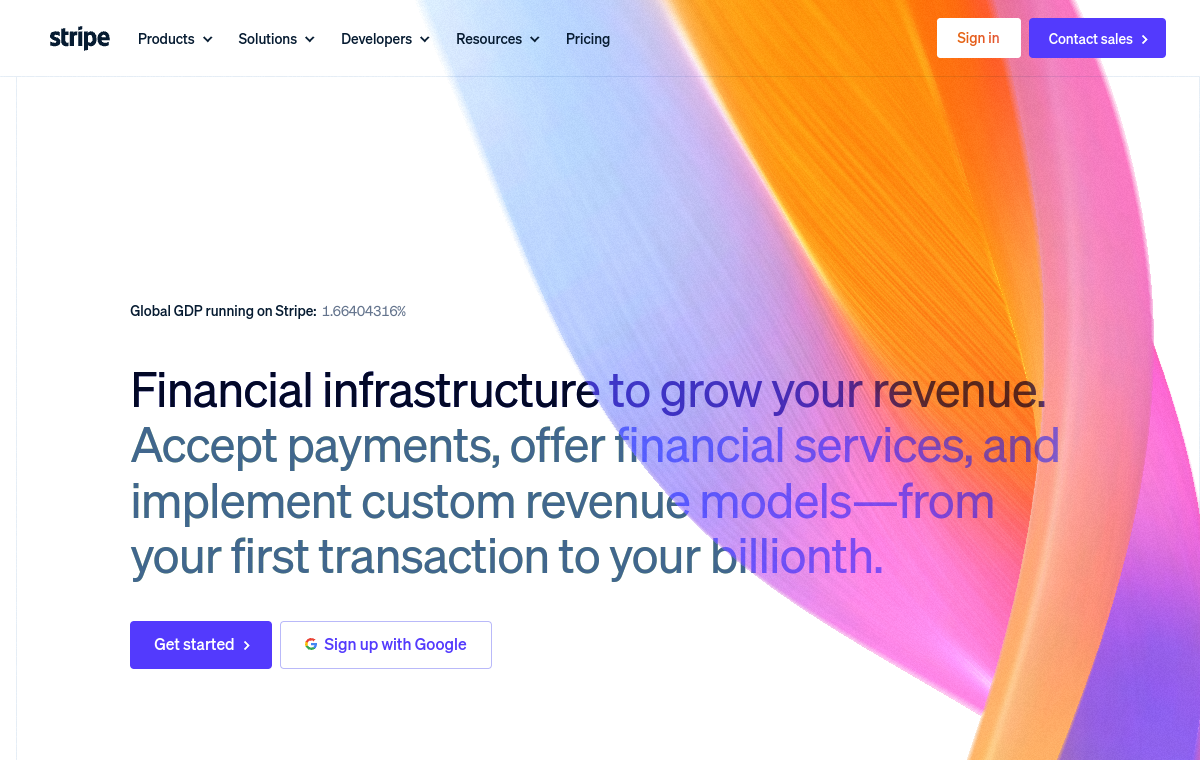
Stripe is the de facto developer-first payments API, offering a unified REST interface for accepting online and in-person card payments, ACH, wallets (Apple Pay, Google Pay, Link), subscriptions (Billing), tax automation, fraud prevention (Radar), payouts (Connect for marketplaces/platforms), and embedded finance. Its core appeal is engineering ergonomics: clean, versioned REST endpoints, idempotency keys, webhooks, test-mode/sandbox parity, and first-party SDKs across every major server and client language. For startups and SaaS companies that want to integrate payments in hours rather than weeks, Stripe is typically the default choice, and its documentation is widely cited as a gold standard in the API industry.
Where Stripe wins is breadth of product surface, global coverage (135+ currencies, dozens of local payment methods), and reliability at scale, it processed 465M+ transactions over the 2024 Black Friday/Cyber Monday window while sustaining "five-nines"-class availability, and publishes a transparent real-time status page. Where it loses is price and account governance. The flat 2.9% + 30¢ US online rate plus stacking surcharges (1.5% international card, 1% currency conversion, $15 disputes) and add-on product fees (Billing 0.7%, Tax 0.5%) make blended costs uncomfortable for low-ticket and high-volume merchants, who can often negotiate interchange-plus elsewhere. The most consistent complaints are not technical but operational: opaque risk decisions, sudden fund holds or account terminations, and slow, generic support for businesses without a dedicated account team.
Net: Stripe is the safest API-first default for developers and product teams who value documentation, SDK quality, and a single integration that scales from MVP to enterprise. The trade-off is that you pay a premium for that polish, and you accept Stripe's automated risk engine as a counterparty, a real concern for businesses in higher-risk verticals or those that cannot tolerate the possibility of a frozen balance. Enterprises with leverage should pursue custom IC+ pricing rather than the headline rate.
How this score is derived
The APIbenchmarks Index is a weighted sum of four dimensions, each scored on an absolute 0–100 reference scale. See the methodology for every mapping.
| Dimension | Score | Weight | Contribution |
|---|---|---|---|
| Documentation & DXWidely regarded as the industry benchmark for API docs, interactive API reference, copy-paste snippets per SDK, guided integration paths, and a fully separate test mode make onboarding exceptionally fast. | 98 | 30% | 29.4 |
| ReliabilitySustained five-nines-class availability with a public real-time status page, and processed 465M+ transactions over four days during Black Friday/Cyber Monday 2024 without major degradation. | 97 | 25% | 24.3 |
| Ecosystem & SDKsVast ecosystem with first-party SDKs in seven server languages, mobile/JS client SDKs, hundreds of partner integrations, Connect for marketplaces, and broad local payment-method coverage across 135+ currencies. | 97 | 25% | 24.3 |
| AccessibilityFree self-serve signup with no setup or monthly fee on the standard plan and instant API keys, though pricing transparency erodes as surcharges and add-on product fees stack, and risk-based account holds can abruptly cut off access. | 98 | 20% | 19.6 |
| APIbenchmarks Index (ABI) | 97.5 | ||
Table 1. Derivation of the ABI for Stripe. Contribution = score × weight; the index is their sum.
At a glance
- Vendor
- Stripe
- Pricing model
- Per transaction (2.9% + $0.30)
- Free tier
- Unlimited test-mode sandbox (no CC); pay-per-transaction live
- Official SDKs
- 12 languages
Pricing
| Standard (pay-as-you-go, US online) | 2.9% + 30¢ | Per successful online card charge; no setup or monthly fees. |
| In-person (Terminal, US) | 2.7% + 5¢ | Per successful in-person card payment. |
| Manually-keyed cards (US) | 3.4% + 30¢ | Per successful keyed-in card transaction. |
| ACH direct debit (US) | 0.8% (capped at $5) | Per ACH payment; disputes billed at $15 each. |
| Billing (subscriptions) | 0.7% of billing volume | Pay-as-you-go add-on; Tax add-on is 0.5% per transaction. |
| Custom / Enterprise | Contact sales | Interchange-plus (IC+) pricing, volume discounts, and multi-product discounts for large businesses. |
Key features
- •Unified REST Payments API with idempotency keys and webhooks
- •Stripe Checkout and prebuilt Elements/Payment Element UI components
- •Billing for recurring subscriptions, invoicing, and usage-based pricing
- •Connect for marketplaces and platforms (split payments, payouts, onboarding)
- •Radar machine-learning fraud detection and rules
- •Stripe Tax for automated global sales tax/VAT calculation and filing
- •Terminal SDK for in-person/POS payments
- •Link one-click checkout wallet plus Apple Pay / Google Pay support
- •135+ currencies and dozens of local payment methods
- •Full test mode / sandbox with API versioning
Official SDKs
Strengths & trade-offs
- +Best-in-class developer experience: clean versioned REST API, idempotency keys, webhooks, and full-parity test/sandbox mode
- +Documentation is an industry gold standard, interactive API reference with per-language snippets
- +First-party SDKs for every major server language plus mobile/JS clients, minimizing boilerplate
- +Huge product surface from one integration: payments, Billing, Tax, Radar fraud, Connect marketplaces, payouts, embedded finance
- +Proven reliability and scale, five-nines-class uptime and 465M+ transactions over the 2024 BFCM weekend
- +Global reach with 135+ currencies and dozens of local payment methods
- –Flat 2.9% + 30¢ rate is expensive for low-ticket and high-volume merchants vs. negotiated interchange-plus
- –Costs stack quickly: +1.5% international cards, +1% currency conversion, $15 disputes, plus add-on product fees (Billing 0.7%, Tax 0.5%)
- –Risk engine can freeze funds or terminate accounts abruptly with opaque explanations
- –Support is slow and generic for businesses without a dedicated account team, especially on chargebacks
- –Headline rate requires contacting sales to improve, best pricing is gated behind enterprise negotiation
- –System can feel complex for non-technical users despite developer-friendly APIs
What developers say
G2 4.7/5 (1,000+ reviews); Capterra 4.7/5
Developers love the API quality and documentation; the loudest complaints are about high fees, slow support, and abrupt risk-based account holds.
“The API is incredibly easy to work with and provides exactly the right level of integration needed, the interface is clean and well documented, making it ideal for rapid deployment.”
Key figures
| US standard online rate | 2.9% + 30¢ per successful charge | Stripe pricing page ↗ |
| In-person (Terminal) rate, US | 2.7% + 5¢ | Stripe pricing page ↗ |
| ACH direct debit | 0.8%, capped at $5 | Stripe pricing page ↗ |
| Dispute fee | $15 per dispute | Stripe pricing page ↗ |
| Peak-period uptime | ~99.999% during 2024 BFCM, 465M+ transactions over 4 days | Engineering Enablement (Stripe interview) ↗ |
| Real-time service availability | Public per-service status with automated historical uptime | Stripe status page ↗ |
| Billing add-on | 0.7% of billing volume (pay-as-you-go) | Stripe pricing page ↗ |
Compare Stripe head to head
Sources
- https://stripe.com/pricing
- https://docs.stripe.com/sdks
- https://docs.stripe.com/api
- https://status.stripe.com/
- https://engineeringenablement.substack.com/p/designing-stripe-for-black-friday
- https://www.g2.com/products/stripe-stripe-payments/reviews
- https://www.capterra.com/p/123889/Stripe/reviews/
- https://github.com/stripe
Figures last verified 2026-06-27. Spotted an error? corrections@apibenchmarks.com