
Nanonets
Nanonets · Ranked #6 of 7 in Document AI & OCR APIs
Workflow-oriented IDP platform with trainable models and deep business-app integrations, but opaque block-based per-run pricing.
Trainable IDP + workflow automation
Overview
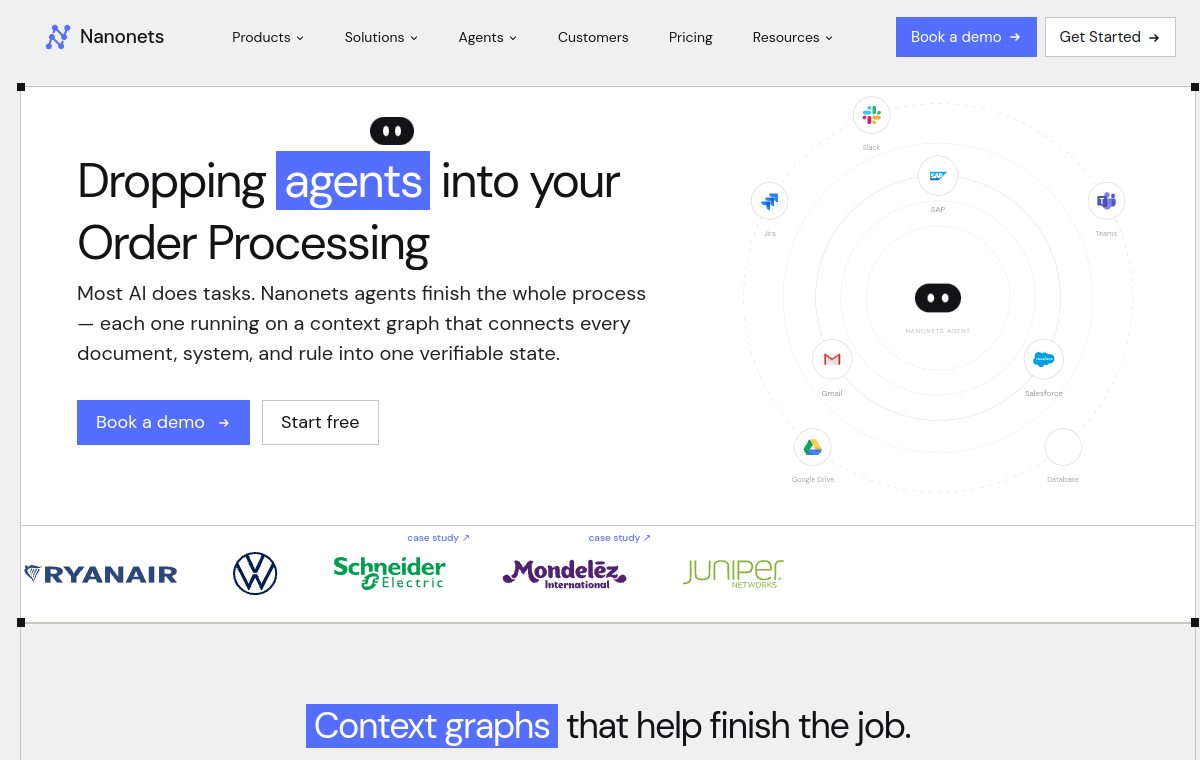
Nanonets is a San Francisco-based intelligent document processing (IDP) platform that wraps OCR, vision-language models, and no-code workflow automation into a single API and web app. Its core proposition is extracting structured data (key-value pairs, line-item tables, classifications) from semi-structured documents like invoices, receipts, purchase orders, ID cards, and forms without per-template training, then routing that data into ERPs, databases, and downstream systems. The product has evolved from a train-your-own-model OCR API into a broader "workflow" platform where each document passes through chained blocks (data-extraction AI, classification, checkbox/barcode/signature detection, generative-AI and custom Python steps), each metered as a credit-priced run. In 2025 the company also open-weighted Nanonets-OCR-s, a 3.75B-parameter VLM fine-tuned from Qwen2.5-VL-3B for image-to-markdown OCR, signaling a model-led direction.
The sweet spot is finance and operations teams automating accounts-payable and document-heavy back-office work who want results without ML engineering. Reviewers consistently report large time savings (one cites ~300 man-hours/month saved; another ~70% faster invoice processing), strong extraction accuracy on clean documents, and responsive support. The platform is genuinely no-code-friendly, and the $200-credit free Starter tier plus usage-based pricing ($0.02 simple, $0.10 standard AI, $0.30 complex AI per run) lowers the barrier to start. Official SDKs span Python (sync + async clients), Node.js, and language bindings for Java, C#, Ruby, Go, and Shell, with a documented REST API and OpenAPI spec.
The trade-offs are real. The most common complaints are processing-speed variability (the same batch can be fast or take many minutes), occasional bugs, setup/training effort for complex document types, and a credit/usage pricing model that feels expensive or inflexible for small or low-volume users. Accuracy, while high on the whole, degrades on blurred or low-quality scans and reviewers note rare incorrect field mappings or hallucinated characters. Because end-to-end workflows chain multiple billable blocks, costs compound at scale (a typical invoice runs several blocks), so heavy users should model per-document economics carefully against alternatives. Compliance-grade needs (HIPAA, SOC 2, SSO/SCIM, on-prem/private-cloud, data residency) are gated behind the custom-priced Enterprise tier.
How this score is derived
The APIbenchmarks Index is a weighted sum of four dimensions, each scored on an absolute 0–100 reference scale. See the methodology for every mapping.
| Dimension | Score | Weight | Contribution |
|---|---|---|---|
| Documentation & DXDedicated API reference at apidocs.nanonets.com plus a public OpenAPI 3.1 spec and GitHub sample repos cover most languages, though docs are spread across legacy and new endpoints. | 72 | 30% | 21.6 |
| ReliabilityNo public status page or stated uptime SLA was found for self-serve tiers, and multiple reviewers report inconsistent processing speed and occasional bugs; formal SLAs appear only on Enterprise. | 70 | 25% | 17.5 |
| Ecosystem & SDKsOfficial SDKs (Python sync/async, Node.js, plus Java/C#/Ruby/Go/Shell bindings) and connectors to ERPs, databases, email and cloud storage give it a solid integration footprint for an IDP vendor. | 72 | 25% | 18.0 |
| AccessibilityA no-code web app, a free $200-credit Starter tier, email-in and prebuilt connectors make it approachable to non-developers, though advanced blocks and compliance features require paid tiers. | 72 | 20% | 14.4 |
| APIbenchmarks Index (ABI) | 71.5 | ||
Table 1. Derivation of the ABI for Nanonets. Contribution = score × weight; the index is their sum.
At a glance
- Vendor
- Nanonets
- Pricing model
- Per-run blocks (~$0.30/page)
- Free tier
- $200 starter credits
- Official SDKs
- 7 languages
Pricing
| Starter | Free ($200 credits included) | Usage-based, no platform fee: data-extraction AI, API access, email integration, cloud storage connectors, up to 3 users, community support. |
| Growth | Volume pricing (up to 40% discount) | Adds classification AI, barcode/signature detection, generative-AI blocks, custom Python blocks, ERP & DB integrations, analytics, team-wide credit sharing. |
| Enterprise | Custom | Adds SAML SSO & SCIM, RBAC, HIPAA & SOC 2 compliance, private-cloud/on-prem deployment, data residency, dedicated SLA support, audit logs, whitelabel UI. |
Key features
- •Pre-trained data extraction for invoices, receipts, POs, IDs, forms (key-value + line-item tables)
- •Document classification AI
- •Checkbox, barcode, and signature detection blocks
- •Chained no-code workflow builder with custom Python and generative-AI blocks
- •Email-in ingestion and cloud storage connectors
- •ERP and database integrations with downstream routing
- •Nanonets-OCR-s open-weight vision-language OCR model (markdown output)
- •REST API with OpenAPI 3.1 spec
- •AI reporting and analytics (Growth+)
- •Enterprise: SSO/SCIM, RBAC, audit logs, on-prem/private-cloud, data residency, whitelabel UI
Official SDKs
Strengths & trade-offs
- +Free Starter tier with $200 of credits and no platform fee lets teams start automating immediately
- +No-code workflow builder makes document automation accessible to non-developers
- +Strong reported time savings (reviewers cite ~300 man-hours/month and ~70% faster invoice processing)
- +Pre-trained extraction handles invoices/receipts/IDs without building per-template models
- +Broad official SDK coverage (Python async/sync, Node.js, Java, C#, Ruby, Go) plus documented REST/OpenAPI
- +Open-weight Nanonets-OCR-s VLM available for self-hosted image-to-markdown OCR
- –Processing speed is inconsistent, the same batch can take seconds or many minutes
- –Credit-per-block usage pricing compounds across multi-step workflows and feels expensive for low-volume/small businesses
- –Setup and model training for complex document types requires painful trial-and-error
- –Accuracy degrades on blurred/low-quality scans, with rare incorrect mappings or hallucinated characters
- –Occasional bugs and limited export options reported by reviewers
- –Compliance (HIPAA/SOC 2), SSO/SCIM, and on-prem deployment locked behind custom Enterprise pricing
What developers say
G2 4.8/5 (~96 reviews) · Capterra 4.9/5 (~80 reviews)
Users praise accuracy, time savings, and support, but recurring gripes are speed variability, setup effort, and usage-based pricing that strains small/low-volume teams.
“Nanonets helped us save almost 300 man hours a month right off the bat”
Key figures
| Simple operation block price | $0.02 per run | Nanonets pricing page ↗ |
| Standard AI block price | $0.10 per run | Nanonets pricing page ↗ |
| Complex / data-extraction AI block price | $0.30 per run | Nanonets pricing page ↗ |
| Starter free credits | $200 included, never expire | Nanonets pricing page ↗ |
| Volume discount | Up to 40% off at scale | Nanonets pricing page ↗ |
| Nanonets-OCR-s model size | 3.75B params (Qwen2.5-VL-3B base) | LearnOpenCV / model card ↗ |
Compare Nanonets head to head
Sources
- https://nanonets.com/pricing
- https://apidocs.nanonets.com/docs/intro/
- https://nanonets.com/ocr-api
- https://github.com/NanoNets/nanonets-python-client
- https://www.capterra.com/p/193484/Nanonets-OCR/reviews/
- https://www.g2.com/products/nanonets/reviews
- https://learnopencv.com/nanonets-ocr-s/
- https://github.com/NanoNets/api-docs/blob/main/nanonets_openapi_3.1.0.yaml
Figures last verified 2026-06-27. Spotted an error? corrections@apibenchmarks.com