
LILT
LILT · Ranked #7 of 7 in Translation APIs
Enterprise AI-translation platform combining MT, LLMs and human linguists; full API support but quote-only, sales-gated pricing with a 99.9% uptime commitment.
Enterprise human-in-the-loop translation
Overview
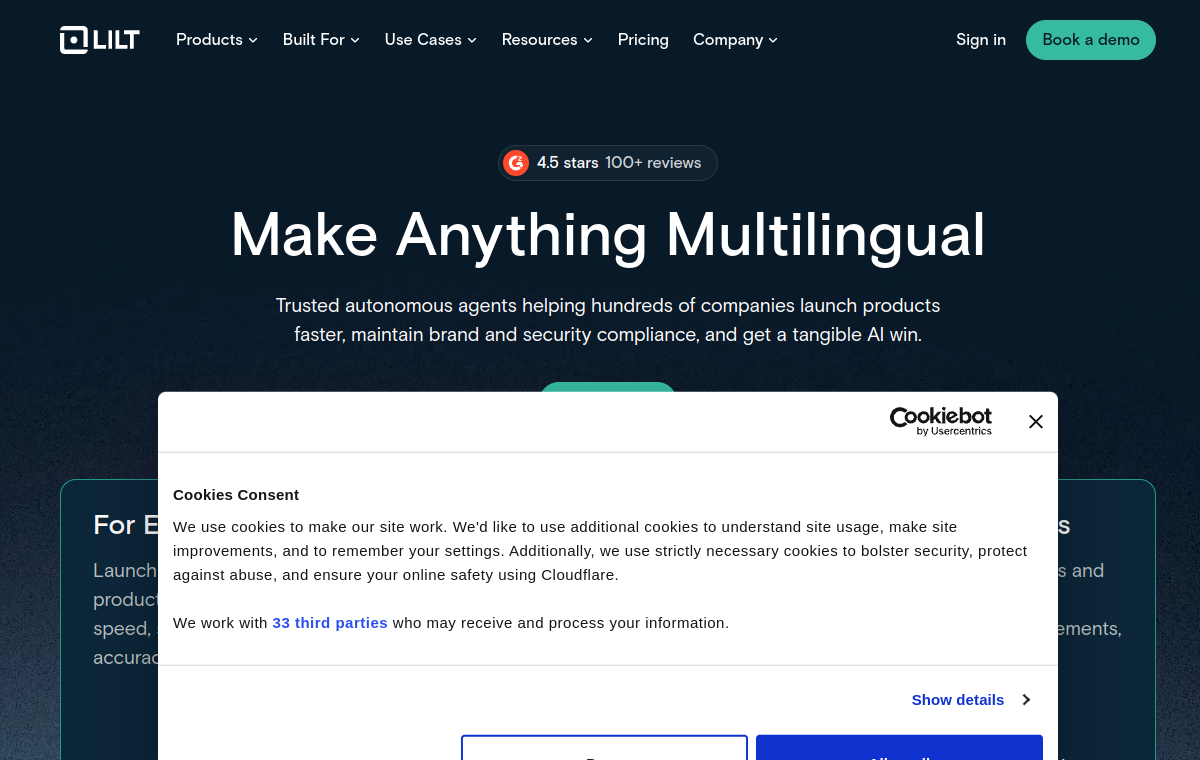
LILT is an enterprise-focused AI translation and localization platform built around a human-in-the-loop "adaptive" model: machine translation suggestions are continuously refined by professional linguists, and the system learns from each correction in real time. Founded by former Google Translate researchers, LILT differentiates itself from raw MT engines (Google Translate, DeepL, GPT-4) by pairing its proprietary Contextual AI Engine with verified human review, translation memory, termbases, and 100+ native connectors (Contentful, Figma, GitHub, Shopify, Drupal, Webflow, and more). The 2024 Contextual AI Engine uses in-context learning, is roughly 5x larger than LILT's prior model yet claims over 1000x fewer parameters than GPT-4, and the company positions it as more accurate and cheaper than Google Translate and GPT-4 for many enterprise contexts.
For developers, LILT exposes a REST API (base URL https://api.lilt.com/, HTTPS only, HTTP Basic Auth using the REST API key) with official SDK bindings for Python, Node.js/JavaScript, and Java, all generated from an OpenAPI spec. The API covers translation, document/file workflows, memories, glossaries, and connector-driven content exchange, and can also route to third-party engines (Google, DeepL, Amazon). Notably, API access is gated behind the Enterprise plan, and there is no public self-serve pricing or free tier, all three plans (Business, Enterprise, Government) require contacting sales, which is a meaningful friction point for individual developers evaluating the platform.
LILT is well-regarded by its enterprise and linguist user base (G2 4.4/5 across ~165 reviews, Capterra 4.4/5 across ~85 reviews, with a Leader badge in Document Translation), praised for ease of use, the adaptive TM/AI workflow, and review-process streamlining. The recurring criticisms are concrete: UI slowness on large documents (e.g. 10K-word files), buggy save/approve flows, low-quality fuzzy matches, slow (>24h) support turnaround, and, from the linguist side, frustrating task-claiming and inaccurate time/payment tracking. The biggest gaps for an API-shopper are the lack of published quantitative benchmarks (accuracy claims are qualitative), no public SLA/uptime numbers, and opaque, sales-gated pricing.
How this score is derived
The APIbenchmarks Index is a weighted sum of four dimensions, each scored on an absolute 0–100 reference scale. See the methodology for every mapping.
| Dimension | Score | Weight | Contribution |
|---|---|---|---|
| Documentation & DXDedicated developer portal (developers.lilt.com / support.lilt.com) with quick-start, API reference, and an llms.txt index, plus auto-generated SDK docs, though deep technical specs sit behind the Enterprise plan. | 66 | 30% | 19.8 |
| ReliabilityNo public status page or published uptime SLA was found; the Enterprise tier advertises 'enhanced uptime' and Government tier 'federal-grade reliability,' but users report occasional bugs/downtime and slowness on large files. | 74 | 25% | 18.5 |
| Ecosystem & SDKsStrong integration ecosystem with 100+ native connectors (Contentful, Figma, GitHub, Shopify, Webflow), a no-code connector builder, and official Python/Node/Java SDKs. | 58 | 25% | 14.5 |
| AccessibilityNo free tier, no self-serve signup, and API access requires the Enterprise plan with sales-gated custom pricing, making it hard for individual developers to start. | 38 | 20% | 7.6 |
| APIbenchmarks Index (ABI) | 60.4 | ||
Table 1. Derivation of the ABI for LILT. Contribution = score × weight; the index is their sum.
At a glance
- Vendor
- LILT
- Pricing model
- Annual flat fee + connectors
- Free tier
- No
- Official SDKs
- 4 languages
Pricing
| Business | Custom (contact sales) | For growing global content teams: Trusted AI platform, business connectors, contextual AI models, agents and copilots. Consumption/per-word based; same price per word across languages except Japanese. |
| Enterprise | Custom (contact sales) | All Business features plus human expert verification, enterprise connectors, REST API access, enhanced uptime/security, managed deployment, and custom invoicing. |
| Government | Custom (contact sales) | All Enterprise capabilities plus deployment flexibility, IL6+ compliance, cleared support staff, and federal-grade reliability for Defense/Intelligence/Public Sector. |
Key features
- •Contextual AI Engine with in-context learning, optimized for real-time enterprise translation
- •Adaptive machine translation that learns from human corrections in real time
- •Verified (human-expert) and instant AI translation workflows
- •Translation memory, termbase, and glossary management with curation/import/export
- •100+ native connectors plus no-code connector builder (LILT Connect)
- •Routing to third-party engines (Google Translate, DeepL, Amazon Translate)
- •In-app multi-modal translation and enterprise AI controls
- •REST API for translation, file/document workflows, memories, and content exchange
- •Multilingual content generation ('Create')
- •Connectors for CMS/CRM/PIM (Contentful, Figma, GitHub, Shopify, Webflow, Drupal)
Official SDKs
Strengths & trade-offs
- +Adaptive human-in-the-loop model learns from each linguist correction in real time, improving consistency over a project's lifetime
- +Contextual AI Engine claims higher accuracy and lower cost than Google Translate and GPT-4 in enterprise contexts while being far smaller (1000x fewer parameters than GPT-4)
- +100+ native connectors (Contentful, Figma, GitHub, Shopify, Webflow, Drupal) plus a no-code connector builder
- +Official SDKs for Python, Node.js, and Java over a clean OpenAPI-based REST API
- +Strong translation-memory, termbase, and glossary management with import/export and curation controls
- +Highly rated by users (G2 4.4/5, Capterra 4.4/5) and a recognized G2 Leader in Document Translation
- –No public, self-serve pricing, all plans are sales-gated with custom quotes
- –REST API access is restricted to the Enterprise plan, blocking smaller developers
- –UI can be slow and buggy on large documents (e.g. 10K-word files), with save/approve glitches reported
- –No published quantitative benchmarks; accuracy/latency superiority claims are qualitative
- –No public status page or stated uptime SLA found
- –Linguist-side friction: hard task-claiming, inaccurate time/payment tracking, and slow (>24h) support turnaround
What developers say
G2 4.4/5 (~165 reviews); Capterra 4.4/5 (~85 reviews)
Users praise LILT's ease of use and adaptive AI-plus-human translation workflow, but criticize platform slowness on large files, occasional bugs, and slow support.
“Users consistently praise the platform for its ease of use and user-friendly interface, and the integration of translation memory and AI features allows for faster, more accurate translations.”
Key figures
| Model size vs GPT-4 | >1000x fewer parameters than GPT-4 | LILT Labs announcement ↗ |
| Model size vs prior engine | 5x more parameters than LILT's previous engine | LILT Labs / Slator ↗ |
| API rate limit | 4,000 requests/minute general quota (60s cooldown on exceed) | LILT developer knowledge base ↗ |
| Per-word pricing structure | Same price per word across all languages except Japanese | LILT Help Center (pricing models) ↗ |
Compare LILT head to head
Sources
- https://lilt.com/pricing
- https://developers.lilt.com/
- https://support.lilt.com/developers/introduction
- https://github.com/lilt/lilt-python
- https://github.com/lilt/lilt-node
- https://www.g2.com/products/lilt/reviews
- https://www.capterra.com/p/204322/LILT/reviews/
- https://labs.lilt.com/lilt-introduces-contextual-ai-engine-for-translation-outperforms-google-translate-and-gpt-4-on-accuracy-latency-and-cost
- https://slator.com/lilt-introduces-contextual-ai-engine-translation-outperforms-gpt-4/
Figures last verified 2026-06-27. Spotted an error? corrections@apibenchmarks.com