
Qdrant Cloud
Qdrant · Ranked #5 of 7 in Vector Database APIs
Rust-built engine with predictable resource-based pricing, a free always-on cluster, and strong filtering.
High-performance open-source vector engine
Overview
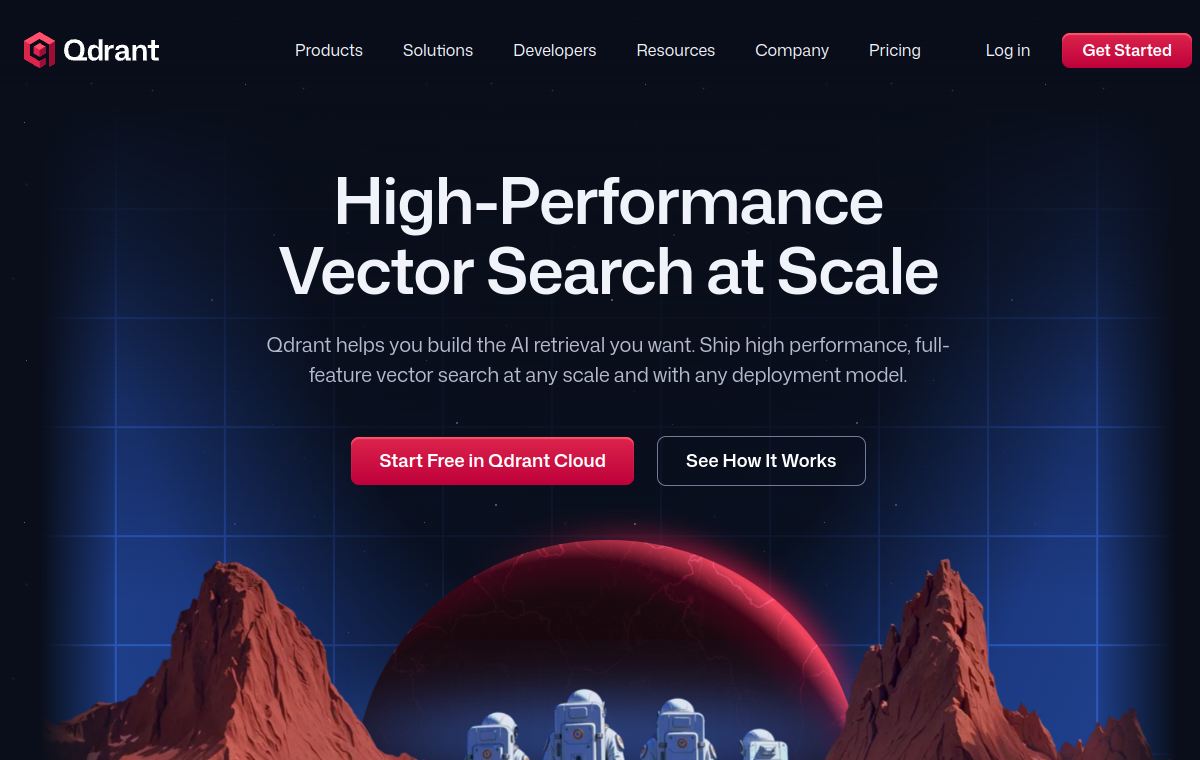
Qdrant Cloud is the managed, hosted offering built on top of Qdrant, an open-source vector search engine written in Rust. It targets teams building RAG pipelines, semantic search, recommendation, and AI-agent memory who want vector search without operating the database themselves. The cloud platform provisions dedicated clusters (single- or multi-AZ), and bills primarily on infrastructure resources (vCPU, RAM, disk, backup storage) rather than per-query, which keeps costs predictable for read-heavy workloads. Qdrant's central selling point is performance: its Rust core consistently posts the lowest latencies and highest requests-per-second in its own ANN-benchmark-derived suite against Weaviate, Milvus, Elasticsearch, and Redis, and third-party tests (e.g., the 1M OpenAI dataset) show it roughly 15x faster in throughput and meaningfully more accurate than pgvector at scale.
Where it wins: raw speed and predictable resource-based pricing, a genuinely generous always-free 1GB managed tier (no credit card), strong filtering and hybrid (dense + sparse) search, scalar/binary/product quantization for memory reduction, and a clean multi-language SDK story. It also offers Hybrid Cloud (Qdrant-managed control plane on your own infra/Kubernetes) and Private Cloud for enterprises with data-residency needs, a differentiator over fully-SaaS-only competitors like Pinecone. Where it loses: the absence of strong built-in vector visualization/observability tooling is the single most-cited complaint; the learning curve for teams new to vector DBs is non-trivial; free clusters are terminated after a period of inactivity; and self-managing the dual-store sync (e.g., Qdrant alongside a primary SQL DB) adds operational burden that some reviewers flagged.
Overall, Qdrant Cloud is a strong default for performance-sensitive, cost-conscious teams that value an open-source core (avoiding lock-in) and want the option to move between managed cloud, hybrid, and self-hosted. It is less turnkey than Pinecone for non-experts and lighter on built-in analytics/visualization, but its price-performance ratio and deployment flexibility are repeatedly praised by practitioners.
How this score is derived
The APIbenchmarks Index is a weighted sum of four dimensions, each scored on an absolute 0–100 reference scale. See the methodology for every mapping.
| Dimension | Score | Weight | Contribution |
|---|---|---|---|
| Documentation & DXDocumentation is broad and well-organized (concepts, cloud quickstart, per-language SDK guides, REST/gRPC reference), widely praised in reviews, though users ask for more practical examples and video tutorials. | 82 | 30% | 24.6 |
| ReliabilityStandard tier offers a 99.5% single-AZ SLA (99.9% single-AZ / 99.95% multi-AZ on Premium) and the public status page shows ~99.97% measured Cloud API uptime over the trailing 90 days. | 78 | 25% | 19.5 |
| Ecosystem & SDKsMature ecosystem with official SDKs for Python, JS/TS, Rust, Go, Java and .NET plus REST/gRPC, integrations with LangChain/LlamaIndex, and AWS/GCP/Azure marketplace listings. | 80 | 25% | 20.0 |
| AccessibilityLow barrier to entry via an always-free 1GB managed cluster with no credit card, plus open-source self-hosting, though the underlying vector-DB concepts carry a learning curve for newcomers. | 90 | 20% | 18.0 |
| APIbenchmarks Index (ABI) | 82.1 | ||
Table 1. Derivation of the ABI for Qdrant Cloud. Contribution = score × weight; the index is their sum.
At a glance
- Vendor
- Qdrant
- Pricing model
- Resource-based (vCPU/RAM/disk)
- Free tier
- 1GB RAM / 4GB disk cluster (~1M vectors), no card
- Official SDKs
- 8 languages
Pricing
| Free Tier | $0 (free forever) | 1GB managed cluster: 0.5 vCPU, 1GB RAM, 4GB disk, no credit card; supports ~1M 768-dim vectors; no SLA/HA. Includes free Cloud Inference with selected models. |
| Standard (Managed Cloud) | Usage-based (resource billing for vCPU/RAM/disk) | Dedicated, scalable clusters; 99.5% single-AZ SLA (99.9%/99.95% multi-AZ); daily backups, zero-downtime upgrades on HA, monitoring, RBAC, free inference tokens. |
| Premium | Custom / minimum spend required | 99.9% Uptime SLA, SSO, faster support response, service credits; contact sales. |
| Hybrid Cloud | Custom (pricing on request) | Qdrant-managed control plane running on your own infrastructure/Kubernetes; custom SLA. |
| Private Cloud | Custom (pricing on request) | Fully isolated, dedicated enterprise deployment with custom SLA and data-residency control. |
Key features
- •HNSW-based approximate nearest-neighbor search
- •Advanced payload (metadata) filtering integrated into the ANN search
- •Hybrid search combining dense and sparse vectors
- •Scalar, binary, and product quantization for memory/cost reduction
- •Distributed/sharded clusters with replication and single- or multi-AZ high availability
- •Cloud Inference for generating embeddings (free tokens on managed tiers)
- •Automated daily backups and zero-downtime upgrades on HA clusters
- •Role-based access control (RBAC) and API-key authentication
- •REST and gRPC APIs
- •Hybrid Cloud and Private Cloud deployment for on-prem/own-infra control
Official SDKs
Strengths & trade-offs
- +Among the fastest open-source vector engines, Rust core delivers highest RPS and lowest latency in benchmarks vs Weaviate, Milvus, Elasticsearch and Redis
- +Predictable resource-based pricing (pay for vCPU/RAM/disk, not per query), which stays flat regardless of search volume
- +Generous always-free 1GB managed tier with no credit card required
- +Deployment flexibility: managed cloud, Hybrid Cloud on your own infra, Private Cloud, or fully self-hosted open source (avoids lock-in)
- +Rich query feature set: advanced payload filtering, hybrid dense+sparse search, and scalar/binary/product quantization for memory savings
- +Official SDKs across six languages plus REST and gRPC APIs
- –Weak built-in vector visualization / observability, the most consistently cited limitation across reviews
- –Learning curve is steep for teams new to vector databases
- –Free clusters are terminated after a period of inactivity (e.g., ~a week unused)
- –Operating Qdrant alongside a primary database requires manual sync, risking data drift
- –Premium SLA (99.9%) and SSO are gated behind a custom/minimum-spend contract
- –Headline benchmark numbers come largely from Qdrant's own test suite, so should be validated on your own workload
What developers say
G2 4.5/5; SaaSworthy 4.5/5 (640 ratings); PeerSpot 9.0/10
Practitioners consistently praise Qdrant for speed, scalability, price-performance, and documentation, while the recurring criticism is weak built-in vector visualization and operational friction around sync and inactivity-based cluster termination.
“Qdrant stood out for its blazing speed, filtering, and hybrid search.”
Key figures
| Throughput vs pgvector (1M OpenAI, t3.2xlarge) | ~15x higher RPS than pgvector | Nirant Kasliwal, pgvector vs Qdrant 1M OpenAI benchmark ↗ |
| p95 latency (1M OpenAI dataset, worst case) | Qdrant ~2.85s vs pgvector 4.02s (best) to 45.46s (worst) | Nirant Kasliwal, pgvector vs Qdrant benchmark ↗ |
| Search accuracy vs pgvector | pgvector ~18% less accurate than Qdrant (kNN brute-force ground truth) | Nirant Kasliwal, pgvector vs Qdrant benchmark ↗ |
| Indexing speed vs Elasticsearch (10M+ vectors) | Qdrant ~32 min vs Elasticsearch ~5.5 hrs (~10x faster) | Qdrant official Vector Search Benchmarks ↗ |
| Measured Cloud API uptime (trailing ~90 days) | 99.97% | Qdrant Cloud status page ↗ |
| Standard tier Uptime SLA | 99.5% single-AZ (99.9% / 99.95% multi-AZ); Premium 99.9% | Qdrant Cloud SLA / pricing ↗ |
| Free tier resources | 0.5 vCPU / 1GB RAM / 4GB disk, $0 forever | Qdrant pricing page ↗ |
Compare Qdrant Cloud head to head
Sources
- https://qdrant.tech/pricing/
- https://qdrant.tech/benchmarks/
- https://qdrant.tech/benchmarks/single-node-speed-benchmark/
- https://status.qdrant.io/
- https://cloud.qdrant.io/sla
- https://qdrant.tech/documentation/interfaces/
- https://nirantk.com/writing/pgvector-vs-qdrant/
- https://www.peerspot.com/products/qdrant-reviews
- https://www.producthunt.com/products/qdrant/reviews
Figures last verified 2026-06-27. Spotted an error? corrections@apibenchmarks.com