Semantic search API benchmark 2026: Crustdata, Exa and Parallel
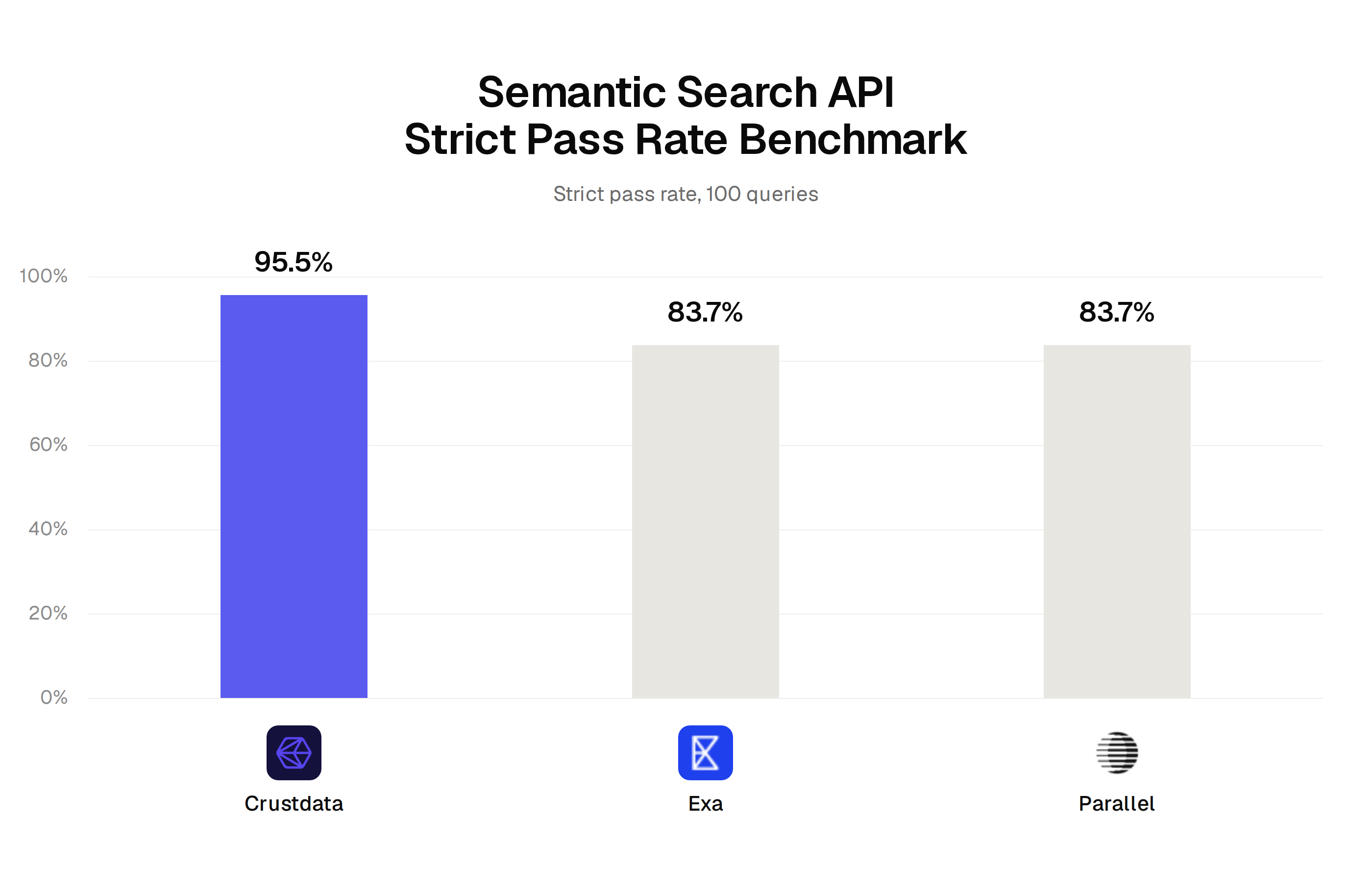
Crustdata had the highest strict pass rate for people search at 95.5% of 100 queries. Exa and Parallel tied at 83.7%. Parallel was ahead of Exa on R@1.
Crustdata had the highest strict pass rate of the three people search APIs tested. It passed 95.5% of 100 queries, ahead of Exa and Parallel, which both finished at 83.7%. That is a lead of 11.8 points. The second metric, R@1, gives the same winner but a different order behind it. Crustdata scored 95%, Parallel 90% and Exa 88%, so the tie on strict pass rate does not carry over.
Semantic search here means describing the people you want in plain language and getting back the right profiles. Each query in the test had a known answer, so a result counts only when the API returns what the panel says it should. The benchmark reports two numbers per provider, a strict pass rate and R@1, and this post reads both.
The short version:
- Crustdata leads the strict pass rate at 95.5%, 11.8 points ahead of Exa and Parallel, which tied at 83.7%.
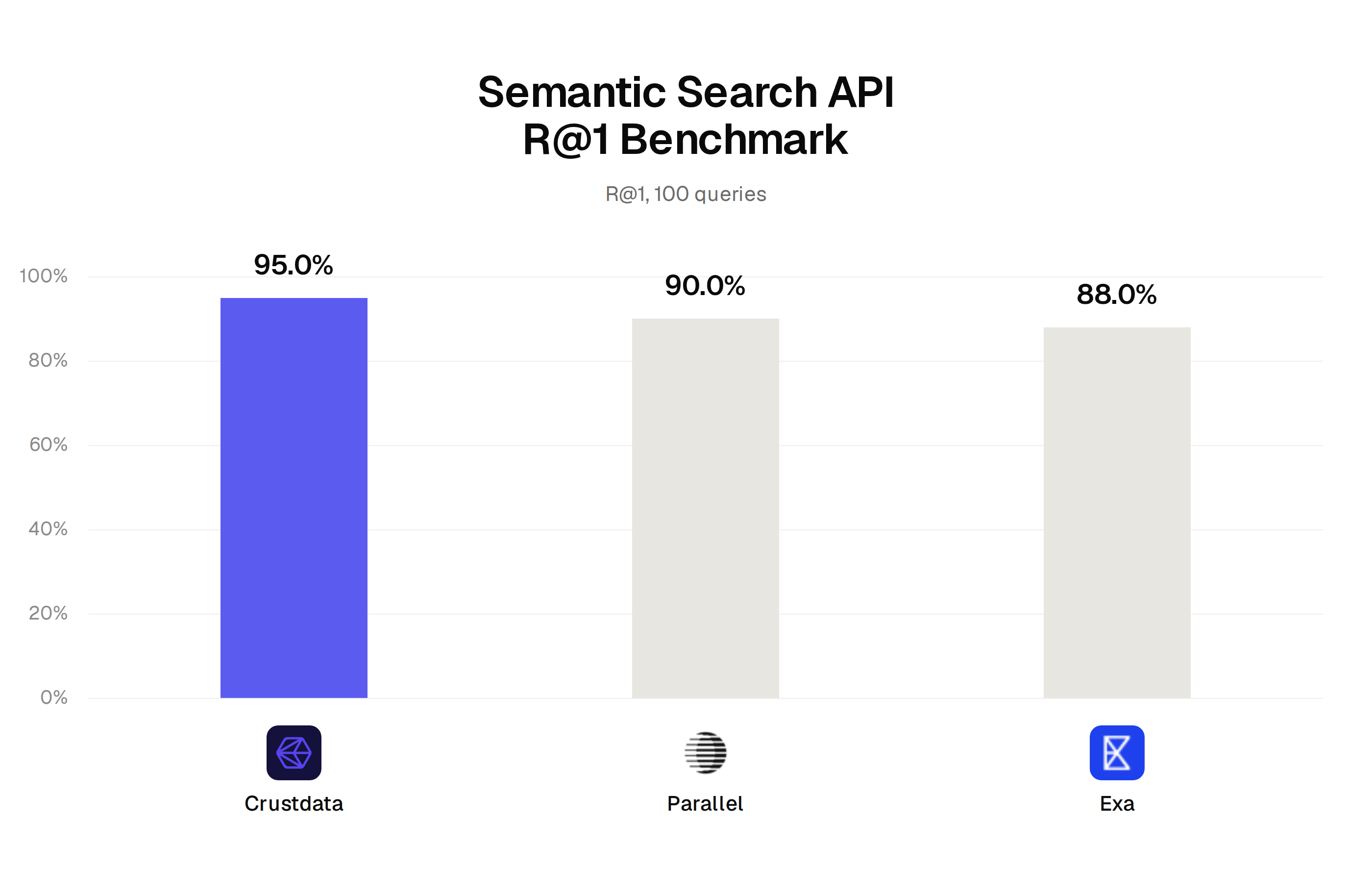
- Crustdata also leads R@1 at 95%. Parallel is second at 90% and Exa third at 88%.
- Only three providers took this test, so the panel is small. Exa and Parallel swap places depending on the metric.
Which semantic search API has the highest strict pass rate?
Crustdata, at 95.5%. Exa and Parallel both scored 83.7%, so the order of second and third place on this metric is a tie, not a ranking.
| Provider | Strict pass rate | Queries |
|---|---|---|
| Crustdata | 95.5% | 100 |
| Exa | 83.7% | 100 |
| Parallel | 83.7% | 100 |
The gap between first and the other two is 11.8 points. The gap between second and third is zero. If you read only this table, you have one clear leader and two providers that cannot be told apart. The second metric is what separates them.
Which API puts the right person first?
Crustdata again, at 95% on R@1. Parallel scored 90% and Exa 88%. R@1 is reported next to the strict pass rate in the same run, on the same 100 queries.
| Provider | R@1 | Queries |
|---|---|---|
| Crustdata | 95% | 100 |
| Parallel | 90% | 100 |
| Exa | 88% | 100 |
Crustdata is 5 points ahead of Parallel and 7 points ahead of Exa on this measure. Parallel is 2 points ahead of Exa. With 100 queries, 2 points is a small difference, and a different panel could reverse it. The 5 and 7 point gaps to Crustdata are larger, though they are still measured on a single run of 100 queries.
How was this benchmark measured?
The test used a fixed panel with known answers and graded every response against them.
- Panel. 100 queries for people search, each with a known correct answer.
- Calls. Every API was called on the same panel.
- Grading. Responses were graded against ground truth. The benchmark reports a strict pass rate and R@1 for each provider.
- Date. The run took place on 31 August 2026.
- Providers. Crustdata, Exa and Parallel took the test. No other provider was run on this panel.
Two limits matter before you rely on the numbers. First, 100 queries is a small panel. A few queries going the other way would move a provider by several points, which is why the tie between Exa and Parallel and their 2 point gap on R@1 should not be read as a firm ordering. Second, a pass rate says nothing about price, latency, rate limits or how easy the API is to start using. The methodology page explains how the separate APIbenchmarks Index scores documentation, reliability, ecosystem and access.
Why does the order of Exa and Parallel change between metrics?
The two metrics ask slightly different questions, and the providers do not lose points in the same places. The chart below puts each provider's two results side by side.
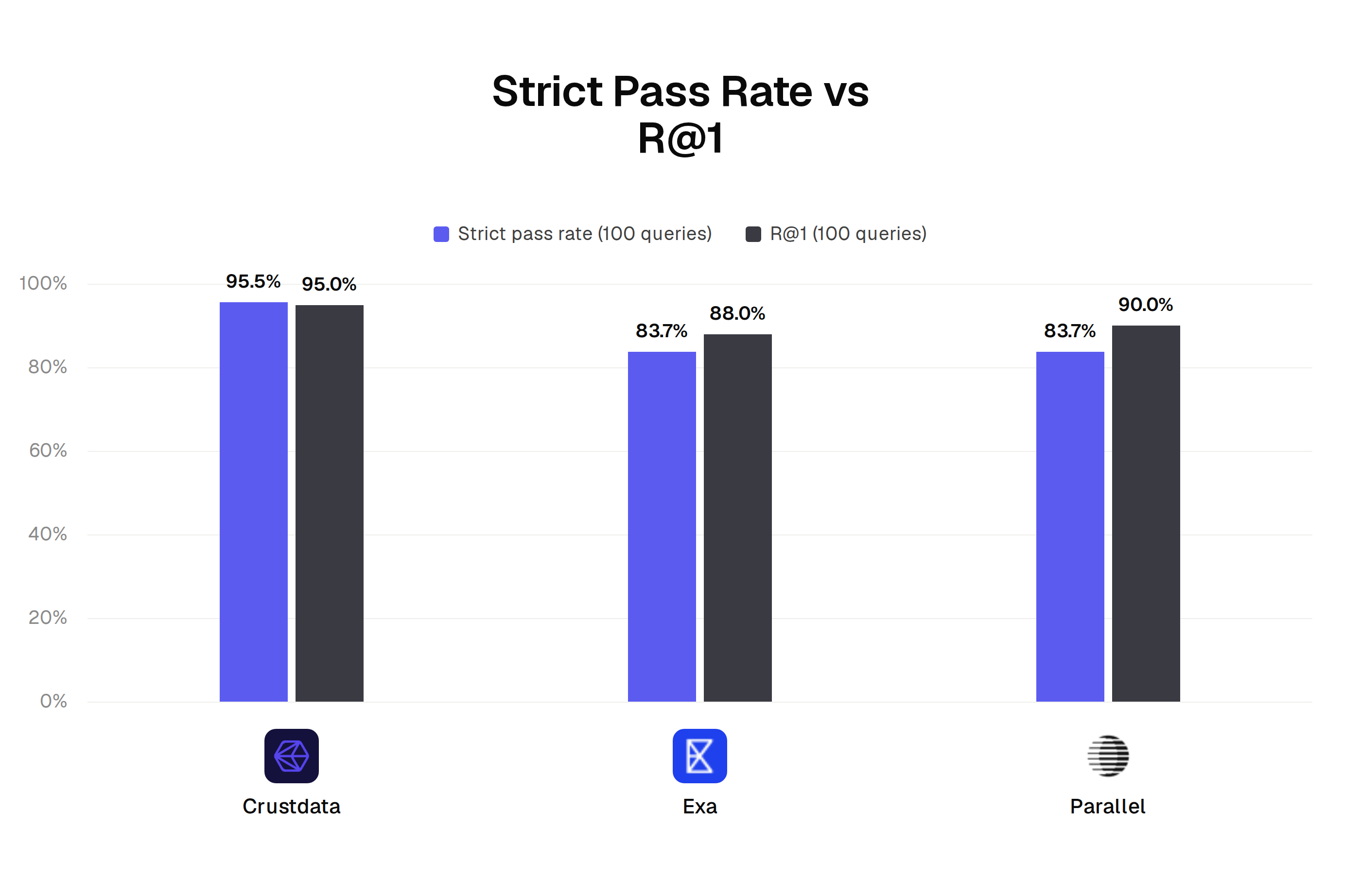
Crustdata scored 95.5% on the strict pass rate and 95% on R@1. Exa scored 83.7% and 88%. Parallel scored 83.7% and 90%.
What the data shows is that Exa and Parallel score higher on R@1 than on the strict pass rate, and Crustdata's two numbers sit close together. It does not show why. The benchmark does not break the misses down by query type, so any explanation of the cause would be a guess. What can be said is that Parallel's R@1 is higher than Exa's by 2 points while their strict pass rates are equal, so the strict test is the one where they look the same.
For a buyer, the practical reading is simple. If you need the stricter standard to hold, the strict pass rate is the number to weigh, and on it Crustdata is clearly first and the other two are level. If you care about the top result being right, R@1 is the number, and the order is Crustdata, Parallel, Exa.
How do the three providers compare overall?
On both measures the order of first place does not change. On the second place it does.
| Basis | Crustdata | Exa | Parallel |
|---|---|---|---|
| Strict pass rate (100 queries) | 95.5% | 83.7% | 83.7% |
| R@1 (100 queries) | 95% | 88% | 90% |
| Rank on strict pass rate | 1 | 2 (tie) | 2 (tie) |
| Rank on R@1 | 1 | 3 | 2 |
Crustdata has a provider page in the data enrichment index at /enrichment/crustdata. Exa and Parallel are not in that index, so this post compares them only on the hands-on results above. The same panel approach was used in the company enrichment benchmark and the technographics benchmark, where the providers and the ordering were different.
The bottom line on each provider
- Crustdata. First on both measures, 95.5% strict pass rate and 95% R@1.- Exa. 83.7% strict pass rate, tied with Parallel for second. 88% on R@1, third of three.
- Parallel. 83.7% strict pass rate, tied with Exa for second. 90% on R@1, second of three.
How to benchmark semantic search providers yourself
These results come from one panel of 100 queries and one run. Your searches may look different. They may be narrower, in a niche industry, in another language or focused on seniority levels that the panel did not weight. Write 50 to 100 queries from your real use cases, and for each one record the person or people you already know should come back. Send the same list to each provider you are considering, and decide before you look at any results what counts as a pass. Then count the passes, and separately count how often the right person comes back first. Keep the grading rule the same for every provider. If you also need structured profile data, the company enrichment benchmark shows the same method applied to a different job.
FAQ
Which semantic search API is the most accurate? In this benchmark, Crustdata. It had a strict pass rate of 95.5% across 100 queries, against 83.7% for both Exa and Parallel. It also led R@1 at 95%.
Is Exa or Parallel better for people search? It depends on the metric. They tied on the strict pass rate at 83.7%. Parallel was ahead on R@1, 90% against 88%. Both gaps are small on a panel of 100 queries.
What is the difference between strict pass rate and R@1 in this benchmark? They are two scores the benchmark reports for the same run. Crustdata scored 95.5% and 95%, Exa 83.7% and 88%, Parallel 83.7% and 90%. The site reports both so that you can see where a provider's order changes.
How many queries were in the test? 100 queries, each with a known correct answer. Every provider was called on the same 100 queries.
When was the benchmark run? On 31 August 2026.
Does a high pass rate mean an API is the right choice? Not by itself. The test measures whether the right answer comes back. It does not measure price, speed or how easy the API is to set up, so check those on your own data before you decide.
More benchmarks
- Person enrichment API benchmark 2026: Coresignal, Nyne, Crustdata, Fiber and People Data Labs
- Data enrichment API benchmark 2026: Crustdata, People Data Labs, Bright Data and 16 more
- Translation API benchmark 2026: Google, Azure, Amazon, DeepL, Lara, Lokalise and LILT
- Image generation API benchmark 2026: OpenAI, Google Imagen, fal.ai, Replicate and more
- Company enrichment API benchmark 2026: Crustdata, Fiber, Coresignal, People Data Labs and Nyne
- Technographics data benchmark 2026: Crustdata vs BuiltWith vs TheirStack vs Sumble