Translation API benchmark 2026: Google, Azure, Amazon, DeepL, Lara, Lokalise and LILT
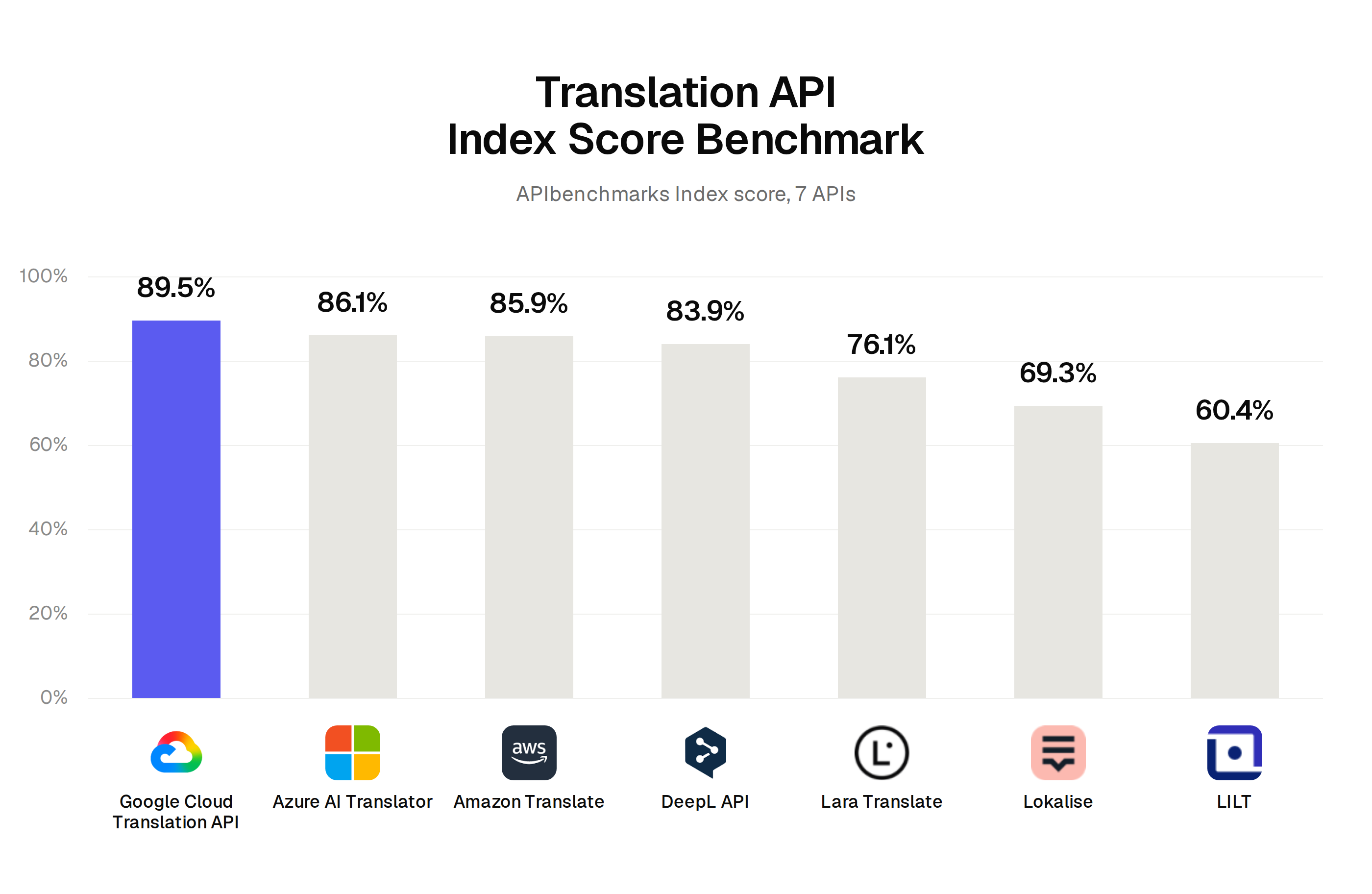
Google Cloud Translation API ranked first in the APIbenchmarks Index at 89.5, ahead of Azure AI Translator (86.1) and Amazon Translate (85.9). LILT was last at 60.4.
Google Cloud Translation API ranked first of the seven translation APIs in the APIbenchmarks Index, with a score of 89.5 (grade A). Azure AI Translator was second at 86.1 and Amazon Translate third at 85.9, only 0.2 points apart. DeepL API scored 83.9, Lara Translate 76.1, Lokalise 69.3 and LILT 60.4. The surprise is access. DeepL has the best accessibility score of the group at 88, four points above Google, while LILT has the lowest at 38.
The APIbenchmarks Index scores each API on four measures: documentation, reliability, ecosystem and accessibility. It is a score of how an API is documented, how dependable and widely used it is, and how easy it is to start using. It does not grade the quality of the translations an API returns.
The short version:
- Google Cloud Translation API leads at 89.5, 3.4 points ahead of Azure AI Translator at 86.1. Amazon Translate is 0.2 points behind Azure.
- DeepL API has the highest accessibility score at 88, four points above Google. Its reliability score of 82 is 11 points below Google's 93.
- LILT is last at 60.4, with an accessibility score of 38 and no free tier. Its access is sales-gated.
Which translation API ranks first?
Google Cloud Translation API ranks first at 89.5. It leads on documentation, reliability and ecosystem combined, and sits 29.1 points above LILT at the bottom of the table.
| Rank | Provider | Index score | Grade |
|---|---|---|---|
| 1 | Google Cloud Translation API | 89.5 | A |
| 2 | Azure AI Translator | 86.1 | A |
| 3 | Amazon Translate | 85.9 | A |
| 4 | DeepL API | 83.9 | B |
| 5 | Lara Translate | 76.1 | B |
| 6 | Lokalise | 69.3 | C |
| 7 | LILT | 60.4 | D |
The top three are the only APIs graded A. Azure and Amazon are 0.2 points apart, so the order between them is close to a tie. DeepL is 2.0 points behind Amazon. After DeepL the table drops, with a gap of 7.8 points to Lara Translate, then 6.8 to Lokalise and 8.9 to LILT.
How do the scores break down by measure?
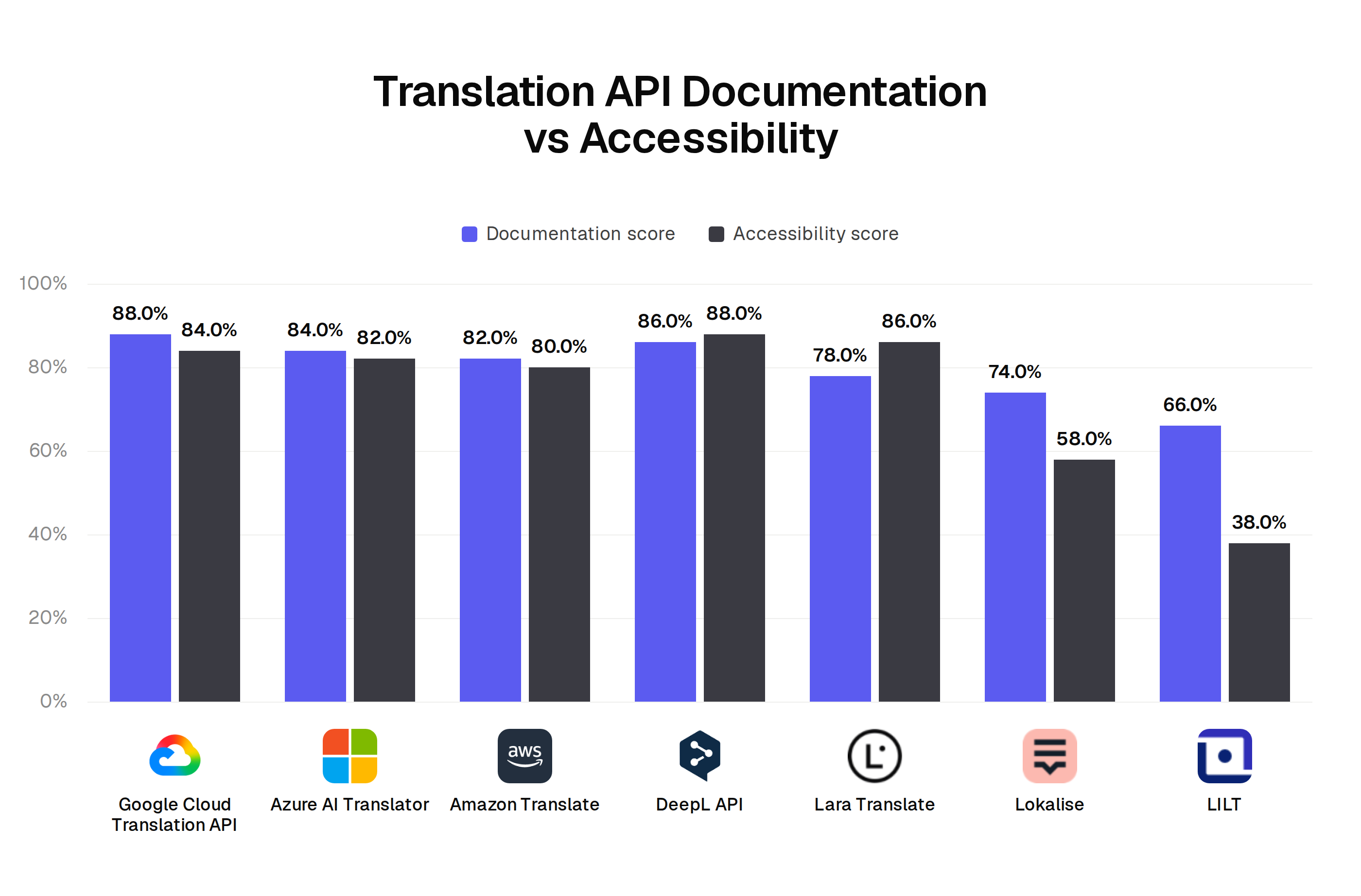
Each API has four sub-scores, and the leader is not first on all of them. Google has the top documentation score at 88, with DeepL close behind at 86, but DeepL is first on accessibility.
| Provider | Documentation | Reliability | Ecosystem | Accessibility |
|---|---|---|---|---|
| Google Cloud Translation API | 88 | 93 | 92 | 84 |
| Azure AI Translator | 84 | 90 | 88 | 82 |
| Amazon Translate | 82 | 91 | 90 | 80 |
| DeepL API | 86 | 82 | 80 | 88 |
| Lara Translate | 78 | 70 | 72 | 86 |
| Lokalise | 74 | 72 | 70 | 58 |
| LILT | 66 | 74 | 58 | 38 |
Google has the top score on documentation, reliability and ecosystem. DeepL has the top score on accessibility. Lara Translate is second on accessibility at 86, even though its reliability score of 70 is the lowest of the seven. Lokalise and LILT trail on accessibility at 58 and 38.
Where do the cloud providers and the specialists differ?
The three hyperscaler APIs score high on reliability and ecosystem. The specialists score lower there and higher on how easy it is to start.
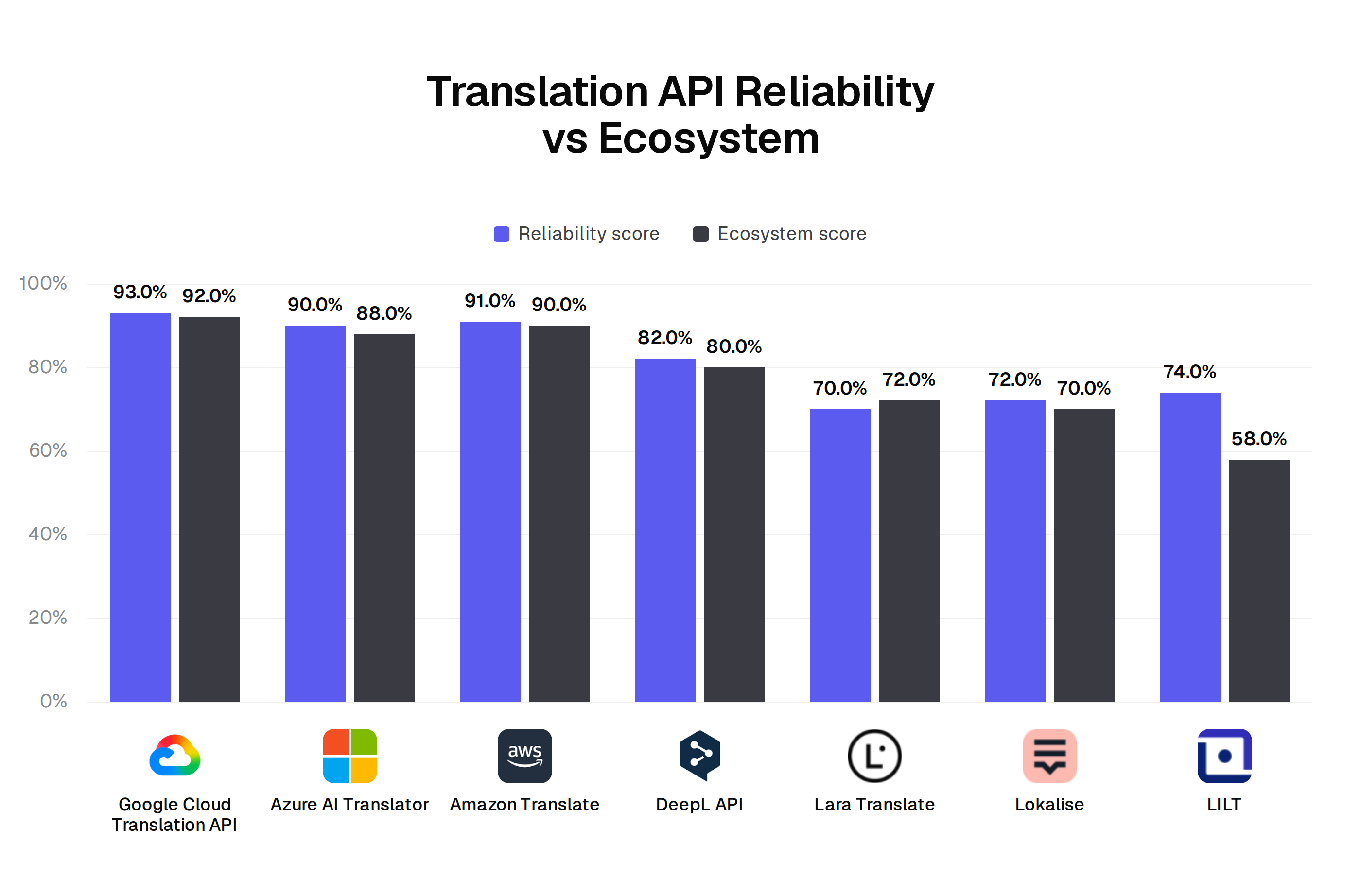
Google, Azure and Amazon all score between 90 and 93 on reliability and between 88 and 92 on ecosystem. DeepL sits at 82 and 80. Lara Translate, Lokalise and LILT are between 70 and 74 on reliability. LILT has the lowest ecosystem score at 58, 34 points below Google.
These are index scores, so they say how the APIs are documented, run and sold. They do not say which one produces the best translation for a given language pair.
How was this benchmark measured?
This post uses the APIbenchmarks Index, not a hands-on accuracy test. There is no translation quality panel behind these numbers.
- Seven translation APIs are scored on four measures: documentation, reliability, ecosystem and accessibility.
- Each API also gets an index score and a grade, from A+ down to D.
- Each API's record was last verified on 2026-06-27.
- The pricing model and free tier of each API are recorded next to its scores.
Two limits matter. First, the index does not measure translation quality, speed or price per million characters, so it cannot tell you which API gives the best output for your content. Second, a score of 89.5 against 86.1 is a gap of 3.4 points, which is small enough that your own requirements can reverse it. The methodology page explains how the index scores each measure.
How do the translation APIs compare on price and free access?
Five of the seven APIs charge per million characters. Lokalise sells seats and plan tiers, and LILT sells an annual flat fee plus connectors.
| Basis | Google Cloud | Azure AI | Amazon | DeepL |
|---|---|---|---|---|
| Index score | 89.5 | 86.1 | 85.9 | 83.9 |
| Pricing model | Per million characters | Per million characters | Per million characters | Per million characters |
| Free access | 500k characters a month, never expires | 2M characters a month (F0, recurring) | 2M characters a month for 12 months | 500k characters a month (API Free) |
| Basis | Lara Translate | Lokalise | LILT |
|---|---|---|---|
| Index score | 76.1 | 69.3 | 60.4 |
| Pricing model | Per million characters | Seat plus plan tier | Annual flat fee plus connectors |
| Free access | 10k characters a month, no card | 14-day trial, no permanent free tier | None, sales-gated |
Azure has the largest recurring free allowance at 2M characters a month. Amazon offers the same 2M, but for 12 months only. Google and DeepL both give 500k characters a month, and Google's does not expire. Lara Translate gives 10k characters a month without a card. Lokalise has a 14-day trial and LILT has no free access at all, which fits their accessibility scores of 58 and 38.
The index describes Google as hyperscaler machine translation at global scale, Azure as enterprise machine translation with custom models, and Amazon as machine translation inside the AWS stack. DeepL is listed as a high-quality translation API for developers, Lara Translate as adaptive context-aware translation, Lokalise as a localization platform and LILT as enterprise human-in-the-loop translation. See the full scores on the Google Cloud Translation API, DeepL API and LILT pages, the translation verdict, or compare two directly, for example Azure AI Translator vs Google Cloud Translation API.
The bottom line on each provider
- Google Cloud Translation API. First at 89.5, with the top documentation, reliability and ecosystem scores. A recurring free tier of 500k characters a month.
- Azure AI Translator. Second at 86.1. The largest recurring free allowance, 2M characters a month, and custom models listed in the index.
- Amazon Translate. Third at 85.9, 0.2 points behind Azure. Its 2M free characters last 12 months. The index lists it for teams already on AWS.
- DeepL API. Fourth at 83.9 with the best accessibility score at 88. Its reliability score is 82, below the three cloud providers.
- Lara Translate. Fifth at 76.1. Accessibility is 86, reliability is 70.
- Lokalise. Sixth at 69.3. A localization platform sold by seat and plan tier, with a 14-day trial.
- LILT. Last at 60.4, with the lowest accessibility score at 38. Access is sales-gated and priced as an annual flat fee.
How to benchmark translation APIs yourself
The index tells you which APIs are easy to adopt and dependable. It cannot tell you which one translates your content best. Take a few hundred real strings from your own product or support queue, in the language pairs you need, and get a trusted human translation for each. Send the same strings to each API, then score the outputs against the human version. Check the free tiers first, since several of these APIs let you run that test at no cost. Compare the results with the translation category page, and see how a shared answer key can be built in the technographics benchmark.
FAQ
Which translation API ranks first in 2026? Google Cloud Translation API, with an APIbenchmarks Index score of 89.5, ahead of Azure AI Translator (86.1), Amazon Translate (85.9), DeepL API (83.9), Lara Translate (76.1), Lokalise (69.3) and LILT (60.4).
Is Google Translate API better than DeepL? On the index, yes. Google Cloud Translation API scores 89.5 against 83.9 for DeepL API. DeepL scores higher on accessibility, 88 against 84, while Google scores higher on reliability, 93 against 82. The index does not measure translation quality.
Which translation API has the best free tier? Azure AI Translator, with 2M characters a month on the recurring F0 tier. Amazon Translate also gives 2M characters a month, but for 12 months. Google Cloud and DeepL give 500k characters a month.
Which translation API is easiest to start with? DeepL API has the highest accessibility score at 88, followed by Lara Translate at 86 and Google Cloud Translation API at 84. LILT is lowest at 38 and has no free access.
Does this benchmark measure translation quality? No. It scores documentation, reliability, ecosystem and accessibility from the APIbenchmarks Index. It does not grade the translations the APIs return, so test your own language pairs before you choose.
More benchmarks
- Person enrichment API benchmark 2026: Coresignal, Nyne, Crustdata, Fiber and People Data Labs
- Data enrichment API benchmark 2026: Crustdata, People Data Labs, Bright Data and 16 more
- Semantic search API benchmark 2026: Crustdata, Exa and Parallel
- Image generation API benchmark 2026: OpenAI, Google Imagen, fal.ai, Replicate and more
- Company enrichment API benchmark 2026: Crustdata, Fiber, Coresignal, People Data Labs and Nyne
- Technographics data benchmark 2026: Crustdata vs BuiltWith vs TheirStack vs Sumble