Data enrichment API benchmark 2026: Crustdata, People Data Labs, Bright Data and 16 more
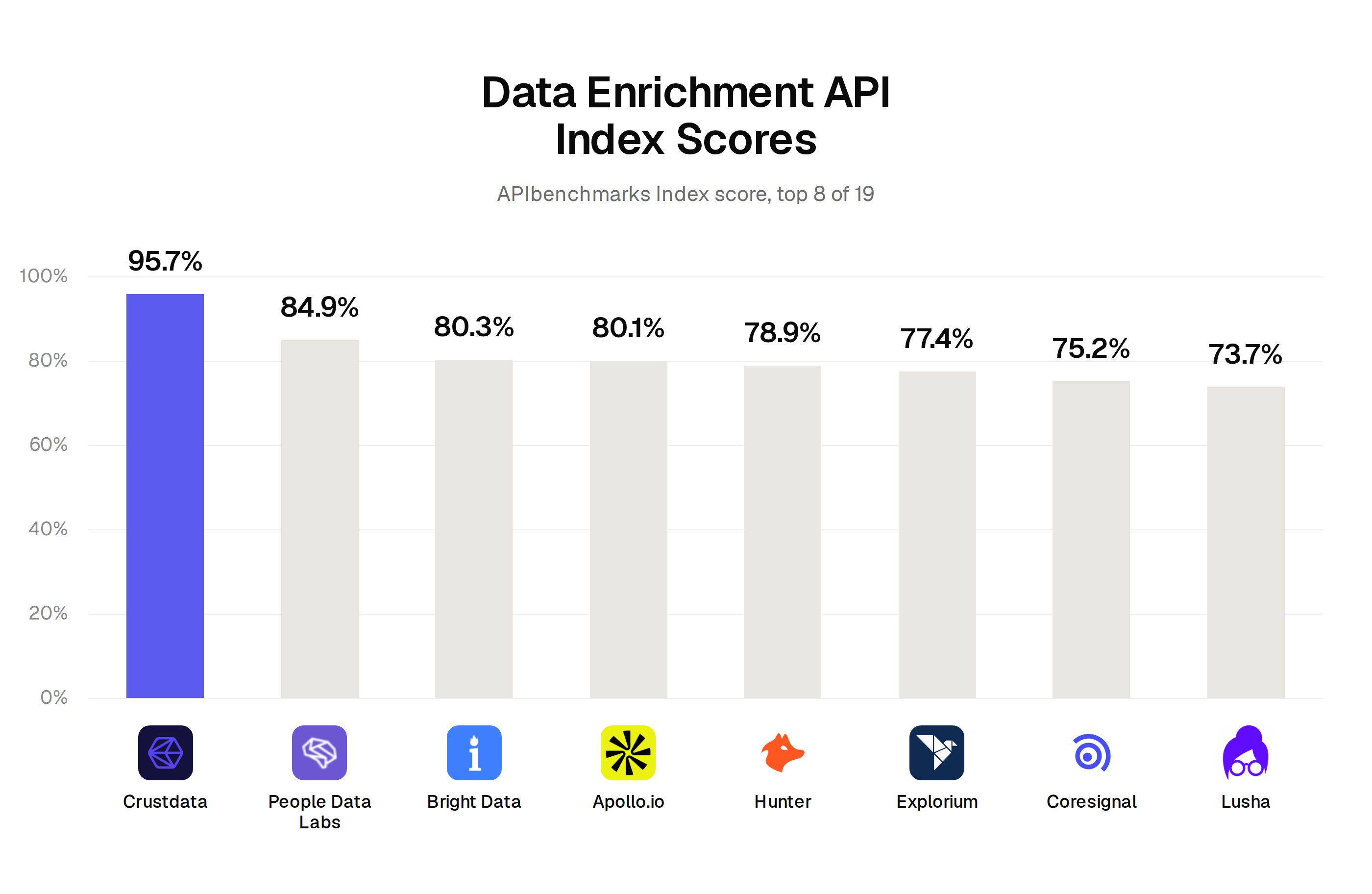
Crustdata scored 95.7 in the APIbenchmarks Index for data enrichment, ahead of People Data Labs at 84.9 and Bright Data at 80.3, across 19 APIs.
Crustdata has the highest score of the 19 data enrichment APIs in the APIbenchmarks Index, at 95.7 with an A+ grade. People Data Labs is second at 84.9, followed by Bright Data at 80.3, Apollo.io at 80.1 and Hunter at 78.9. ContactOut is last at 55. The gap between first and second is 10.8 points, which is more than the 9.7 points that separate People Data Labs in second from Coresignal in seventh.
A data enrichment API takes a company or a person you already know a little about and returns more: firmographics, job history, emails, phone numbers. The index scores each API on four things, documentation, reliability, ecosystem and accessibility, and combines them into one number. It does not measure how often an API returns the right record. The hands-on tests further down do that.
The short version:
- Crustdata leads the index at 95.7, 10.8 points ahead of People Data Labs at 84.9. It is the only API with an A+ grade among the 19.
- The middle is tight. Bright Data (80.3) and Apollo.io (80.1) are 0.2 points apart, and 17 of the 19 APIs sit between 55 and 80.3.
- On the hands-on tests, the order is not the index order. Crustdata is first on company identity match at 93/100, and Coresignal and Nyne are first on person match at 100/100.
Which data enrichment API scores highest in the index?
Crustdata, at 95.7. It also has the highest score on each of the four parts: documentation 96, reliability 95, ecosystem 95 and accessibility 97. Only 1 API gets an A+, 6 get a B, 9 get a C and 3 get a D.
| Rank | API | Index | Grade | Docs | Reliability | Ecosystem | Access |
|---|---|---|---|---|---|---|---|
| 1 | Crustdata | 95.7 | A+ | 96 | 95 | 95 | 97 |
| 2 | People Data Labs | 84.9 | B | 88 | 82 | 80 | 90 |
| 3 | Bright Data | 80.3 | B | 82 | 80 | 82 | 76 |
| 4 | Apollo.io | 80.1 | B | 80 | 84 | 78 | 78 |
| 5 | Hunter | 78.9 | B | 84 | 80 | 66 | 86 |
| 6 | Explorium | 77.4 | B | 82 | 70 | 74 | 84 |
| 7 | Coresignal | 75.2 | B | 80 | 78 | 66 | 76 |
| 8 | Lusha | 73.7 | C | 76 | 78 | 68 | 72 |
| 9 | FullEnrich | 72.5 | C | 80 | 66 | 64 | 80 |
| 10 | Prospeo | 71.8 | C | 78 | 66 | 62 | 82 |
| 11 | Fiber | 69.9 | C | 80 | 60 | 74 | 62 |
| 12 | FullContact | 68.4 | C | 70 | 70 | 62 | 72 |
| 14 | RocketReach | 67.8 | C | 76 | 74 | 66 | 50 |
| 15 | ZoomInfo | 67.5 | C | 70 | 90 | 72 | 30 |
| 16 | Clay | 66.9 | C | 65 | 75 | 60 | 68 |
| 17 | Cognism | 60 | D | 72 | 66 | 62 | 32 |
| 18 | Clearbit (Breeze Intelligence) | 59.6 | D | 58 | 80 | 55 | 42 |
| 19 | ContactOut | 55 | D | 70 | 58 | 50 | 35 |
The table leaves out the API at rank 13, which scores 68.3 with a C grade. The full list of 19 is on the data enrichment page. Below the top four, the scores bunch up. Hunter, Explorium and Coresignal sit within 3.7 points of each other, and from Lusha at rank 8 to Clay at rank 16 the whole spread is 6.8 points. A one-place move in that range is a small change in score. The distance from first to last is 40.7 points.
Does a high index score mean better data?
No. The index scores how well an API is documented, how reliable it is, how large its ecosystem is and how easy it is to start using. It says nothing about whether a returned record is correct. For that, the site runs separate hands-on tests, and two of them cover enrichment.
| Provider | Company identity matched (of 100) | Right person matched (of 100) |
|---|---|---|
| Crustdata | 93 | 99 |
| Fiber | 92 | 98 |
| Coresignal | 89 | 100 |
| People Data Labs | 87 | 92 |
| Nyne | 79 | 100 |
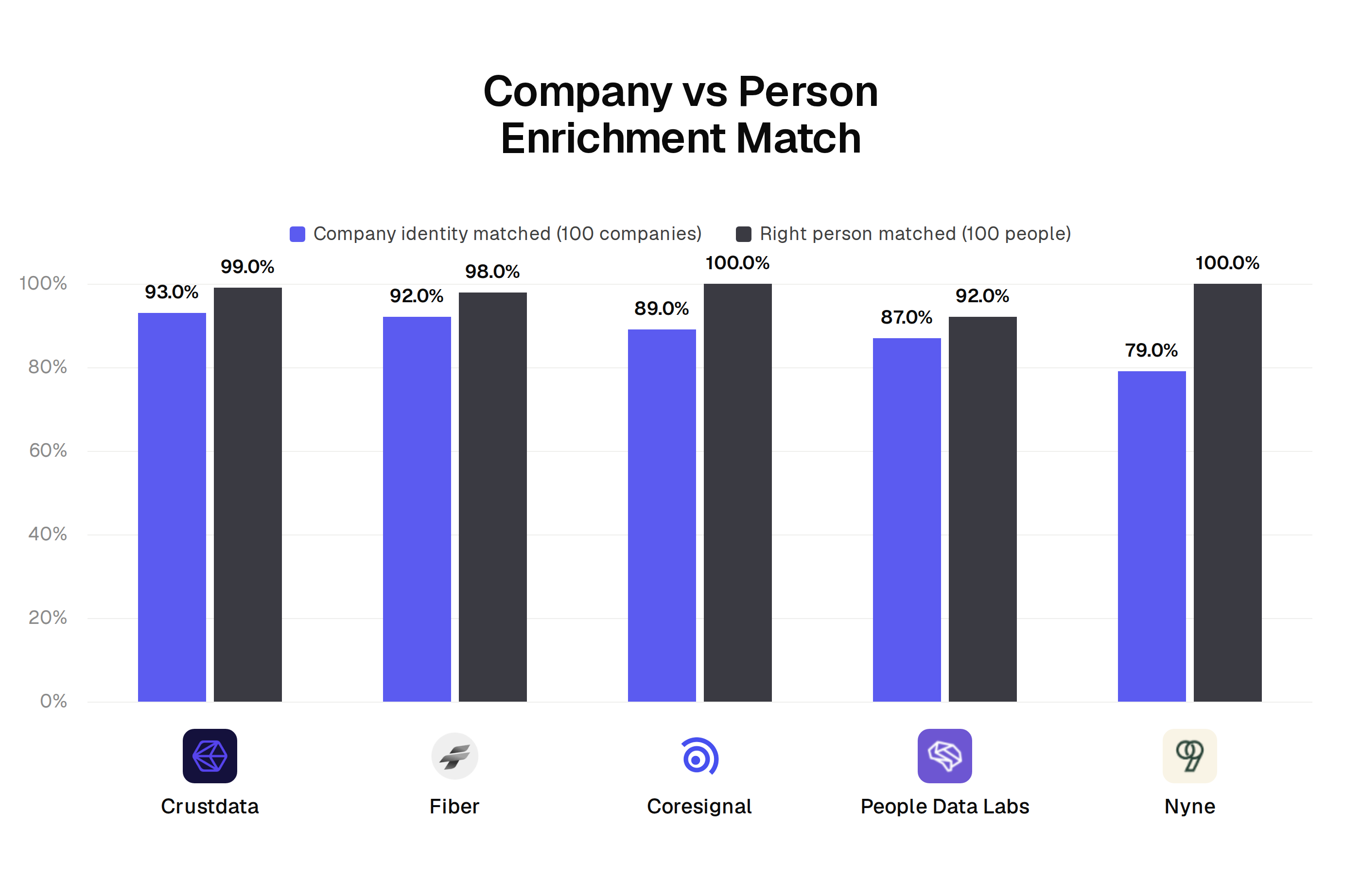
Crustdata leads the company test at 93/100, one match ahead of Fiber at 92/100. On the person test Coresignal and Nyne both reached 100/100, with Crustdata at 99/100 and Fiber at 98/100. People Data Labs is fourth on the company test at 87/100 and fifth on the person test at 92/100. Nyne has the lowest company result, 79/100, and a perfect person result. Nyne is not scored in the index, so it does not appear in the table above.
Both tests used 100 records, so one record is one point. The 1 point between Crustdata and Fiber on the company test is a single company.
How was this benchmark measured?
There are two sources in this post, and they measure different things.
- The APIbenchmarks Index. Each API is scored on documentation, reliability, ecosystem and accessibility. 19 data enrichment APIs are scored. The index was last updated on 19 October 2026.
- Company enrichment test. A fixed panel of 100 companies with known answers. Each API was called on the same panel and graded against the ground truth for identity match. Run on 3 September 2026.
- Person enrichment test. A fixed panel of 100 people with known answers, graded the same way for matching the right person. Run on 3 September 2026.
- Five providers took both hands-on tests. Four of them, Crustdata, People Data Labs, Coresignal and Fiber, are also in the index.
Two limits apply. The index covers 19 APIs and the hands-on tests cover five, so most of the APIs in the first table have no hands-on result yet. And 100 records is a small panel, so treat gaps of a few points as ties. The methodology page explains how the index is scored.
Why do the index and the hands-on results rank providers differently?
They answer different questions. The index rewards an API that is easy to learn, reliable and easy to start with. The hands-on tests reward an API that returns the right record on a given panel.
The clearest case is Coresignal. It is seventh in the index at 75.2, and it is first on the person test at 100/100. Fiber is eleventh in the index at 69.9, with a reliability score of 60, and second on company match at 92/100 and fourth on person match at 98/100. People Data Labs is second in the index and fourth and fifth in the two hands-on tests.
The four index parts do not always move together. The next chart puts reliability and accessibility side by side for the top 8.
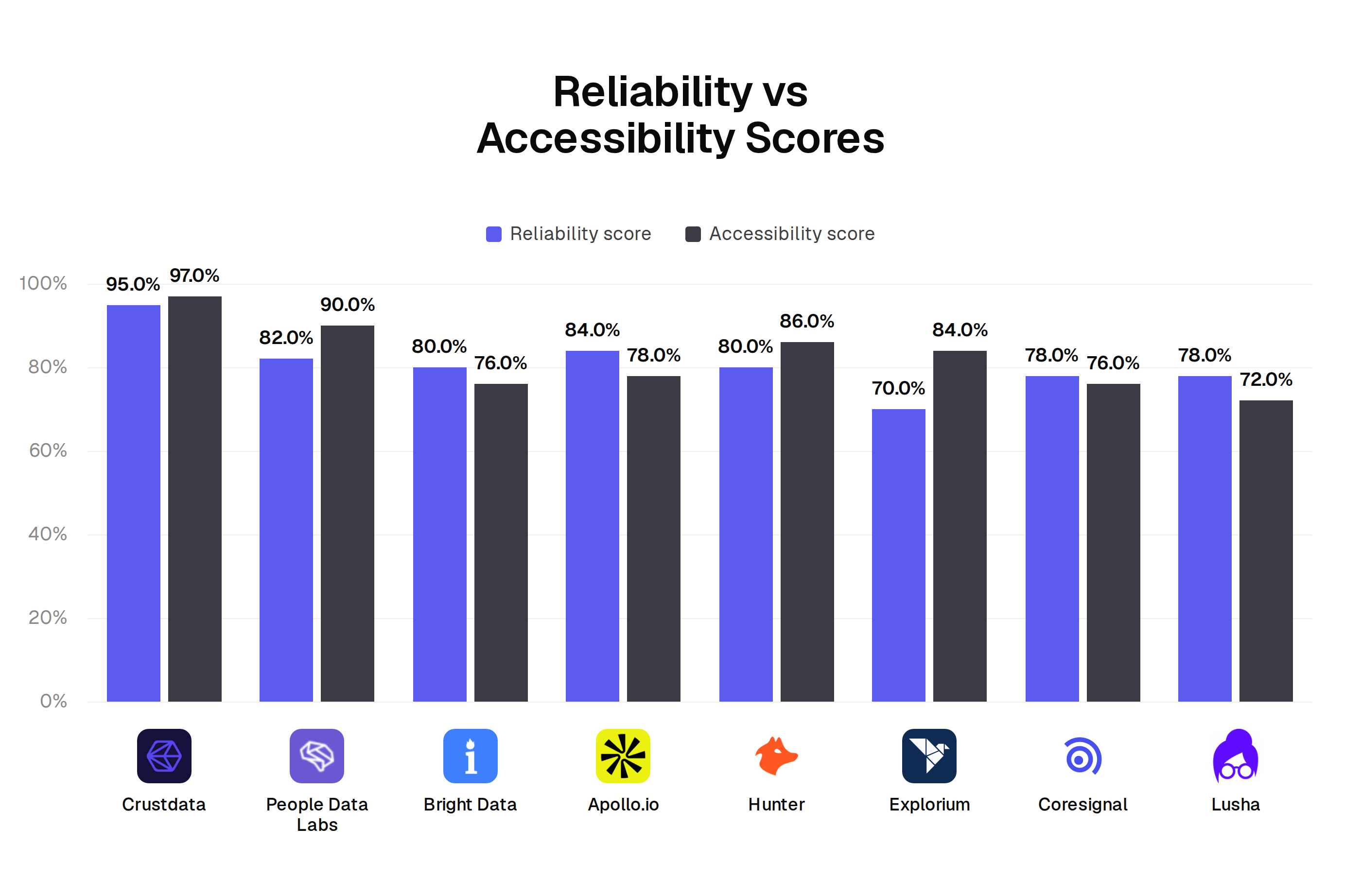
ZoomInfo shows the split most clearly. Its reliability score is 90, the second highest of the 19 after Crustdata at 95, and its accessibility score is 30, the lowest. Its pricing is an annual contract with bulk credits and it has no free tier. Cognism (32) and ContactOut (35) are also below 40 on accessibility.
How do the top enrichment APIs compare on pricing and free access?
The index records how each API is sold. The table shows the five highest ranked.
| Basis | Crustdata | People Data Labs | Bright Data | Apollo.io | Hunter |
|---|---|---|---|---|---|
| Index score | 95.7 | 84.9 | 80.3 | 80.1 | 78.9 |
| Pricing model | Per credit (additive) | Per enrichment credit | Per 1,000 records ($2.50 CPM), plans or commits | Per credit (email 1, phone 8) | Per credit (1 per email found, 0.5 per verification) |
| Free access | Free trial credits and a free-forever tier | 100 person or company lookups a month, emails and phones obfuscated | Free dataset samples, new-account credits unconfirmed for datasets | 10k credits a month with a verified corporate domain, or 100 | 50 credits a month, API included |
| Best for | Real-time data for AI agents and sourcing | Bulk person and company data for builders | Bulk public people and company datasets | Sales engagement plus enrichment | Email finding and verification |
All five list some free access, which makes a small test on your own list cheap. Bright Data's free access is the least clear, since the index marks the new-account credit as unconfirmed for datasets. See the full scores on the Crustdata, People Data Labs and Bright Data pages, or compare two directly, for example Crustdata vs People Data Labs.
The bottom line on each provider
- Crustdata. First in the index at 95.7 and first on the company identity test at 93/100. Third on the person test at 99/100, behind Coresignal and Nyne.
- People Data Labs. Second in the index at 84.9. 87/100 on company match and 92/100 on person match, the lowest person result of the five providers tested.
- Bright Data. Third at 80.3, sold per 1,000 records. No hands-on result yet.
- Apollo.io. Fourth at 80.1, sold per credit. Free credits rise from 100 to 10k a month with a verified corporate domain. No hands-on result yet.
- Hunter. Fifth at 78.9, with accessibility 86. Free plan includes the API. No hands-on result yet.
- Coresignal. Seventh at 75.2, with 100/100 on person match and 89/100 on company match.
- Fiber. Eleventh at 69.9, with 92/100 on company match and 98/100 on person match.
- ZoomInfo. Fifteenth at 67.5, with reliability 90 and accessibility 30.
- ContactOut. Last at 55, with accessibility 35. Its API is sold on a quoted plan and the free tier does not include API access.
How to benchmark data enrichment providers yourself
The index and a 100-record panel are a starting point, not a verdict on your data. Take a few hundred companies or people from your own CRM where you already know the right answer, send the same list to each provider you are considering, and count only exact matches. Score what you will use, whether that is firmographics, job titles or contact details, and read the free tier terms before you start. If you also need contact data, the company enrichment benchmark has the full company test and the technographics benchmark shows how a shared answer key can be built.
FAQ
Which data enrichment API has the highest score in 2026? Crustdata, at 95.7 in the APIbenchmarks Index with an A+ grade. People Data Labs is second at 84.9 and Bright Data third at 80.3, out of 19 APIs.
Which data enrichment API is the most accurate? The index does not measure accuracy. On the hands-on company test, Crustdata matched 93/100 companies, ahead of Fiber at 92/100, Coresignal at 89/100, People Data Labs at 87/100 and Nyne at 79/100. On the person test, Coresignal and Nyne both matched 100/100.
Is Crustdata or People Data Labs better? Crustdata scores higher in the index, 95.7 against 84.9, and higher on both hands-on tests, 93/100 against 87/100 on companies and 99/100 against 92/100 on people. See the side-by-side comparison for the pricing and access details.
What are the lowest scoring data enrichment APIs? ContactOut at 55, Clearbit (Breeze Intelligence) at 59.6 and Cognism at 60. All three have a D grade, and all three score 42 or lower on accessibility.
How is the APIbenchmarks Index calculated? Each API is scored on documentation, reliability, ecosystem and accessibility, and the four are combined into one score and a letter grade. It measures how well an API is built and sold, not how often it returns the right record.
More benchmarks
- Person enrichment API benchmark 2026: Coresignal, Nyne, Crustdata, Fiber and People Data Labs
- Semantic search API benchmark 2026: Crustdata, Exa and Parallel
- Translation API benchmark 2026: Google, Azure, Amazon, DeepL, Lara, Lokalise and LILT
- Image generation API benchmark 2026: OpenAI, Google Imagen, fal.ai, Replicate and more
- Company enrichment API benchmark 2026: Crustdata, Fiber, Coresignal, People Data Labs and Nyne
- Technographics data benchmark 2026: Crustdata vs BuiltWith vs TheirStack vs Sumble