Authentication API benchmark 2026: Auth0, Firebase, WorkOS, Clerk, Stytch and more
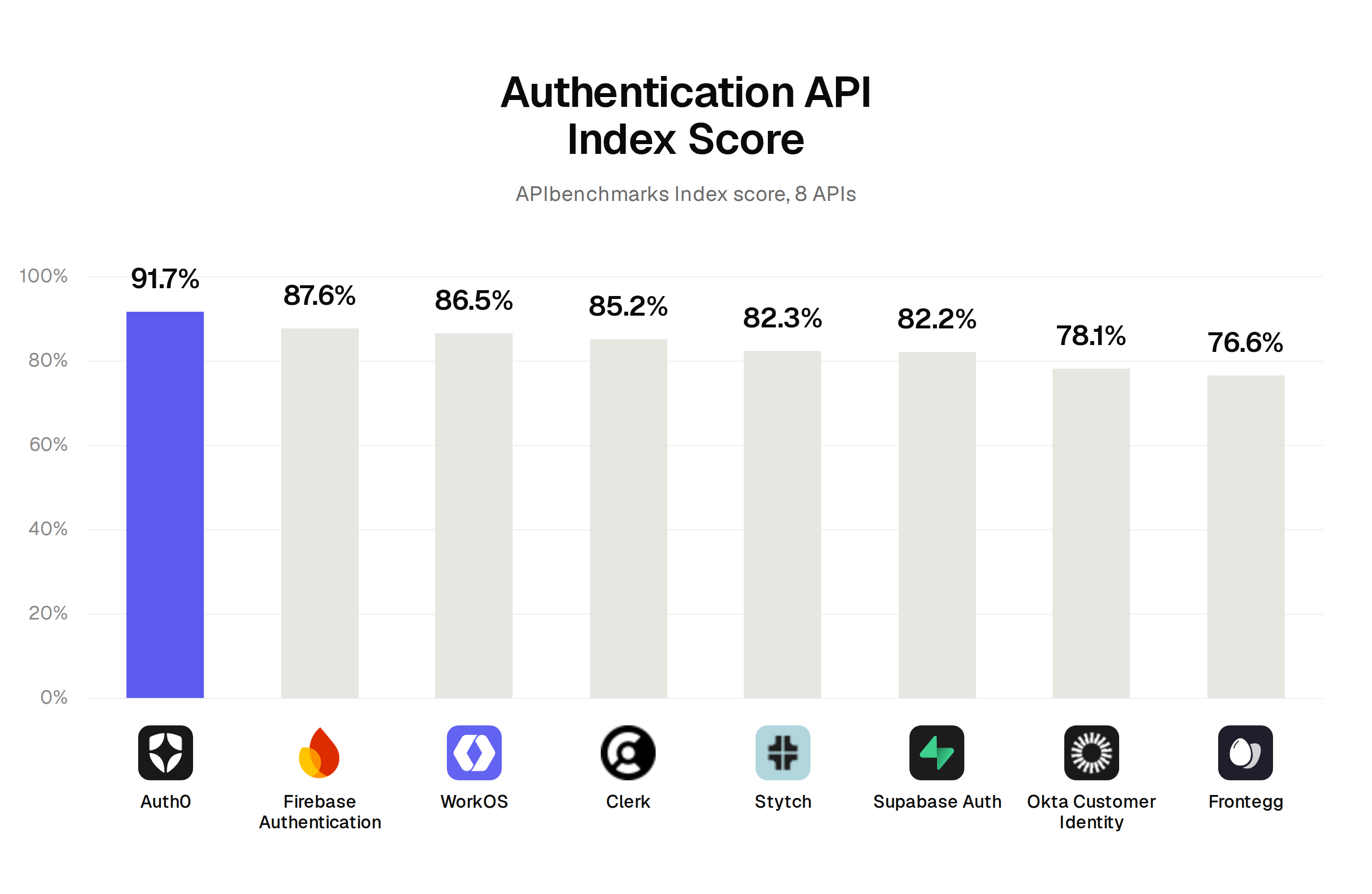
Auth0 leads the authentication APIs with an APIbenchmarks Index score of 91.7, ahead of Firebase Authentication at 87.6 and WorkOS at 86.5. Okta is last on access.
Auth0 has the highest APIbenchmarks Index score of the eight authentication and identity APIs in the index, at 91.7 (grade A). Firebase Authentication is second at 87.6, WorkOS third at 86.5 and Clerk fourth at 85.2. Stytch (82.3), Supabase Auth (82.2), Okta Customer Identity (78.1) and Frontegg (76.6) follow. The surprise is Okta. It has the best reliability score of the group, 93, and the lowest accessibility score by a wide margin, 48.
An authentication API handles sign-in, sessions, single sign-on and user management so a product does not have to build them. The APIbenchmarks Index scores each API on documentation, reliability, ecosystem and accessibility, where accessibility is how easy it is to start using the API. These are index scores, not results from a fixed panel with known answers, because no hands-on test exists for this category.
The short version:
- Auth0 leads at 91.7, 4.1 points ahead of Firebase Authentication in second place. It has the top documentation score (93) and the top ecosystem score (95).
- Clerk has the best accessibility score at 92. Okta has the worst at 48, which is 34 points below Frontegg in seventh place on that measure.
- The middle is tight. Firebase Authentication, WorkOS and Clerk sit within 2.4 points of each other, and Stytch and Supabase Auth are 0.1 apart.
Which authentication API has the highest index score?
Auth0 does, at 91.7. Firebase Authentication scores 87.6, WorkOS 86.5 and Clerk 85.2. The first four are grade A. The other four are grade B.
| Provider | Index score | Grade | Documentation | Reliability | Ecosystem | Accessibility |
|---|---|---|---|---|---|---|
| Auth0 | 91.7 | A | 93 | 92 | 95 | 85 |
| Firebase Authentication | 87.6 | A | 85 | 90 | 88 | 88 |
| WorkOS | 86.5 | A | 90 | 84 | 82 | 90 |
| Clerk | 85.2 | A | 91 | 78 | 80 | 92 |
| Stytch | 82.3 | B | 86 | 78 | 76 | 90 |
| Supabase Auth | 82.2 | B | 84 | 76 | 80 | 90 |
| Okta Customer Identity | 78.1 | B | 80 | 93 | 85 | 48 |
| Frontegg | 76.6 | B | 78 | 75 | 72 | 82 |
The gap between first and last is 15.1 points. Most of the spread comes from the top: Auth0 is 4.1 points clear of second place, while places two to four are only 2.4 points apart. Stytch and Supabase Auth are 0.1 apart, so the order between them should not drive a decision.
Which authentication API is easiest to start with?
Clerk, with an accessibility score of 92. WorkOS, Stytch and Supabase Auth are next at 90 each, then Firebase Authentication at 88, Auth0 at 85 and Frontegg at 82. Okta Customer Identity is last at 48.
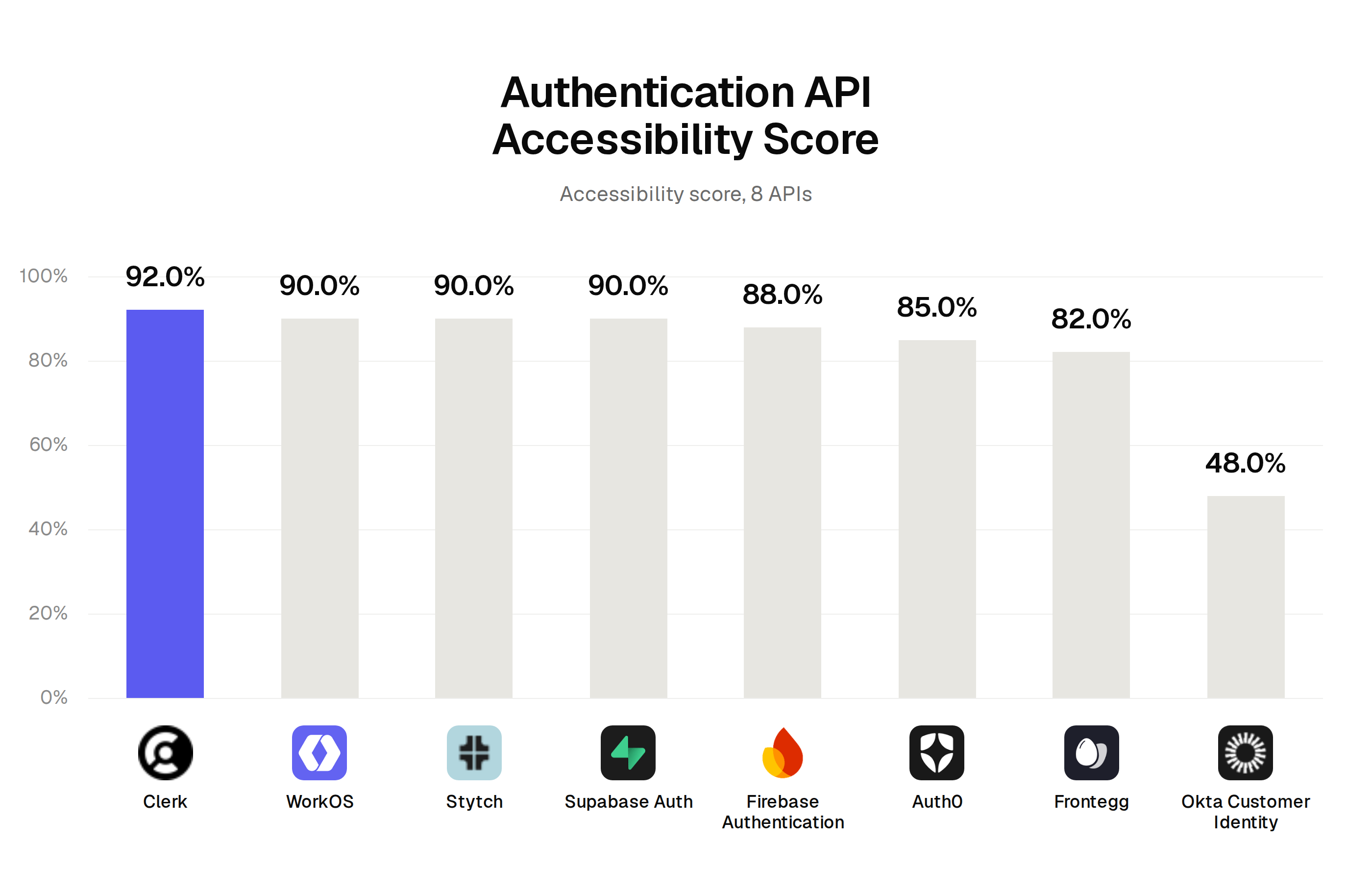
Seven of the eight APIs sit between 82 and 92, a spread of 10 points. Okta is the outlier. Its listing says it has a dev trial only and that production is sales-gated, and its pricing is MAU-based with enterprise minimums. Auth0 scores 85 on the same measure, so Auth0 is 37 points ahead of Okta on getting started.
How was this benchmark measured?
This comparison uses the APIbenchmarks Index, not a hands-on test.
- What is scored. Documentation, reliability, ecosystem and accessibility, which feed one index score and a letter grade.
- Who is included. 8 authentication and identity APIs from the index category.
- What is not measured. There is no fixed panel with known answers for authentication here, so no result in this post is an accuracy or latency measurement.
Two limits matter. First, an index score summarises how an API is documented, supported and sold. It does not say how it will behave in your product. Second, the free tier and pricing details below come from each provider's public terms and can change. The methodology page explains how the index works.
Why do reliability and accessibility pull in different directions?
Because the two scores describe different things, and some APIs are strong on one and weak on the other. The chart puts both side by side.
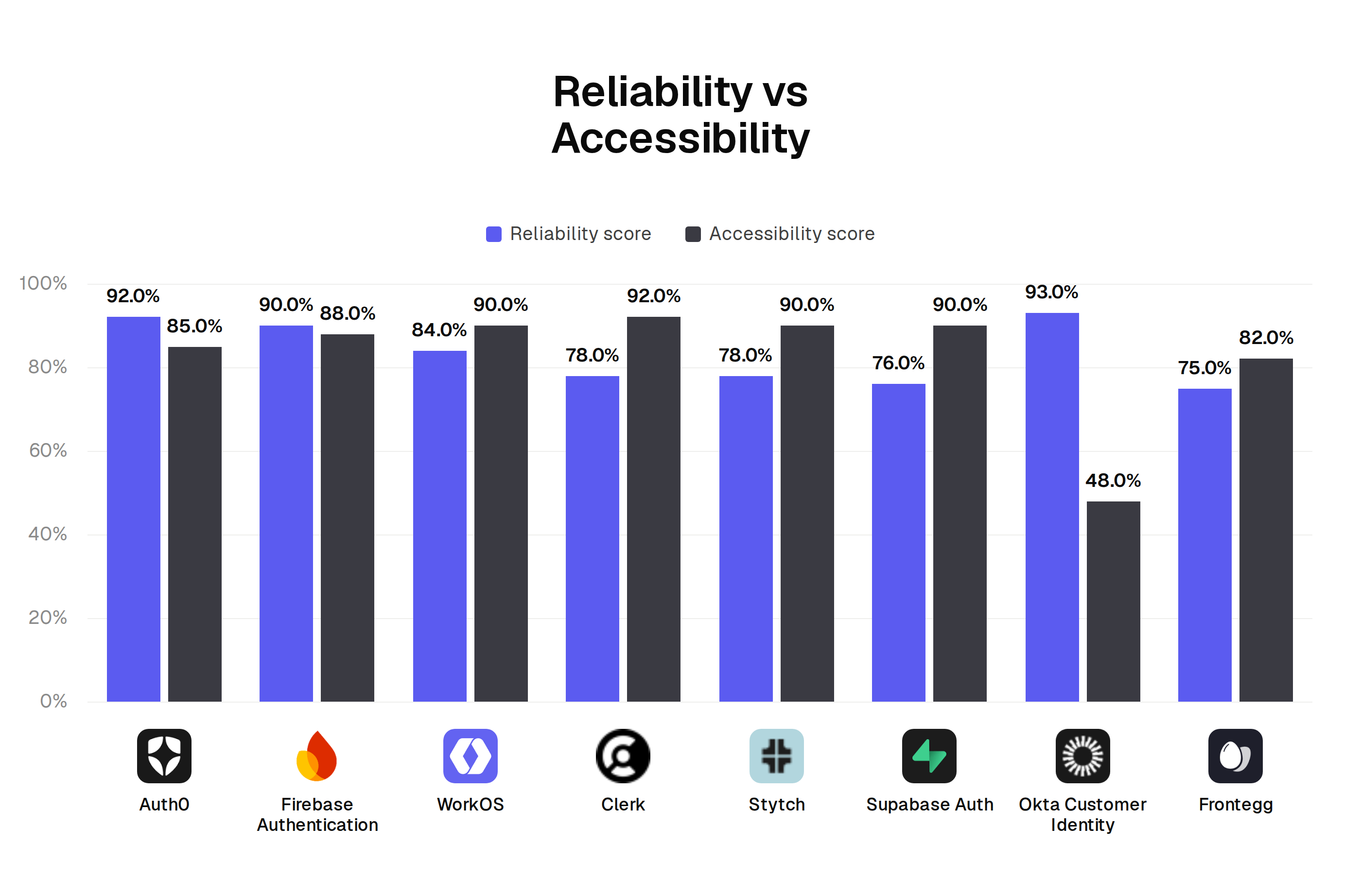
Okta moves the most. It has the highest reliability score, 93, and the lowest accessibility score, 48, a 45 point difference between the two. Auth0 and Firebase Authentication are the most even of the group, with reliability at 92 and 90 and accessibility at 85 and 88.
Clerk, Stytch and Supabase Auth are the opposite of Okta. Their accessibility scores are 92, 90 and 90, while their reliability scores are 78, 78 and 76. Clerk has a 14 point gap in favour of accessibility. For a team that wants to ship a login screen this week, accessibility may matter more. For a team that cannot tolerate sign-in outages, reliability may matter more.
How do these providers compare on pricing and free access?
Every API in this category prices by monthly active users, though the add-ons differ. The free allowances are very different in size.
| Provider | Pricing model | Free access |
|---|---|---|
| Auth0 | MAU-based | 25k MAU on the free plan |
| Firebase Authentication | MAU-based, plus per-SMS | 50k MAU for basic email and social sign-in |
| WorkOS | Per connection or MAU-based | Up to 1M MAU on AuthKit, $125 per connection for SSO and SCIM |
| Clerk | MAU-based | 50k monthly retained users |
| Stytch | Usage-based (MAU and connections) | 10k MAU and 5 SSO and SCIM connections |
| Supabase Auth | MAU-based, plus a platform fee | 50k MAU on the free plan |
| Okta Customer Identity | MAU-based with enterprise minimums | Dev trial only, production is sales-gated |
| Frontegg | MAU-based, plus feature add-ons | 7.5k MAU on the free tier |
WorkOS has the largest free allowance on AuthKit, 1M MAU, but SSO and SCIM are charged per connection at $125. Stytch includes 5 SSO and SCIM connections in its free tier, which is a different trade-off. Frontegg has the smallest free user allowance at 7.5k MAU. See the full scores on the Auth0, Firebase Authentication and Okta Customer Identity pages, read the authentication category page, or compare two directly, for example Auth0 vs WorkOS.
The bottom line on each provider
- Auth0. First at 91.7, with the best documentation (93) and ecosystem (95) scores. Accessibility is 85, and the free plan covers 25k MAU.
- Firebase Authentication. Second at 87.6. Even scores across the board, from 85 to 90, and 50k MAU free for basic sign-in.
- WorkOS. Third at 86.5. Accessibility of 90 and a free AuthKit allowance of up to 1M MAU. SSO and SCIM cost $125 per connection.
- Clerk. Fourth at 85.2. The best accessibility score, 92, and a reliability score of 78.
- Stytch. 82.3, grade B. Accessibility 90, reliability 78, and 5 SSO and SCIM connections in the free tier.
- Supabase Auth. 82.2, grade B. Accessibility 90, reliability 76, and 50k MAU free.
- Okta Customer Identity. 78.1. The highest reliability score, 93, and the lowest accessibility score, 48, with production access gated by sales.
- Frontegg. Last at 76.6. Accessibility of 82 and the lowest reliability score, 75.
How to benchmark authentication providers yourself
An index score is a starting point. To test for your own product, list the flows you need, such as email and password, social sign-in, SSO for a customer and a user import, then build the same small prototype on two or three providers. Time how long it takes to reach a working login, count how many of your flows work without a sales call, and note what your expected user count costs at each tier. The authentication verdict page summarises the index view, and the LLM API benchmark shows the same index approach applied to another category.
FAQ
Which authentication API has the highest score? Auth0, with an APIbenchmarks Index score of 91.7. Firebase Authentication is second at 87.6 and WorkOS third at 86.5.
Which authentication API is easiest to start with? Clerk, with an accessibility score of 92. WorkOS, Stytch and Supabase Auth follow at 90. Okta Customer Identity is lowest at 48.
Which authentication API has the best reliability score? Okta Customer Identity at 93, just ahead of Auth0 at 92 and Firebase Authentication at 90. Frontegg is lowest at 75.
Which authentication API has the biggest free tier? WorkOS allows up to 1M MAU on AuthKit. Firebase Authentication, Clerk and Supabase Auth each list 50k MAU, Auth0 lists 25k, Stytch 10k and Frontegg 7.5k. Okta offers a dev trial only.
Is this a hands-on accuracy test? No. These are index scores for documentation, reliability, ecosystem and accessibility. No fixed panel with known answers was run for authentication, so the numbers say nothing about login speed or uptime in your product.
Is Auth0 or Firebase Authentication better? Auth0 scores higher overall, 91.7 against 87.6, and leads on documentation and ecosystem. Firebase Authentication scores higher on accessibility, 88 against 85, and lists a larger free tier at 50k MAU against 25k.
More benchmarks
- Job postings API benchmark 2026: TheirStack, Bright Data and Crustdata
- People search API benchmark 2026: Crustdata, Fiber and Exa
- LLM API benchmark 2026: OpenAI, Claude, Gemini, Mistral, Grok, Groq and DeepSeek
- Transactional email API benchmark 2026: SendGrid, Resend, Postmark, Mailgun and more
- Vector database API benchmark 2026: Pinecone, MongoDB Atlas, Zilliz, Supabase and more
- Text-to-speech API benchmark 2026: ElevenLabs, Google Cloud, Polly, OpenAI and more
- Payments API benchmark 2026: Stripe, Square, Razorpay, Mollie, Braintree, Checkout.com, Adyen
- Maps and geocoding API benchmark 2026: Google Maps Platform, Mapbox, HERE, TomTom and more
- Crustdata vs People Data Labs API benchmark 2026: company and person matching
- E-signature API benchmark 2026: DocuSign, Dropbox Sign, PandaDoc and 4 more
- KYC API benchmark 2026: Stripe Identity, Persona, Plaid, Sumsub and more
- Personal email API benchmark 2026: ContactOut, FullEnrich, Nyne, SignalHire, Wiza and Apollo
- SMS API benchmark 2026: Twilio, Vonage, Telnyx, Plivo, Sinch and more
- Person enrichment API benchmark 2026: Coresignal, Nyne, Crustdata, Fiber and People Data Labs
- Data enrichment API benchmark 2026: Crustdata, People Data Labs, Bright Data and 16 more
- Semantic search API benchmark 2026: Crustdata, Exa and Parallel
- Translation API benchmark 2026: Google, Azure, Amazon, DeepL, Lara, Lokalise and LILT
- Image generation API benchmark 2026: OpenAI, Google Imagen, fal.ai, Replicate and more
- Company enrichment API benchmark 2026: Crustdata, Fiber, Coresignal, People Data Labs and Nyne
- Technographics data benchmark 2026: Crustdata vs BuiltWith vs TheirStack vs Sumble