Vector database API benchmark 2026: Pinecone, MongoDB Atlas, Zilliz, Supabase and more
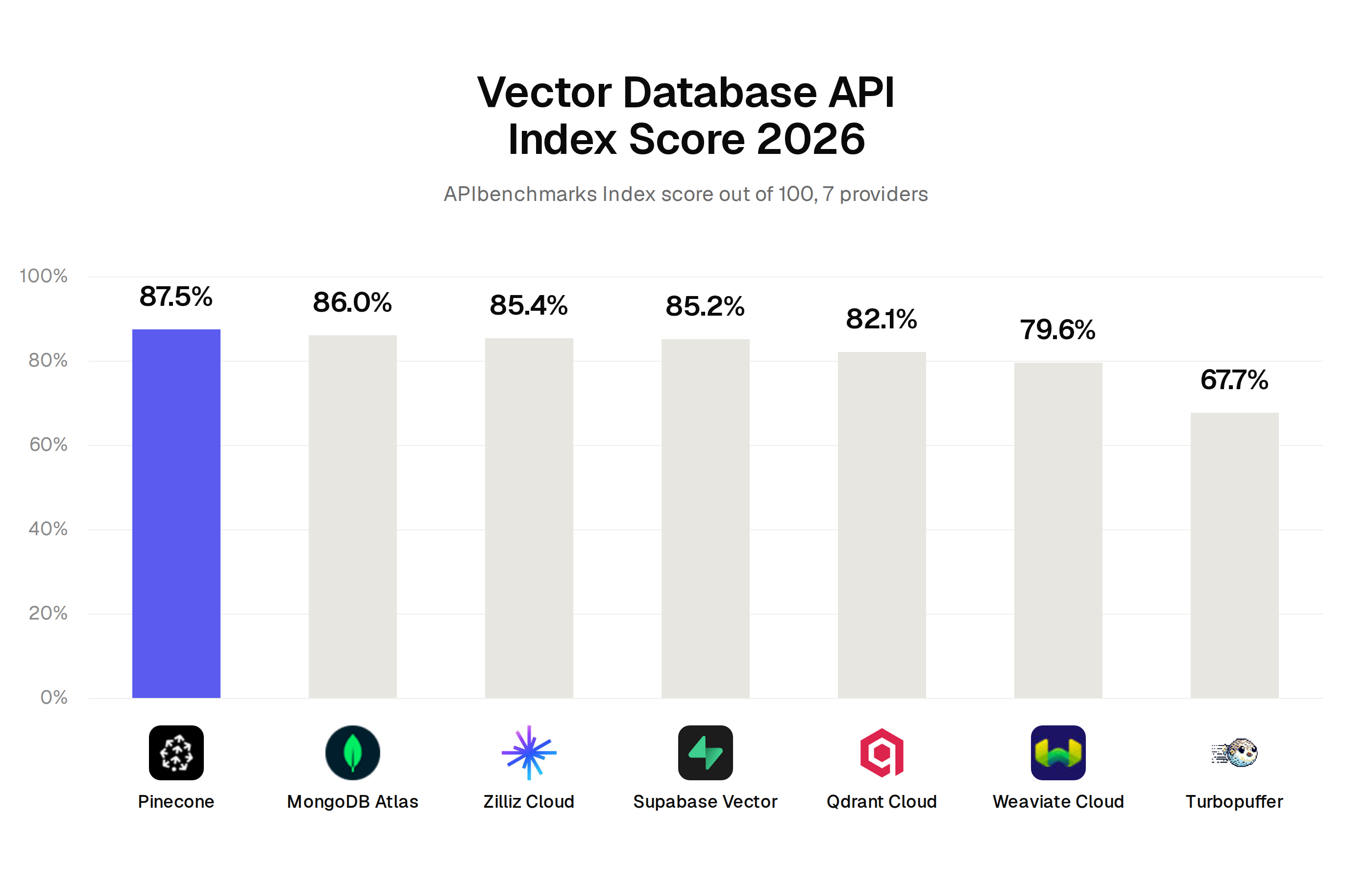
Pinecone leads the 2026 vector database API index at 87.5, ahead of MongoDB Atlas Vector Search at 86 and Zilliz Cloud at 85.4. Turbopuffer is last at 67.7.
Pinecone scores highest of the seven vector database APIs in the APIbenchmarks Index, at 87.5 out of 100 (grade A). MongoDB Atlas Vector Search is second at 86, Zilliz Cloud (Milvus) third at 85.4 and Supabase Vector (pgvector) fourth at 85.2. Qdrant Cloud scores 82.1, Weaviate Cloud 79.6 and Turbopuffer 67.7. The top four sit within 2.3 points of each other, so the order among them depends on which sub-score matters to you.
The index scores each API on four things: documentation, reliability, ecosystem and accessibility. It is a measure of how well an API is documented, how dependable it looks, how much surrounds it and how easy it is to start using. It does not run a query test. This post has no hands-on speed or recall result for any of these seven providers.
The short version:
- Pinecone leads at 87.5, 1.5 points ahead of MongoDB Atlas Vector Search at 86. The next two providers are 0.6 and 0.2 points apart.
- Each of the top four leads a different sub-score: Pinecone on documentation (90), MongoDB on reliability (90) and ecosystem (88), Supabase on accessibility (92).
- Turbopuffer is last at 67.7, 19.8 points behind Pinecone, with the lowest ecosystem score (58) and the lowest accessibility score (60).
Which vector database API scores highest?
Pinecone, at 87.5. MongoDB Atlas Vector Search follows at 86, then Zilliz Cloud at 85.4 and Supabase Vector at 85.2. These four all earn grade A. Qdrant Cloud and Weaviate Cloud earn grade B, and Turbopuffer earns grade C.
| Provider | Index score | Grade |
|---|---|---|
| Pinecone | 87.5 | A |
| MongoDB Atlas Vector Search | 86 | A |
| Zilliz Cloud (Milvus) | 85.4 | A |
| Supabase Vector (pgvector) | 85.2 | A |
| Qdrant Cloud | 82.1 | B |
| Weaviate Cloud | 79.6 | B |
| Turbopuffer | 67.7 | C |
The top four are close. Pinecone to Supabase is a spread of 2.3 points, and Zilliz and Supabase are only 0.2 apart, so a small change in one sub-score would swap them. The bigger steps come lower down. Supabase to Qdrant is 3.1 points, Qdrant to Weaviate is 2.5, and Weaviate to Turbopuffer is 11.9.
Where does each vector database API win and lose?
Each of the top four leads at least one sub-score, which is why the overall order is tight. The chart below shows documentation and reliability side by side.
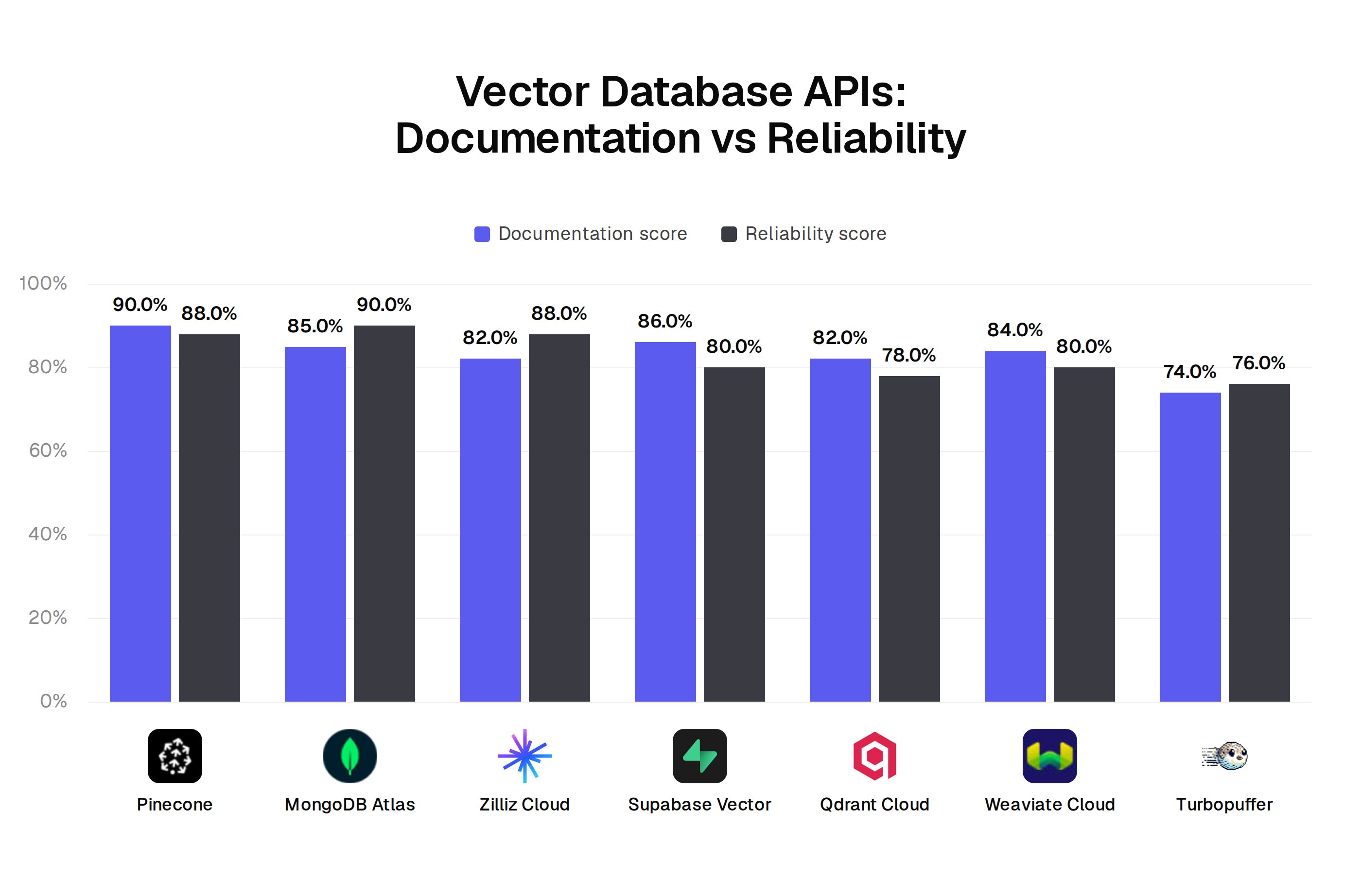
Pinecone has the best documentation score at 90. MongoDB Atlas Vector Search has the best reliability score at 90, followed by Pinecone and Zilliz Cloud at 88 each. Supabase Vector is fourth overall but only 80 on reliability, 10 points behind MongoDB. Qdrant Cloud has the lowest reliability score outside Turbopuffer, at 78, against 76 for Turbopuffer.
The second pair of sub-scores is ecosystem and accessibility.
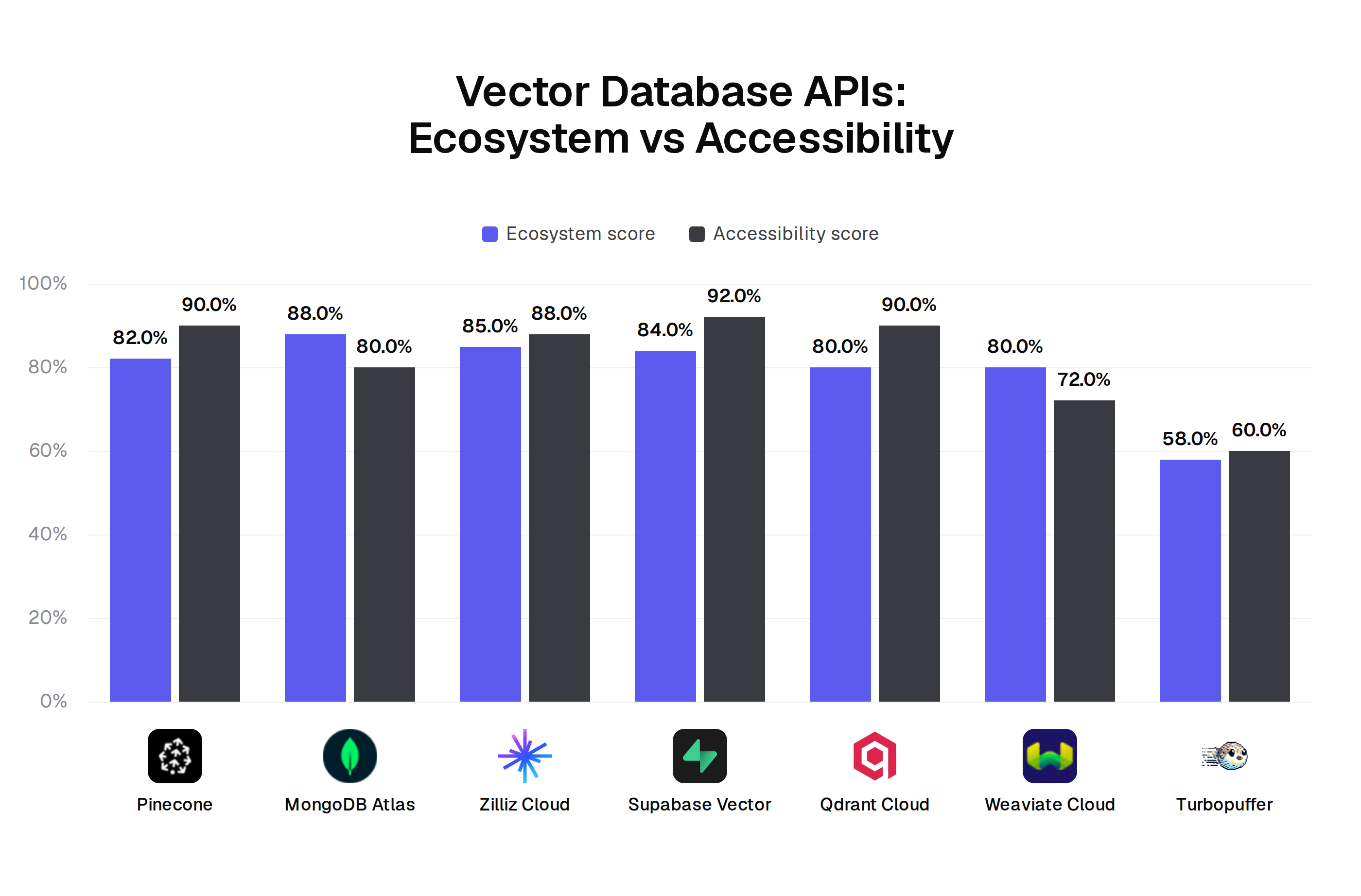
MongoDB leads ecosystem at 88, ahead of Zilliz Cloud at 85 and Supabase Vector at 84. Supabase Vector leads accessibility at 92, with Pinecone and Qdrant Cloud both at 90. MongoDB's accessibility score is 80, 10 points below Pinecone. Weaviate Cloud scores 72 on accessibility, the second lowest after Turbopuffer at 60.
Turbopuffer has the largest gap of any provider. Its ecosystem score is 58. The next lowest is 80, shared by Qdrant Cloud and Weaviate Cloud.
How was this benchmark measured?
This is an index comparison, not a live test. Each API has a score from 0 to 100 on four sub-scores, and the index combines them into one score and a letter grade.
- Sub-scores. Documentation, reliability, ecosystem and accessibility.
- Providers. Seven vector database APIs in the index.
- Verification date. The vector database entries were last verified in June 2026. The index was last updated in November 2026.
- Free tier and pricing. Taken from the same entries, as listed in each provider's record.
There are limits to know before you read the numbers. The index says nothing about query latency, recall at your data size or cost at your volume, because none of those were measured here. The overall score is not a plain average of the four sub-scores, so a provider can rank above another while trailing it on one sub-score. The methodology page explains how the index is built.
How do the free tiers and pricing models compare?
The accessibility score is easier to read next to what each provider offers for free, so here is the record for all seven.
| Provider | Pricing model | Free access |
|---|---|---|
| Pinecone | Per read/write unit + storage | Starter: 2GB storage (~350K vectors), 1 index, no SLA |
| MongoDB Atlas Vector Search | Atlas cluster consumption-based | M0 cluster: 512MB storage, shared |
| Zilliz Cloud (Milvus) | Per compute-unit-hour + storage | 5GB storage + compute credits, permanent free tier |
| Supabase Vector (pgvector) | Bundled in Postgres plan (storage-based) | Free project: 500MB DB, pgvector included |
| Qdrant Cloud | Resource-based (vCPU/RAM/disk) | 1GB RAM / 4GB disk cluster (~1M vectors), no card |
| Weaviate Cloud | Usage-based (dimensions + storage) | 14-day sandbox only (auto-expires), no permanent free |
| Turbopuffer | Per GB queried/written + storage | None ($64/mo Launch minimum) |
Six of the seven have some free access. Turbopuffer has none and lists a $64 a month Launch minimum, and its accessibility score is 60. Weaviate Cloud offers a 14-day sandbox that expires, and it scores 72 on accessibility. Zilliz Cloud lists a permanent free tier, and Zilliz, Qdrant Cloud, Supabase Vector and Pinecone all score 88 or higher on accessibility. MongoDB Atlas Vector Search has a free M0 cluster too, but scores 80 on accessibility.
The pricing models differ in what they charge for. Pinecone and Turbopuffer bill on reads, writes and storage. Qdrant Cloud bills on the resources you reserve. Supabase Vector is bundled into a Postgres plan, and MongoDB bills on the Atlas cluster. See the full records on the Pinecone and MongoDB Atlas Vector Search pages, or compare the top two directly in MongoDB Atlas Vector Search vs Pinecone.
The bottom line on each provider
- Pinecone. First at 87.5, with the best documentation score (90) and 90 on accessibility. Listed as serverless vector search for production RAG. Its ecosystem score of 82 is fourth among the top four.
- MongoDB Atlas Vector Search. Second at 86, first on reliability (90) and ecosystem (88). Accessibility is its low point at 80. Listed as vector search inside operational MongoDB.
- Zilliz Cloud (Milvus). Third at 85.4, with 88 on both reliability and accessibility. Listed as managed Milvus at billion-vector scale.
- Supabase Vector (pgvector). Fourth at 85.2 and first on accessibility (92). Reliability is 80. Listed as Postgres-native embeddings with no separate service.
- Qdrant Cloud. Fifth at 82.1, with 90 on accessibility and the lowest reliability score outside Turbopuffer at 78.
- Weaviate Cloud. Sixth at 79.6. Documentation is 84, but accessibility is 72 and the free access is a 14-day sandbox.
- Turbopuffer. Last at 67.7, with 58 on ecosystem and 60 on accessibility, and no free tier.
How to benchmark vector databases yourself
The index tells you which APIs are well documented and easy to start with. It cannot tell you which one returns the right neighbours for your data. Take a few thousand of your own embeddings, pick a set of queries where you already know which items should come back, load the same data into each provider's free tier, and count how often the right items appear in the top results. Record the latency and the cost at your expected volume as well. The free access listed above is enough to try most of these without a card. For other categories, the data enrichment benchmark and the personal email benchmark show the fixed-panel method used for the hands-on tests on this site. You can also browse the full vector database category and its verdict page.
FAQ
Which vector database API is best in 2026? Pinecone has the highest score in the APIbenchmarks Index at 87.5, ahead of MongoDB Atlas Vector Search (86), Zilliz Cloud (85.4) and Supabase Vector (85.2). The index scores documentation, reliability, ecosystem and accessibility, not query speed.
Is Pinecone or MongoDB Atlas Vector Search better? Pinecone scores higher overall, 87.5 against 86. Pinecone leads on documentation (90 against 85) and accessibility (90 against 80). MongoDB leads on reliability (90 against 88) and ecosystem (88 against 82).
Which vector database has a free tier? Six of the seven. Pinecone offers 2GB of storage, MongoDB Atlas an M0 cluster with 512MB, Zilliz Cloud 5GB, Supabase Vector a 500MB database, and Qdrant Cloud a 1GB RAM and 4GB disk cluster. Weaviate Cloud has only a 14-day sandbox. Turbopuffer has no free tier and lists a $64 a month Launch minimum.
Which vector database API is the easiest to start with? Supabase Vector has the highest accessibility score at 92. Pinecone and Qdrant Cloud follow at 90, and Zilliz Cloud at 88. Turbopuffer is lowest at 60.
Does this benchmark measure search quality or speed? No. The scores cover documentation, reliability, ecosystem and accessibility. There is no hands-on recall or latency result for vector databases here, so test your own data before you choose.
More benchmarks
- Job postings API benchmark 2026: TheirStack, Bright Data and Crustdata
- People search API benchmark 2026: Crustdata, Fiber and Exa
- Authentication API benchmark 2026: Auth0, Firebase, WorkOS, Clerk, Stytch and more
- LLM API benchmark 2026: OpenAI, Claude, Gemini, Mistral, Grok, Groq and DeepSeek
- Transactional email API benchmark 2026: SendGrid, Resend, Postmark, Mailgun and more
- Text-to-speech API benchmark 2026: ElevenLabs, Google Cloud, Polly, OpenAI and more
- Payments API benchmark 2026: Stripe, Square, Razorpay, Mollie, Braintree, Checkout.com, Adyen
- Maps and geocoding API benchmark 2026: Google Maps Platform, Mapbox, HERE, TomTom and more
- Crustdata vs People Data Labs API benchmark 2026: company and person matching
- E-signature API benchmark 2026: DocuSign, Dropbox Sign, PandaDoc and 4 more
- KYC API benchmark 2026: Stripe Identity, Persona, Plaid, Sumsub and more
- Personal email API benchmark 2026: ContactOut, FullEnrich, Nyne, SignalHire, Wiza and Apollo
- SMS API benchmark 2026: Twilio, Vonage, Telnyx, Plivo, Sinch and more
- Person enrichment API benchmark 2026: Coresignal, Nyne, Crustdata, Fiber and People Data Labs
- Data enrichment API benchmark 2026: Crustdata, People Data Labs, Bright Data and 16 more
- Semantic search API benchmark 2026: Crustdata, Exa and Parallel
- Translation API benchmark 2026: Google, Azure, Amazon, DeepL, Lara, Lokalise and LILT
- Image generation API benchmark 2026: OpenAI, Google Imagen, fal.ai, Replicate and more
- Company enrichment API benchmark 2026: Crustdata, Fiber, Coresignal, People Data Labs and Nyne
- Technographics data benchmark 2026: Crustdata vs BuiltWith vs TheirStack vs Sumble