Text-to-speech API benchmark 2026: ElevenLabs, Google Cloud, Polly, OpenAI and more
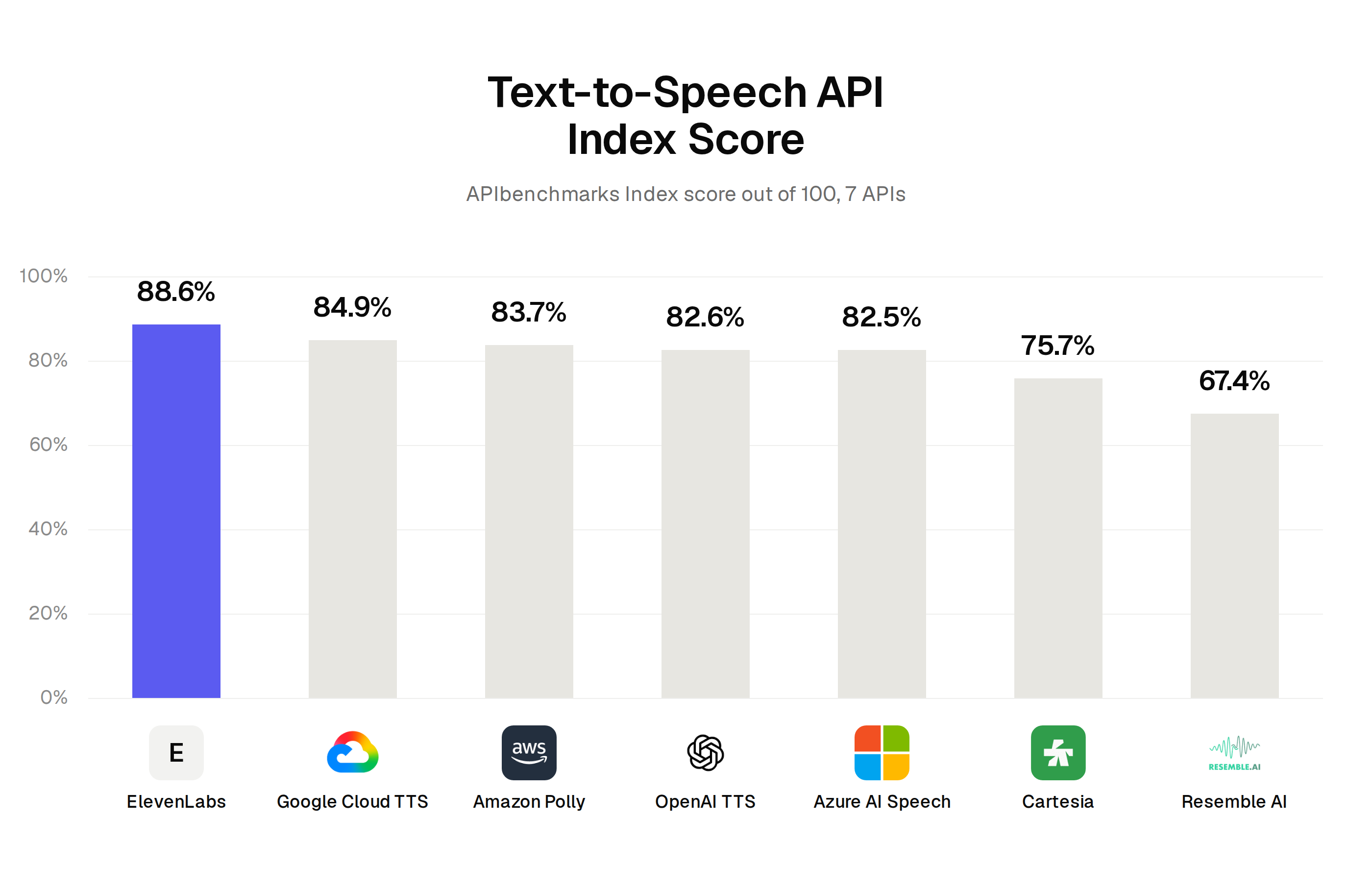
ElevenLabs leads the text-to-speech API index at 88.6 out of 100, ahead of Google Cloud Text-to-Speech at 84.9 and Amazon Polly at 83.7. Resemble AI is last of seven at 67.4.
ElevenLabs has the highest score of the seven text-to-speech APIs in the APIbenchmarks Index, 88.6 out of 100 and grade A. Google Cloud Text-to-Speech is second at 84.9, Amazon Polly third at 83.7 and OpenAI TTS fourth at 82.6. Azure AI Speech scores 82.5, Cartesia 75.7 and Resemble AI 67.4. The gap between first and second is 3.7 points, and places two to five sit within 2.4 points of each other.
A text-to-speech API turns text into spoken audio that your code can stream or save. This post uses the index, which scores each API on documentation, reliability, ecosystem and accessibility. It is not a listening test, so it says nothing about how natural any voice sounds.
The short version:
- ElevenLabs leads at 88.6, 3.7 points ahead of Google Cloud Text-to-Speech. It is first on documentation, at 92, and on accessibility, at 90.
- The top three on reliability are Google Cloud at 93, Amazon Polly at 92 and Azure AI Speech at 91. ElevenLabs is fourth on reliability at 82.
- Resemble AI is last at 67.4, the only grade C. Its reliability score of 62 and ecosystem score of 58 are the lowest of the seven.
Which text-to-speech API scores highest?
ElevenLabs, at 88.6. It is the only API in this category with an A grade. Six of the seven are grade B or lower, and Resemble AI is grade C.
| Provider | Index score | Grade |
|---|---|---|
| ElevenLabs | 88.6 | A |
| Google Cloud Text-to-Speech | 84.9 | B |
| Amazon Polly | 83.7 | B |
| OpenAI TTS | 82.6 | B |
| Azure AI Speech | 82.5 | B |
| Cartesia | 75.7 | B |
| Resemble AI | 67.4 | C |
The range from first to last is 21.2 points. The middle is tight: 1.2 points from Amazon Polly to OpenAI TTS and 0.1 from OpenAI TTS to Azure AI Speech, so the order of those three is close to a tie. The steps get bigger at the bottom, with 6.8 points from Azure AI Speech to Cartesia and 8.3 from Cartesia to Resemble AI. The full scores are on the text-to-speech category page and the verdict page.
Which text-to-speech API is easiest to start with?
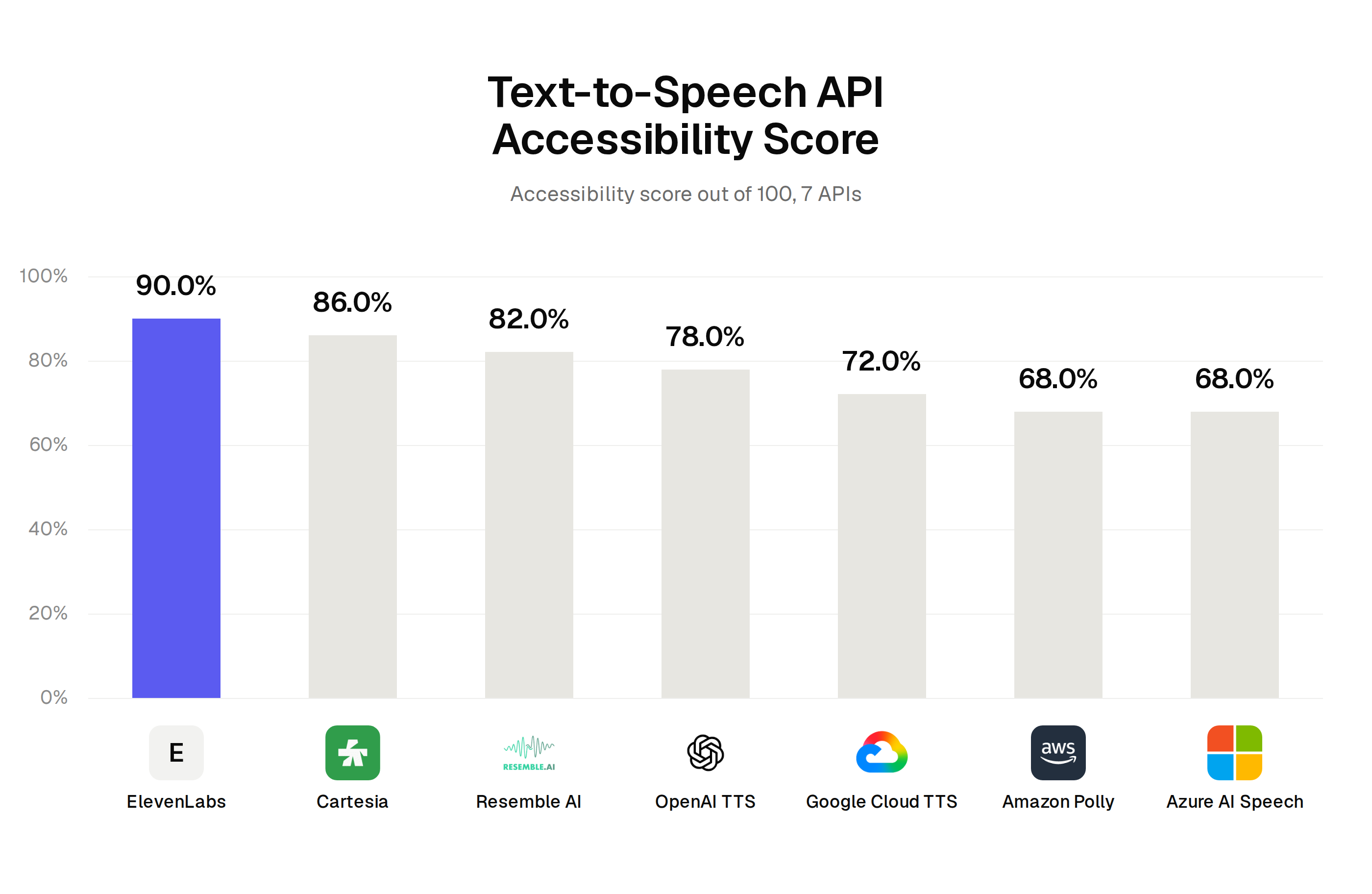
ElevenLabs again, with an accessibility score of 90. Cartesia follows at 86, Resemble AI at 82 and OpenAI TTS at 78. Google Cloud Text-to-Speech scores 72, and Amazon Polly and Azure AI Speech both score 68.
| Provider | Accessibility | Free access | Pricing model |
|---|---|---|---|
| ElevenLabs | 90 | 10k credits a month (about 10 minutes of audio) | Per character (credits) |
| Cartesia | 86 | 20k credits (about 15 to 20 minutes of audio) | Per character (credits) |
| Resemble AI | 82 | $0 credits that never expire | Per second of audio |
| OpenAI TTS | 78 | None, pay-as-you-go credits | Per 1M characters or tokens |
| Google Cloud Text-to-Speech | 72 | 1M (WaveNet) or 4M (Standard) characters a month | Per 1M characters |
| Amazon Polly | 68 | 5M characters a month for 12 months (Neural 1M) | Per 1M characters |
| Azure AI Speech | 68 | 500k characters a month (F0 tier) | Per 1M characters |
Six of the seven APIs give you something to try before you pay. OpenAI TTS is the exception. The three hyperscaler APIs, from Google, Amazon and Azure, have the lowest accessibility scores and the largest free character allowances. The score measures how quickly a developer can get started, so a large free allowance does not lift it on its own. The pricing models also differ in unit. Three bill per million characters, two per character through credits, one per second of audio and one per million characters or tokens, so compare your own monthly volume before you compare rates.
How was this benchmark measured?
This is an index category, so every number comes from the APIbenchmarks Index and not from a hands-on test.
- Four scores. Each API is scored out of 100 on documentation, reliability, ecosystem and accessibility. The index score combines them.
- Same scale for all. All seven APIs are scored on the same four dimensions.
- Verified date. The data for these seven APIs was last verified on 2026-06-27. The index was updated on 2026-11-16.
- Seven APIs. ElevenLabs, Google Cloud Text-to-Speech, Amazon Polly, OpenAI TTS, Azure AI Speech, Cartesia and Resemble AI.
The limits are plain. The index does not send a fixed panel of text through each API and grade the audio against known answers, which is how the site's hands-on benchmarks work. A high score here does not mean a more natural voice, lower latency or better pronunciation in the languages you need. Prices and free tier terms change, so check each provider before you rely on a figure. The methodology page explains the scoring.
Do the APIs differ more on reliability or accessibility?
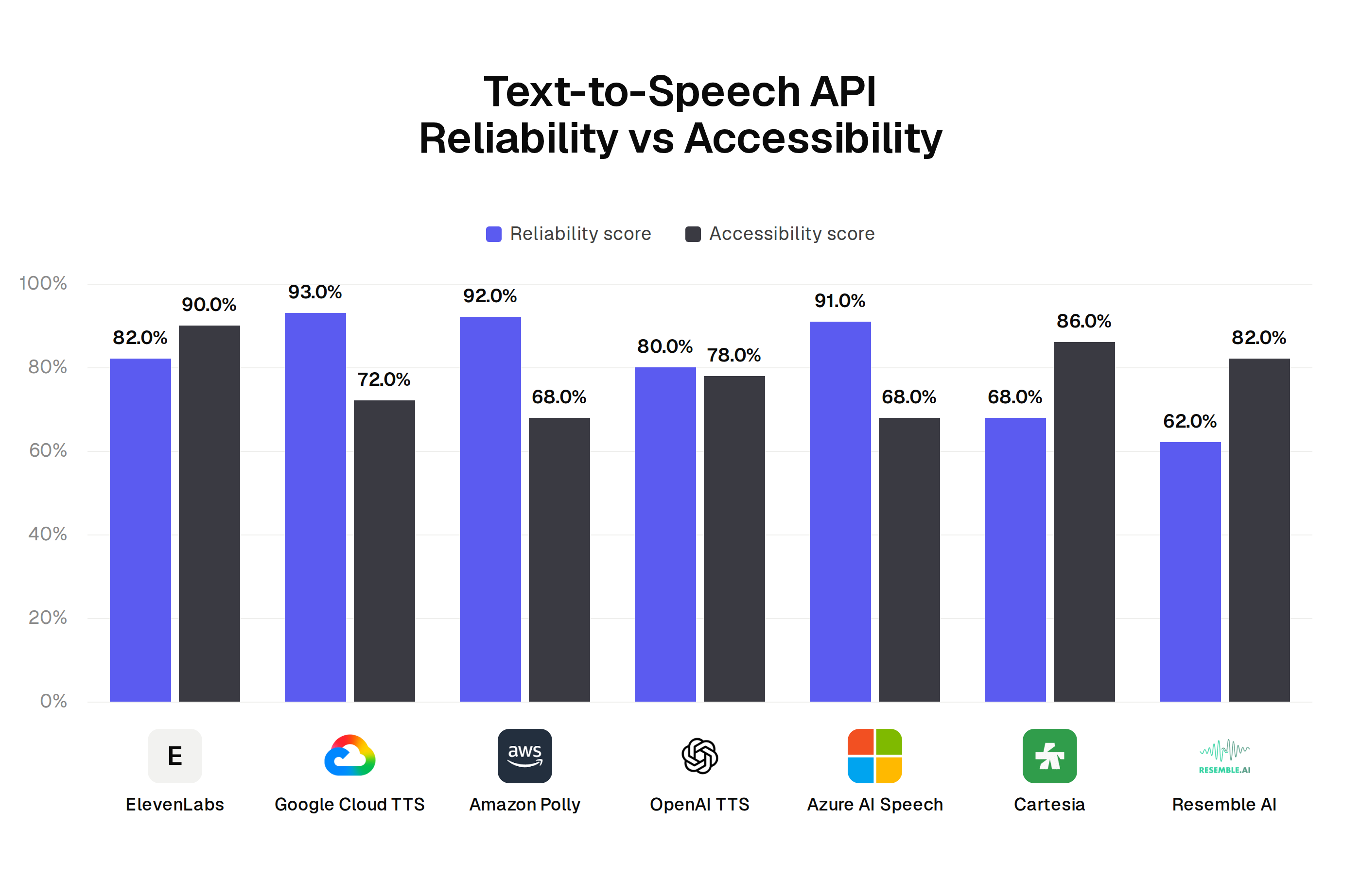
They split. The APIs that score high on reliability tend to score lower on accessibility, and the reverse.
| Provider | Documentation | Reliability | Ecosystem | Accessibility |
|---|---|---|---|---|
| ElevenLabs | 92 | 82 | 90 | 90 |
| Google Cloud Text-to-Speech | 84 | 93 | 88 | 72 |
| Amazon Polly | 82 | 92 | 90 | 68 |
| OpenAI TTS | 85 | 80 | 86 | 78 |
| Azure AI Speech | 83 | 91 | 85 | 68 |
| Cartesia | 80 | 68 | 70 | 86 |
| Resemble AI | 70 | 62 | 58 | 82 |
Reliability runs from 93 down to 62, and accessibility from 90 down to 68. Google Cloud, Amazon Polly and Azure AI Speech are the three highest on reliability at 93, 92 and 91, and the three lowest on accessibility at 72, 68 and 68. Cartesia and Resemble AI go the other way. Cartesia has an accessibility score of 86 and a reliability score of 68. Resemble AI has 82 and 62.
OpenAI TTS has the smallest split, 80 on reliability and 78 on accessibility. ElevenLabs scores 82 on reliability, 11 points below Google Cloud, and first on accessibility. It leads the index on documentation, ecosystem and accessibility, not on reliability.
Which APIs are close enough to compare directly?
Three pairs are worth a direct look.
- ElevenLabs and Google Cloud Text-to-Speech. 88.6 against 84.9. ElevenLabs is ahead on documentation (92 against 84), ecosystem (90 against 88) and accessibility (90 against 72). Google Cloud is ahead on reliability (93 against 82). See ElevenLabs vs Google Cloud Text-to-Speech.
- Amazon Polly and Azure AI Speech. 83.7 against 82.5, a gap of 1.2. They tie on accessibility at 68. Azure is ahead on documentation (83 against 82), while Polly is ahead on ecosystem (90 against 85) and reliability (92 against 91). See Amazon Polly vs Azure AI Speech.
- Amazon Polly and OpenAI TTS. 83.7 against 82.6. OpenAI TTS is ahead on documentation (85 against 82) and accessibility (78 against 68). Polly is ahead on reliability (92 against 80) and ecosystem (90 against 86). See Amazon Polly vs OpenAI TTS.
The bottom line on each provider
- ElevenLabs. First at 88.6, grade A. Highest on documentation (92), ecosystem (90, tied with Amazon Polly) and accessibility (90). Reliability of 82 is fourth. 10k free credits a month.
- Google Cloud Text-to-Speech. Second at 84.9. Highest reliability at 93, accessibility of 72. 1M (WaveNet) or 4M (Standard) free characters a month.
- Amazon Polly. Third at 83.7. Reliability of 92 and ecosystem of 90, accessibility of 68. 5M free characters a month for 12 months.
- OpenAI TTS. Fourth at 82.6. The most even profile, with every dimension between 78 and 86. No free tier.
- Azure AI Speech. Fifth at 82.5, 0.1 behind OpenAI TTS. Reliability of 91 and accessibility of 68. 500k free characters a month.
- Cartesia. Sixth at 75.7. Accessibility of 86 but reliability of 68. 20k free credits.
- Resemble AI. Last at 67.4, grade C. Accessibility of 82, with the lowest documentation (70), reliability (62) and ecosystem (58) scores. $0 credits that never expire.
How to benchmark text-to-speech providers yourself
An index score tells you how easy an API is to adopt. It cannot tell you how your text will sound. To test it, take a few hundred real sentences from your own product, including names, numbers, abbreviations and the languages you serve. Send the same list to each provider's free tier with a voice you would ship. Count how many outputs mispronounce a word you can check, and record time to first audio and cost per thousand characters. Have two or three people listen blind before they know which provider made which file. For a worked example of grading providers against known answers, see the technographics benchmark, and for another category scored with the same index, the SMS API benchmark.
FAQ
What is the best text-to-speech API? In the APIbenchmarks Index it is ElevenLabs, with a score of 88.6 and grade A. Google Cloud Text-to-Speech is second at 84.9 and Amazon Polly third at 83.7. The index scores documentation, reliability, ecosystem and accessibility, and does not measure voice quality.
Which text-to-speech API has a free tier? Six of the seven do. ElevenLabs gives 10k credits a month, Cartesia 20k credits, Google Cloud 1M (WaveNet) or 4M (Standard) characters a month, Amazon Polly 5M characters a month for 12 months and Azure AI Speech 500k characters a month. Resemble AI gives $0 credits that never expire. OpenAI TTS has no free tier.
Is ElevenLabs or Google Cloud Text-to-Speech better? ElevenLabs scores higher, 88.6 against 84.9, and is ahead on documentation (92 against 84), ecosystem (90 against 88) and accessibility (90 against 72). Google Cloud is ahead on reliability, 93 against 82. The full comparison has the detail.
Which text-to-speech API has the best reliability score? Google Cloud Text-to-Speech, at 93. Amazon Polly is second at 92 and Azure AI Speech third at 91. Resemble AI has the lowest at 62.
Is this a test of voice quality? No. These are index scores, last verified on 2026-06-27. No text was sent through the APIs for this post, so it does not show voice naturalness, latency or language coverage.
More benchmarks
- Job postings API benchmark 2026: TheirStack, Bright Data and Crustdata
- People search API benchmark 2026: Crustdata, Fiber and Exa
- Authentication API benchmark 2026: Auth0, Firebase, WorkOS, Clerk, Stytch and more
- LLM API benchmark 2026: OpenAI, Claude, Gemini, Mistral, Grok, Groq and DeepSeek
- Transactional email API benchmark 2026: SendGrid, Resend, Postmark, Mailgun and more
- Vector database API benchmark 2026: Pinecone, MongoDB Atlas, Zilliz, Supabase and more
- Payments API benchmark 2026: Stripe, Square, Razorpay, Mollie, Braintree, Checkout.com, Adyen
- Maps and geocoding API benchmark 2026: Google Maps Platform, Mapbox, HERE, TomTom and more
- Crustdata vs People Data Labs API benchmark 2026: company and person matching
- E-signature API benchmark 2026: DocuSign, Dropbox Sign, PandaDoc and 4 more
- KYC API benchmark 2026: Stripe Identity, Persona, Plaid, Sumsub and more
- Personal email API benchmark 2026: ContactOut, FullEnrich, Nyne, SignalHire, Wiza and Apollo
- SMS API benchmark 2026: Twilio, Vonage, Telnyx, Plivo, Sinch and more
- Person enrichment API benchmark 2026: Coresignal, Nyne, Crustdata, Fiber and People Data Labs
- Data enrichment API benchmark 2026: Crustdata, People Data Labs, Bright Data and 16 more
- Semantic search API benchmark 2026: Crustdata, Exa and Parallel
- Translation API benchmark 2026: Google, Azure, Amazon, DeepL, Lara, Lokalise and LILT
- Image generation API benchmark 2026: OpenAI, Google Imagen, fal.ai, Replicate and more
- Company enrichment API benchmark 2026: Crustdata, Fiber, Coresignal, People Data Labs and Nyne
- Technographics data benchmark 2026: Crustdata vs BuiltWith vs TheirStack vs Sumble