
Transactional email API benchmark 2026: SendGrid, Resend, Postmark, Mailgun and more
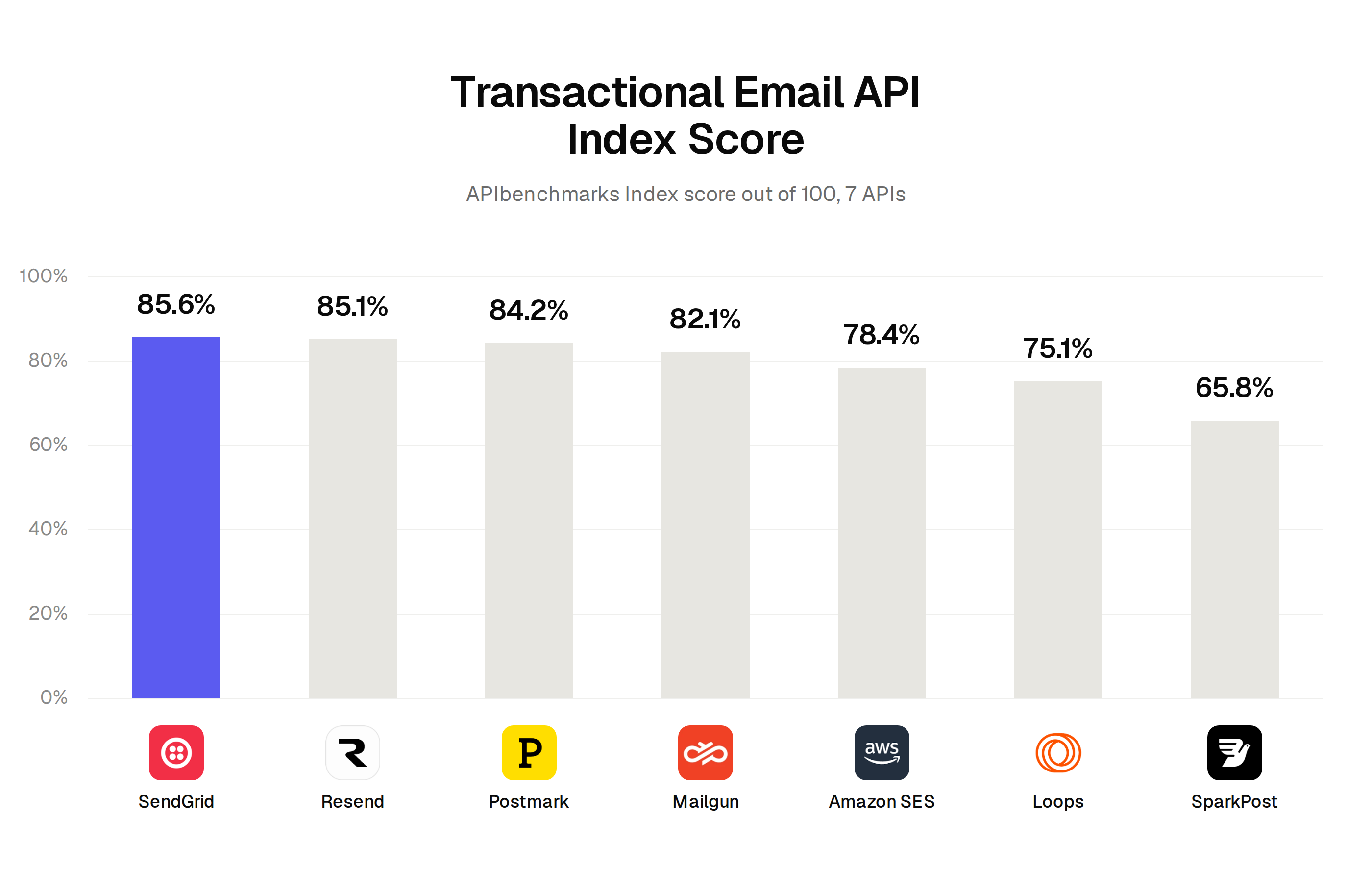
SendGrid leads the transactional email API index at 85.6 out of 100, ahead of Resend at 85.1 and Postmark at 84.2. SparkPost is last of seven at 65.8.
SendGrid has the highest score of the seven transactional email APIs in the APIbenchmarks Index, 85.6 out of 100 and grade A. Resend is a close second at 85.1, also grade A, and Postmark is third at 84.2. Mailgun scores 82.1, Amazon SES 78.4, Loops 75.1 and SparkPost 65.8. The top three sit within 1.4 points of each other, while SparkPost is 9.3 points behind the next API.
A transactional email API sends the messages your product triggers, such as password resets, receipts and sign-in codes. This post uses the index, which scores each API on documentation, reliability, ecosystem and accessibility. It is not a delivery test, so no inbox placement or speed numbers appear here.
The short version:
- SendGrid leads at 85.6, only 0.5 points ahead of Resend. Resend, Postmark and SendGrid are all within 1.4 points of each other.
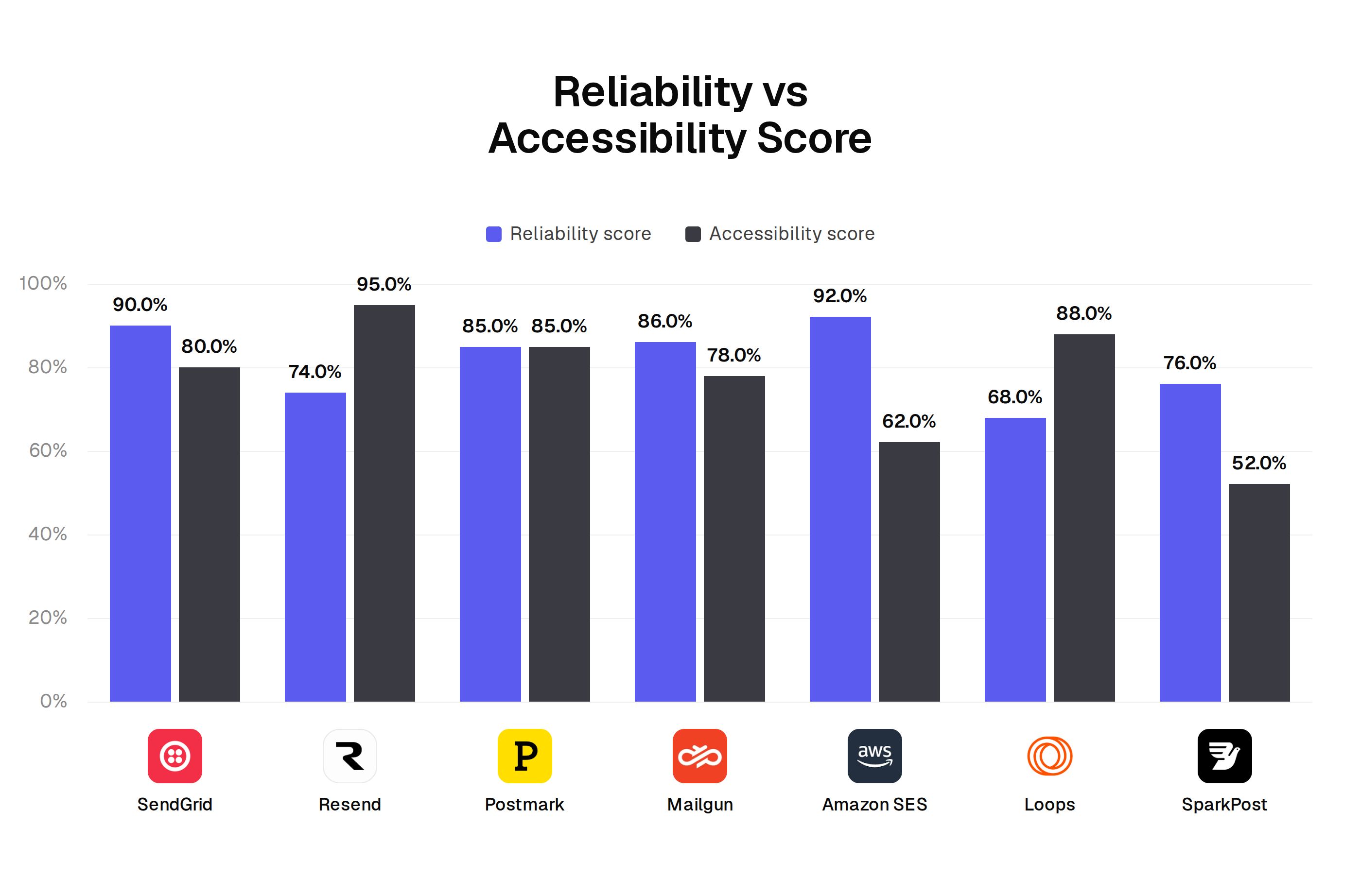
- The same scores hide very different profiles. Resend has the highest accessibility score at 95 and one of the lowest reliability scores at 74. Amazon SES is the reverse, first on reliability at 92 and second to last on accessibility at 62.
- SparkPost is last at 65.8, the only API below grade B, with the lowest accessibility score at 52.
Which transactional email API scores highest?
SendGrid, at 85.6. It and Resend are the only two APIs with an A grade. The other five are grade B, except SparkPost, which is grade C.
| Provider | Index score | Grade |
|---|---|---|
| SendGrid | 85.6 | A |
| Resend | 85.1 | A |
| Postmark | 84.2 | B |
| Mailgun | 82.1 | B |
| Amazon SES | 78.4 | B |
| Loops | 75.1 | B |
| SparkPost | 65.8 | C |
From first to last the range is 19.8 points. Most of the spread is at the bottom. The first four APIs cover only 3.5 points, from SendGrid at 85.6 to Mailgun at 82.1. Then the steps grow: 3.7 from Mailgun to Amazon SES, 3.3 from Amazon SES to Loops and 9.3 from Loops to SparkPost. At the top, the order of SendGrid and Resend is close to a tie. You can read the full scores on the transactional email category page and the verdict page.
Which transactional email API is easiest to start with?
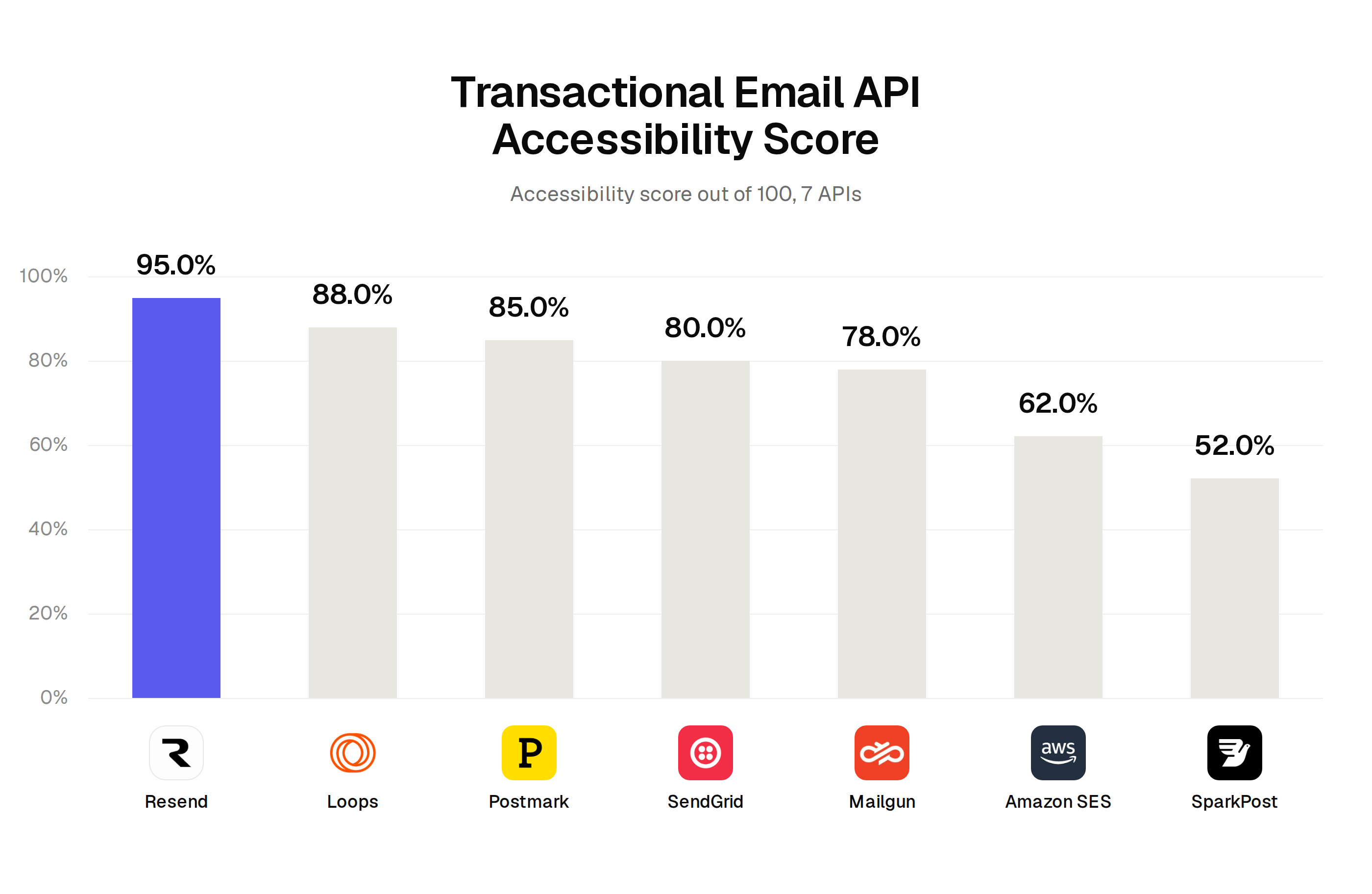
Resend, with an accessibility score of 95. Loops follows at 88, Postmark at 85, SendGrid at 80 and Mailgun at 78. Amazon SES scores 62 and SparkPost 52.
| Provider | Accessibility | Free access | Pricing model |
|---|---|---|---|
| Resend | 95 | 3,000 emails a month (100 a day) | Per monthly email volume |
| Loops | 88 | 4,000 transactional emails a month (1k contacts) | Contact-based plan, transactional included |
| Postmark | 85 | 100 emails a month, never expires | Per monthly email volume |
| SendGrid | 80 | 100 emails a day after a 60-day trial | Per monthly email volume |
| Mailgun | 78 | 100 emails a day, forever | Per monthly email volume |
| Amazon SES | 62 | 3,000 messages a month for the first 12 months | Pay as you go per 1k emails |
| SparkPost | 52 | About 500 emails a month (dev tier) | Volume tiers or custom enterprise |
All seven offer some free sending, so none of them needs a sales call to try. The free allowances differ a lot in shape. Loops gives the most transactional volume at 4,000 a month, Resend and Amazon SES give 3,000 a month, though the Amazon SES allowance runs for the first 12 months only. Postmark gives the least at 100 a month, but it never expires. Accessibility says how quickly a developer can get a key and send a first message. It does not say how well the mail is delivered.
How was this benchmark measured?
This is an index category, so every number comes from the APIbenchmarks Index and not from a hands-on test.
- Four scores. Each API is scored out of 100 on documentation, reliability, ecosystem and accessibility. The index score combines them.
- Same scale for all. All seven APIs are scored on the same four dimensions.
- Verified date. The data for these seven APIs was last verified on 2026-06-27. The index was updated on 2026-11-16.
- Seven APIs. SendGrid, Resend, Postmark, Mailgun, Amazon SES, Loops and SparkPost.
The limits are plain. The index does not send a fixed panel of emails through each API and grade the results against known answers, which is how the site's hands-on benchmarks work. A high score here does not mean better inbox placement, lower latency or a lower price at your volume. Free tier terms and prices change, so check each provider before you rely on a figure. The methodology page explains the scoring.
Do the APIs differ more on reliability or accessibility?
Accessibility spreads the most, from 95 down to 52. Reliability runs from 92 to 68. The two do not move together, which is why the overall scores look so close at the top.
| Provider | Documentation | Reliability | Ecosystem | Accessibility |
|---|---|---|---|---|
| SendGrid | 82 | 90 | 90 | 80 |
| Resend | 92 | 74 | 80 | 95 |
| Postmark | 88 | 85 | 78 | 85 |
| Mailgun | 80 | 86 | 84 | 78 |
| Amazon SES | 70 | 92 | 88 | 62 |
| Loops | 80 | 68 | 66 | 88 |
| SparkPost | 68 | 76 | 64 | 52 |
Three APIs show the split most clearly. Amazon SES is first on reliability at 92 and second on ecosystem at 88, but its documentation score is 70 and its accessibility score is 62. Resend goes the other way, with the top documentation score at 92 and the top accessibility score at 95, but a reliability score of 74, the second lowest of the seven. Loops is lowest on reliability at 68 and has an accessibility score of 88. Postmark is the most even, at 85 on both reliability and accessibility, with documentation at 88 and ecosystem at 78.
The reliability score is an index score, not an uptime measurement taken for this post. Read it as how the index rates each API on that dimension, not as a count of outages.
Why are SendGrid and Resend so close?
They get to nearly the same score by different routes. SendGrid is ahead on reliability, 90 against 74, a gap of 16 points, and on ecosystem, 90 against 80, a gap of 10. Resend is ahead on documentation, 92 against 82, a gap of 10, and on accessibility, 95 against 80, a gap of 15. Those differences cancel out to a 0.5 point gap overall.
Which one fits depends on which dimension matters more to you. A team that wants the fastest path to a first send will find Resend scores higher on that. A team that weighs reliability and ecosystem more will find SendGrid scores higher there. See the full Resend vs SendGrid comparison.
Which APIs are close enough to compare directly?
Three pairs are worth a direct look.
- Postmark and Resend. 84.2 against 85.1. Resend is ahead on documentation (92 against 88) and accessibility (95 against 85). Postmark is ahead on reliability (85 against 74), and Resend also leads on ecosystem (80 against 78). See Postmark vs Resend.
- Mailgun and Amazon SES. 82.1 against 78.4, a gap of 3.7. Mailgun is ahead on documentation (80 against 70) and accessibility (78 against 62). Amazon SES is ahead on reliability (92 against 86) and ecosystem (88 against 84). See Amazon SES vs Mailgun.
- Loops and SparkPost. 75.1 against 65.8, a gap of 9.3. Loops is ahead on documentation (80 against 68), ecosystem (66 against 64) and accessibility (88 against 52). SparkPost is ahead on reliability (76 against 68). See Loops vs SparkPost.
The bottom line on each provider
- SendGrid. First at 85.6, grade A. Reliability of 90 and ecosystem of 90, accessibility of 80. Free sending is 100 emails a day after a 60-day trial.
- Resend. Second at 85.1, grade A. Highest documentation at 92 and accessibility at 95, reliability of 74. Free sending is 3,000 emails a month.
- Postmark. Third at 84.2. Even scores, 85 on reliability and accessibility. Free sending is 100 emails a month, and it does not expire.
- Mailgun. Fourth at 82.1. Reliability of 86, accessibility of 78. Free sending is 100 emails a day, with no end date.
- Amazon SES. Fifth at 78.4. Highest reliability at 92, accessibility of 62. Pay as you go per 1k emails, with 3,000 free messages a month for the first 12 months.
- Loops. Sixth at 75.1. Accessibility of 88, the lowest reliability at 68. Pricing is a contact-based plan with transactional sending included.
- SparkPost. Last at 65.8, grade C. Reliability of 76, accessibility of 52, the lowest of the seven. Volume tiers or custom enterprise pricing.
How to benchmark transactional email providers yourself
An index score tells you how easy an API is to adopt and how it is rated. It cannot tell you how your messages will arrive. To test delivery, create seed addresses at the mailbox providers your users actually have. Send the same set of password resets and receipts through each provider's free tier, using your own sending domain. Record whether each message arrived in the inbox, how long it took and what it cost at your expected volume. Count a message as delivered only when it is in the inbox, not the spam folder. For a worked example of grading providers against known answers, see the technographics benchmark. For another category scored with the same index, see the SMS API benchmark and the KYC API benchmark.
FAQ
What is the best transactional email API? In the APIbenchmarks Index it is SendGrid, with a score of 85.6 and grade A. Resend is second at 85.1 and Postmark third at 84.2. The index scores documentation, reliability, ecosystem and accessibility, and does not measure inbox placement.
Which transactional email API has a free tier? All seven do. Loops gives 4,000 transactional emails a month, Resend 3,000 a month and Amazon SES 3,000 messages a month for the first 12 months. SendGrid and Mailgun give 100 a day, though SendGrid's starts after a 60-day trial. Postmark gives 100 a month with no expiry and SparkPost about 500 a month on a dev tier.
Is SendGrid or Resend better? SendGrid scores slightly higher, 85.6 against 85.1. SendGrid is ahead on reliability (90 against 74) and ecosystem (90 against 80). Resend is ahead on documentation (92 against 82) and accessibility (95 against 80). The full comparison has the detail.
Which transactional email API has the best reliability score? Amazon SES, at 92. SendGrid is second at 90 and Mailgun third at 86. Loops has the lowest at 68.
Which transactional email API scores lowest? SparkPost, at 65.8 and grade C. Its accessibility score of 52 is the lowest of the seven, and it is 9.3 points behind Loops in sixth place.
Is this a test of email delivery? No. These are index scores, last verified on 2026-06-27. No emails were sent through the APIs for this post, so it does not show inbox placement, latency or deliverability.
More benchmarks
- Job postings API benchmark 2026: TheirStack, Bright Data and Crustdata
- People search API benchmark 2026: Crustdata, Fiber and Exa
- Authentication API benchmark 2026: Auth0, Firebase, WorkOS, Clerk, Stytch and more
- LLM API benchmark 2026: OpenAI, Claude, Gemini, Mistral, Grok, Groq and DeepSeek
- Vector database API benchmark 2026: Pinecone, MongoDB Atlas, Zilliz, Supabase and more
- Text-to-speech API benchmark 2026: ElevenLabs, Google Cloud, Polly, OpenAI and more
- Payments API benchmark 2026: Stripe, Square, Razorpay, Mollie, Braintree, Checkout.com, Adyen
- Maps and geocoding API benchmark 2026: Google Maps Platform, Mapbox, HERE, TomTom and more
- Crustdata vs People Data Labs API benchmark 2026: company and person matching
- E-signature API benchmark 2026: DocuSign, Dropbox Sign, PandaDoc and 4 more
- KYC API benchmark 2026: Stripe Identity, Persona, Plaid, Sumsub and more
- Personal email API benchmark 2026: ContactOut, FullEnrich, Nyne, SignalHire, Wiza and Apollo
- SMS API benchmark 2026: Twilio, Vonage, Telnyx, Plivo, Sinch and more
- Person enrichment API benchmark 2026: Coresignal, Nyne, Crustdata, Fiber and People Data Labs
- Data enrichment API benchmark 2026: Crustdata, People Data Labs, Bright Data and 16 more
- Semantic search API benchmark 2026: Crustdata, Exa and Parallel
- Translation API benchmark 2026: Google, Azure, Amazon, DeepL, Lara, Lokalise and LILT
- Image generation API benchmark 2026: OpenAI, Google Imagen, fal.ai, Replicate and more
- Company enrichment API benchmark 2026: Crustdata, Fiber, Coresignal, People Data Labs and Nyne
- Technographics data benchmark 2026: Crustdata vs BuiltWith vs TheirStack vs Sumble