Speech-to-Text API benchmark 2026: Deepgram, AssemblyAI, OpenAI Whisper and more
Deepgram leads the speech-to-text index at 87.5, 0.6 points ahead of AssemblyAI at 86.9. Rev AI is last at 72.7. Amazon Transcribe is the most reliable at 93.
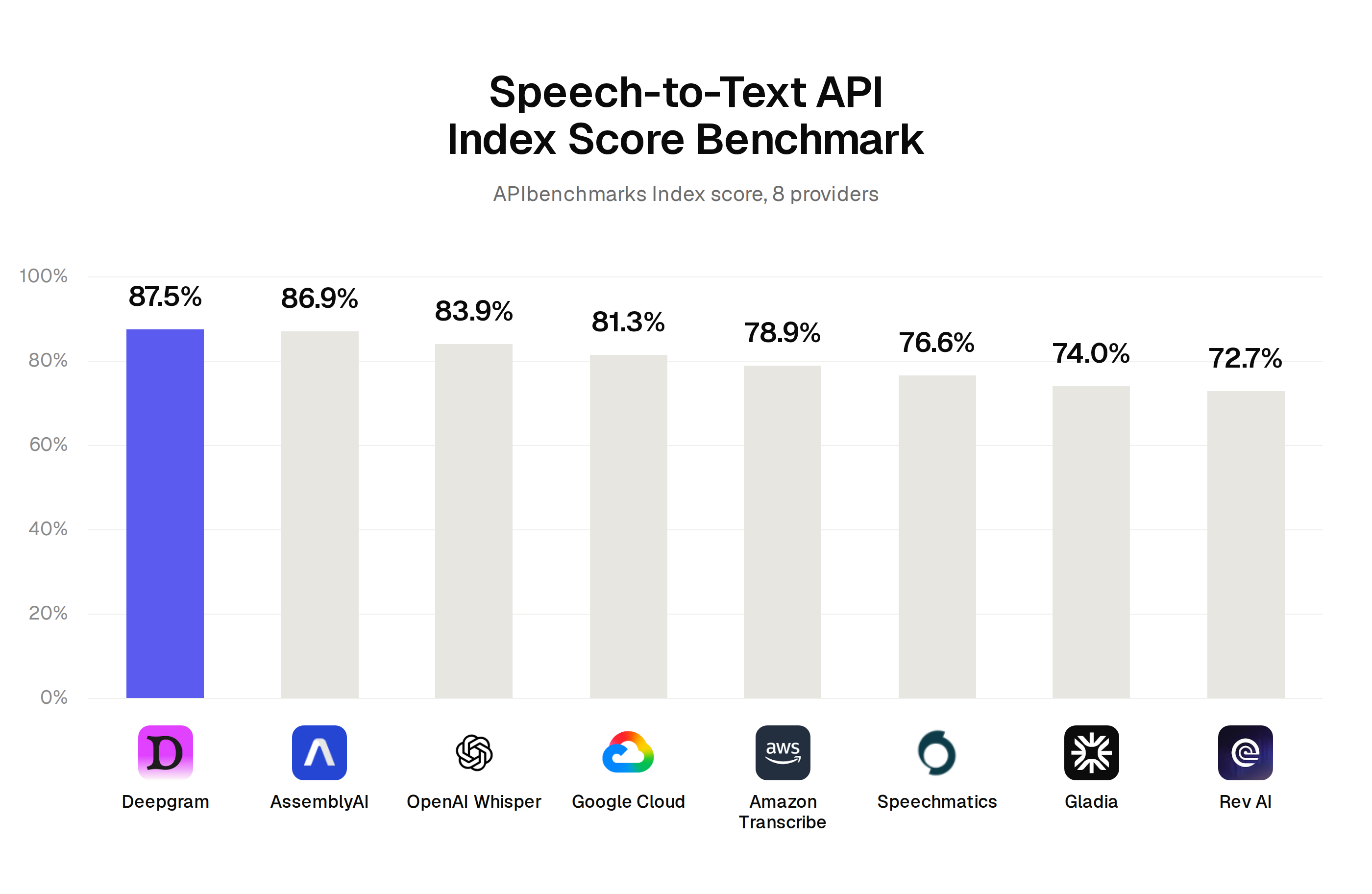
Deepgram ranks first among the eight speech-to-text APIs in the APIbenchmarks Index, with a score of 87.5 and grade A. AssemblyAI is second at 86.9, only 0.6 points behind, and also grade A. OpenAI Whisper / GPT-4o Transcribe follows at 83.9, then Google Cloud Speech-to-Text at 81.3 and Amazon Transcribe at 78.9. Rev AI is last at 72.7. The order is not the same on every score. Amazon Transcribe has the highest reliability score at 93, yet its accessibility score of 62 is the lowest of the eight.
A speech-to-text API takes audio and returns a transcript. The APIbenchmarks Index scores each API on four things: documentation, reliability, ecosystem and accessibility. This post reads those scores. It does not report a word error rate, because the benchmark data behind it has no transcription accuracy test.
The short version:
- Deepgram leads the index at 87.5, 0.6 points ahead of AssemblyAI at 86.9. The two are the only grade A providers.
- Amazon Transcribe (93) and Google Cloud Speech-to-Text (92) have the highest reliability scores, but also two of the three lowest accessibility scores, 62 and 68.
- Rev AI is last overall at 72.7, 14.8 points behind Deepgram. Its accessibility score of 85 is higher than Google's and Amazon's.
Which speech-to-text API ranks first?
Deepgram does, at 87.5. AssemblyAI is 0.6 points behind at 86.9, which is close enough that the choice between them should rest on the sub-scores and your use case rather than the headline number. The gap from second to third is larger: OpenAI Whisper / GPT-4o Transcribe scores 83.9, 3.0 points below AssemblyAI.
| Provider | Index score | Grade |
|---|---|---|
| Deepgram | 87.5 | A |
| AssemblyAI | 86.9 | A |
| OpenAI Whisper / GPT-4o Transcribe | 83.9 | B |
| Google Cloud Speech-to-Text | 81.3 | B |
| Amazon Transcribe | 78.9 | B |
| Speechmatics | 76.6 | B |
| Gladia | 74.0 | C |
| Rev AI | 72.7 | C |
The table splits into three groups. Deepgram and AssemblyAI sit alone at the top with grade A. Four providers share grade B, spread over 7.3 points from 83.9 down to 76.6. Gladia and Rev AI take grade C, only 1.3 points apart. The full spread from first to last is 14.8 points.
How do the four sub-scores compare?
Each provider has a score for documentation, reliability, ecosystem and accessibility. The top score in each column belongs to a different provider, which is why the overall order hides real differences.
| Provider | Documentation | Reliability | Ecosystem | Accessibility |
|---|---|---|---|---|
| Deepgram | 90 | 84 | 82 | 95 |
| AssemblyAI | 92 | 82 | 83 | 90 |
| OpenAI Whisper / GPT-4o Transcribe | 85 | 80 | 88 | 82 |
| Google Cloud Speech-to-Text | 78 | 92 | 85 | 68 |
| Amazon Transcribe | 74 | 93 | 84 | 62 |
| Speechmatics | 76 | 80 | 68 | 84 |
| Gladia | 78 | 70 | 62 | 88 |
| Rev AI | 74 | 74 | 60 | 85 |
AssemblyAI has the best documentation score at 92, 2 points above Deepgram. Deepgram has the best accessibility score at 95. OpenAI Whisper / GPT-4o Transcribe has the best ecosystem score at 88. Amazon Transcribe has the best reliability score at 93, 9 points above Deepgram, with Google Cloud Speech-to-Text right behind at 92.
Which speech-to-text APIs are the most reliable?
Amazon Transcribe at 93, then Google Cloud Speech-to-Text at 92. Deepgram is third at 84, AssemblyAI fourth at 82. Gladia has the lowest reliability score at 70, 23 points below Amazon.
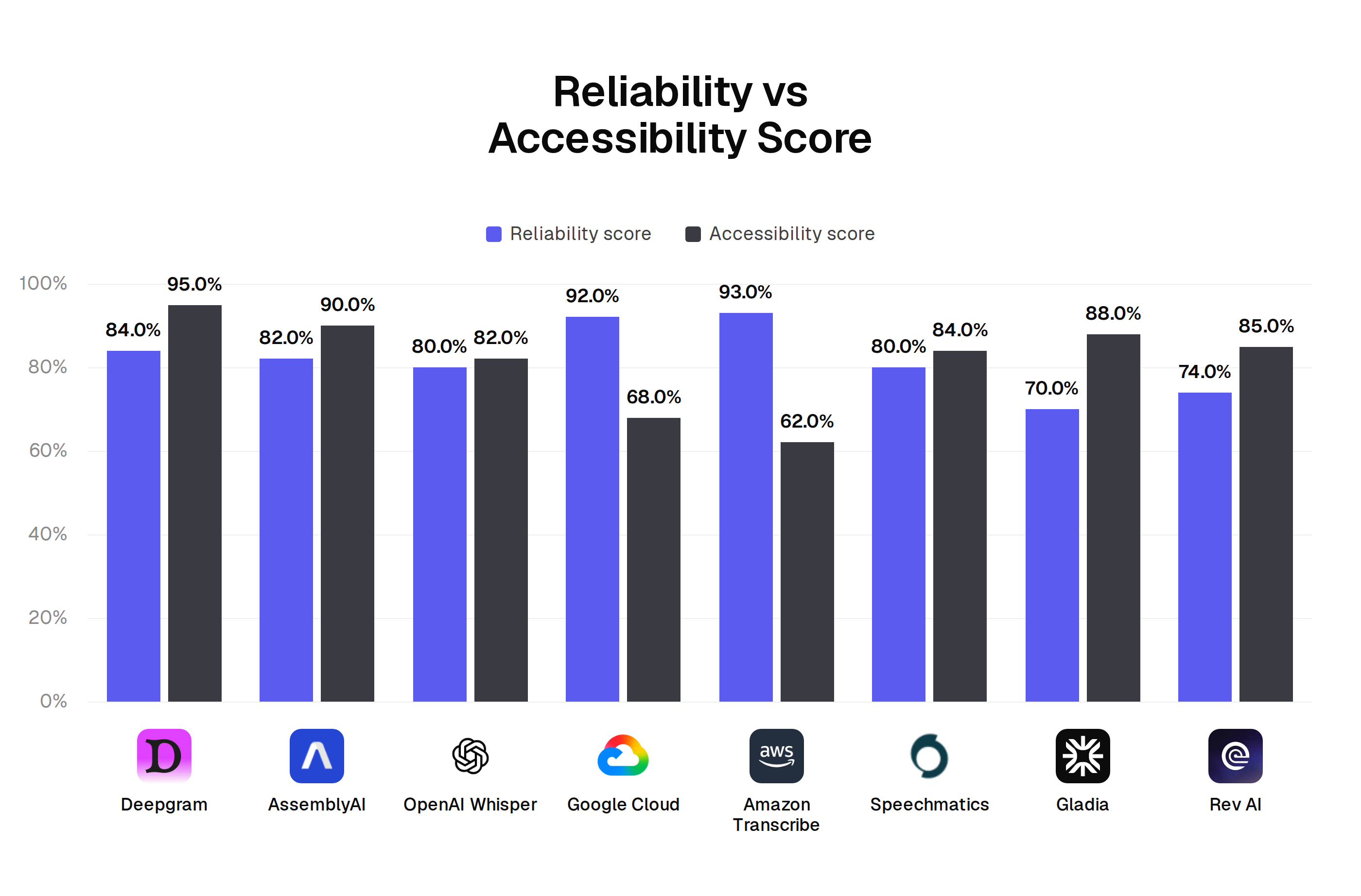
The chart shows a trade-off. The two providers with the best reliability scores are the ones that are hardest to start with. Amazon Transcribe has the lowest accessibility score of the eight at 62, and Google Cloud Speech-to-Text has 68. Deepgram has the best accessibility at 95 and still holds a reliability score of 84. Gladia and Rev AI go the other way, with accessibility scores of 88 and 85 and the two lowest reliability scores, 70 and 74.
How was this benchmark measured?
This post uses the APIbenchmarks Index, not a hands-on test. The index scores each API on a fixed set of criteria and combines them into one number and a letter grade.
- Four scores per API. Documentation, reliability, ecosystem and accessibility, each shown here as published.
- One overall score. The index score and grade are the figures in the first table.
- Same criteria for every provider. All eight were scored on the same four dimensions.
- Verification date. The scores for this category were verified in June 2026.
Two limits matter. First, the index says nothing about how accurate a transcript is on your audio. Accents, noise, call quality and language all change the result, and no word error rate is reported here. Second, a high accessibility score means the API is easy to start using, not that it transcribes better. The methodology page explains how the index is scored.
How do the providers compare on price and free access?
Pricing models are close to each other. Most providers bill per minute of audio. Google Cloud Speech-to-Text bills per 15 seconds, Gladia bills per hour, and OpenAI bills per minute with per-second billing. The free access differs more.
| Provider | Pricing model | Free access |
|---|---|---|
| Deepgram | Per minute | $200 credit, no card |
| AssemblyAI | Per minute | $50 one-time credit |
| OpenAI Whisper / GPT-4o Transcribe | Per minute | None, pay per use |
| Google Cloud Speech-to-Text | Per 15 seconds | 60 min a month plus $300 credit |
| Amazon Transcribe | Per minute, volume-tiered | 60 min a month for 12 months |
| Speechmatics | Per minute | 8 hours a month (480 min) |
| Gladia | Per hour | 10 hours a month |
| Rev AI | Per minute | 45 AI min a month, English |
For a first test, Gladia (10 hours a month) and Speechmatics (8 hours a month) give the most recurring free audio. Deepgram gives the largest one-time credit without asking for a card. OpenAI Whisper / GPT-4o Transcribe is the only provider with no free access. See the full scores on the Deepgram, AssemblyAI and Amazon Transcribe pages, or compare two directly, for example AssemblyAI vs Deepgram. The whole category is on the speech-to-text index page.
Why does the ranking change between the sub-scores?
The overall score combines four different things, and providers are built for different buyers. The chart below puts documentation and ecosystem side by side.
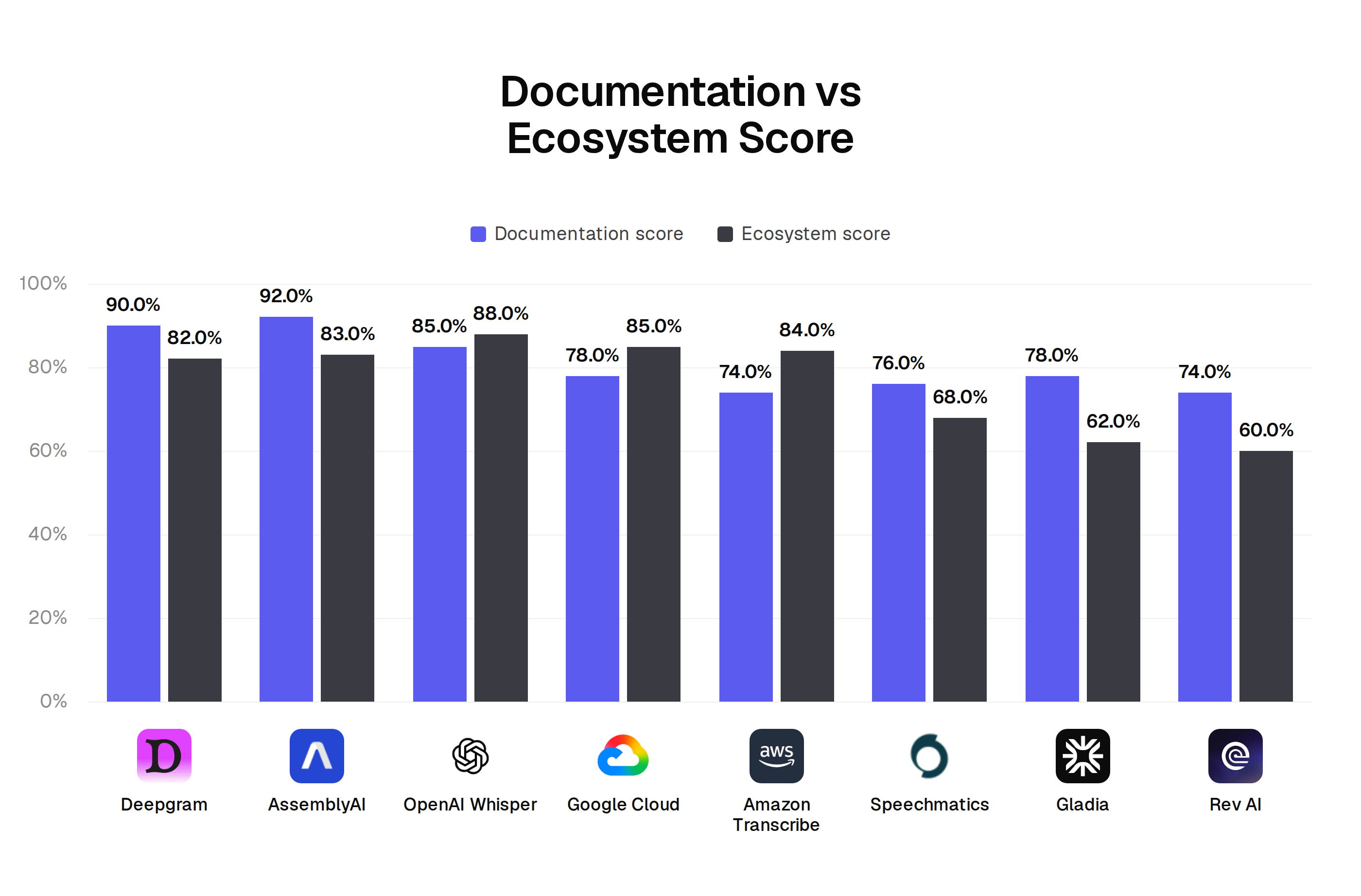
Three providers have a larger ecosystem score than documentation score. OpenAI Whisper / GPT-4o Transcribe is 3 points higher on ecosystem (88 against 85), Google Cloud Speech-to-Text is 7 points higher (85 against 78) and Amazon Transcribe is 10 points higher (84 against 74). The index describes these as transcription inside a larger platform, and the scores fit that: the surrounding tools are rated higher than the speech-to-text docs themselves.
The opposite holds for the smaller providers. Gladia has documentation at 78 and ecosystem at 62, a gap of 16 points. Rev AI has 74 and 60, a gap of 14. Deepgram and AssemblyAI keep both scores at 82 or above.
The bottom line on each provider
- Deepgram. First overall at 87.5, with the best accessibility score at 95. Reliability is 84, 9 points below Amazon Transcribe. Described in the index as real-time streaming for voice agents.
- AssemblyAI. Second at 86.9, with the best documentation score at 92. Described as accurate transcription plus audio intelligence.
- OpenAI Whisper / GPT-4o Transcribe. Third at 83.9, with the best ecosystem score at 88. No free access.
- Google Cloud Speech-to-Text. Fourth at 81.3, with reliability of 92 and accessibility of 68. Billed per 15 seconds.
- Amazon Transcribe. Fifth at 78.9. The highest reliability score at 93 and the lowest accessibility score at 62.
- Speechmatics. Sixth at 76.6. Accessibility of 84 and 8 hours of free audio a month.
- Gladia. Seventh at 74.0. Accessibility of 88 and 10 hours of free audio a month, with reliability at 70.
- Rev AI. Last at 72.7. Accessibility of 85 and the lowest ecosystem score at 60.
How to benchmark speech-to-text providers yourself
The index tells you how easy each API is to adopt and how it is scored on documentation and reliability. It cannot tell you which one transcribes your audio best. To find that out, take a few hours of your own recordings where a human transcript already exists, send the same files to each provider you are considering, and compare each output with the human version. Count word errors the same way for every provider, and keep the audio types separate if you have more than one, such as phone calls and meetings. The free access in the table above is enough to run a first pass on most of these APIs. For a comparison of tests where answers are known in advance, see the text-to-speech benchmark and the LLM API benchmark.
FAQ
Which is the best speech-to-text API? In the APIbenchmarks Index, Deepgram ranks first at 87.5, ahead of AssemblyAI at 86.9 and OpenAI Whisper / GPT-4o Transcribe at 83.9. The index scores documentation, reliability, ecosystem and accessibility. It does not measure transcript accuracy.
Is Deepgram or AssemblyAI better? The overall gap is 0.6 points, 87.5 against 86.9. Deepgram has the higher accessibility score, 95 against 90. AssemblyAI has the higher documentation score, 92 against 90, and a slightly higher ecosystem score, 83 against 82. Deepgram is ahead on reliability, 84 against 82.
Which speech-to-text API is the most reliable? Amazon Transcribe has the highest reliability score at 93, followed by Google Cloud Speech-to-Text at 92. Gladia has the lowest at 70.
Which speech-to-text API has the biggest free tier? It depends on the unit. Gladia offers 10 hours a month and Speechmatics offers 8 hours a month. Deepgram offers a $200 credit without a card, and Google Cloud Speech-to-Text offers 60 minutes a month plus a $300 credit. OpenAI Whisper / GPT-4o Transcribe has no free access.
Does this benchmark measure word error rate? No. The scores are from the APIbenchmarks Index and cover documentation, reliability, ecosystem and accessibility. To measure accuracy on your own audio, run the same recordings through each provider and compare each output with a human transcript.
More benchmarks
- Unofficial API benchmark 2026: Supergood, Truv, superglue, Argyle and more
- Reverse email lookup API benchmark 2026: Crustdata, FullEnrich, Apollo, ContactOut and 6 more
- Contact enrichment API benchmark 2026: Crustdata, ContactOut, Reverse Contact, FullEnrich and 6 more
- Funding data API benchmark 2026: Crustdata, Coresignal and People Data Labs
- Social posts API benchmark 2026: Fiber, Crustdata and Bright Data
- Job postings API benchmark 2026: TheirStack, Bright Data and Crustdata
- People search API benchmark 2026: Crustdata, Fiber and Exa
- Authentication API benchmark 2026: Auth0, Firebase, WorkOS, Clerk, Stytch and more
- LLM API benchmark 2026: OpenAI, Claude, Gemini, Mistral, Grok, Groq and DeepSeek
- Transactional email API benchmark 2026: SendGrid, Resend, Postmark, Mailgun and more
- Vector database API benchmark 2026: Pinecone, MongoDB Atlas, Zilliz, Supabase and more
- Text-to-speech API benchmark 2026: ElevenLabs, Google Cloud, Polly, OpenAI and more
- Payments API benchmark 2026: Stripe, Square, Razorpay, Mollie, Braintree, Checkout.com, Adyen
- Maps and geocoding API benchmark 2026: Google Maps Platform, Mapbox, HERE, TomTom and more
- Crustdata vs People Data Labs API benchmark 2026: company and person matching
- E-signature API benchmark 2026: DocuSign, Dropbox Sign, PandaDoc and 4 more
- KYC API benchmark 2026: Stripe Identity, Persona, Plaid, Sumsub and more
- Personal email API benchmark 2026: ContactOut, FullEnrich, Nyne, SignalHire, Wiza and Apollo
- SMS API benchmark 2026: Twilio, Vonage, Telnyx, Plivo, Sinch and more
- Person enrichment API benchmark 2026: Coresignal, Nyne, Crustdata, Fiber and People Data Labs
- Data enrichment API benchmark 2026: Crustdata, People Data Labs, Bright Data and 16 more
- Semantic search API benchmark 2026: Crustdata, Exa and Parallel
- Translation API benchmark 2026: Google, Azure, Amazon, DeepL, Lara, Lokalise and LILT
- Image generation API benchmark 2026: OpenAI, Google Imagen, fal.ai, Replicate and more
- Company enrichment API benchmark 2026: Crustdata, Fiber, Coresignal, People Data Labs and Nyne
- Technographics data benchmark 2026: Crustdata vs BuiltWith vs TheirStack vs Sumble